

1.2 Wave Equations in Geophysical Fluid Dynamies
11
Op =0
oz
at z = -H.
The wave-like character of the solution is produced by the time-dependent upper
boundary condition.
The elliptic nature of (1.20) does not follow from the the preceding c1assification scheme, which requires the evaluation of b
2 - ac and is directly applicable
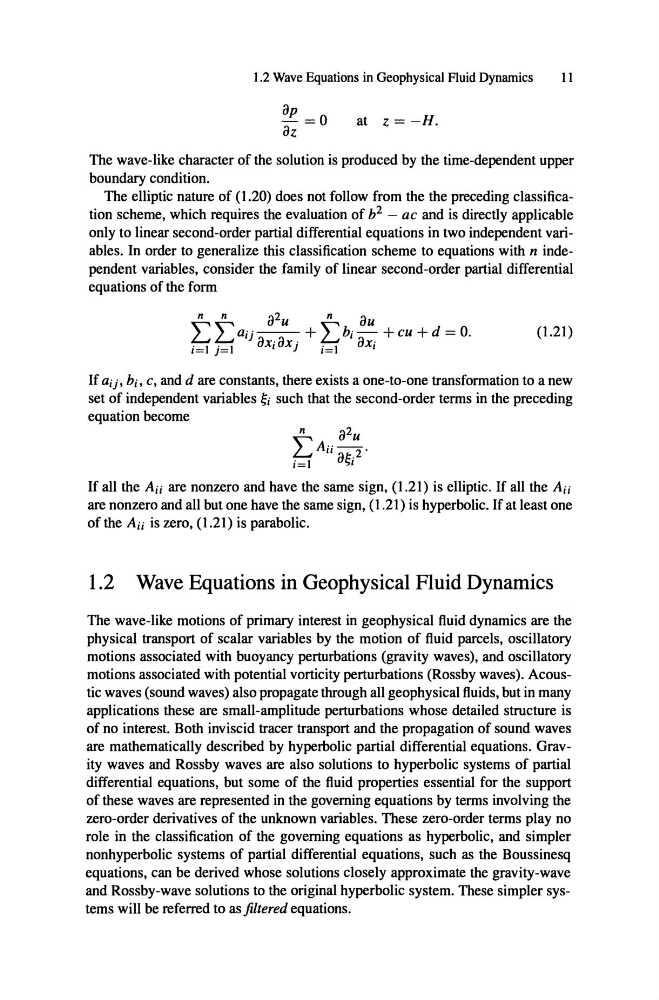
only to linear second-order partial differential equations in two independent variables. In order to generalize this c1assification scheme to equations with n independent variables, consider the family of linear second-order partial differential
equations of the form
(1.21)
L L
n
n
a i j - - + L
o2 u
n
Bu + cu + d = O.
b; -
; = 1 j = 1
OX;OXj ; = 1 Bx,
If a;j, bi, c, and d are constants, there exists a one-to-one transformation to a new
set of independent variables
equation become
such that the second-order terms in the preceding
n
o2 u
LA;;--2 ·
;=1
If all the A;; are nonzero and have the same sign, (1.21) is elliptic. If all the A ;;
are nonzero and all but one have the same sign, (1.21) is hyperbolic. If at least one
ofthe A jj is zero, (1.21) is parabolic.
1.2 Wave Equations in Geophysical Fluid Dynamics
The wave-Iike motions of primary interest in geophysical fluid dynamics are the
physical transport of scalar variables by the motion of fluid parcels, oscillatory
motions associated with buoyancy perturbations (gravity waves), and oscillatory
motions associated with potential vorticity perturbations (Rossby waves). Acoustic waves (sound waves) also propagate through all geophysical fluids, but in many
applications these are small-amplitude perturbations whose detailed structure is
of no interest. Both inviscid tracer transport and the propagation of sound waves
are mathematically described by hyperbolic partial differential equations . Gravity waves and Rossby waves are also solutions to hyperbolic systems of partial
differential equations, but some of the fluid properties essential for the support
of these waves are represented in the goveming equations by terms involving the
zero-order derivatives of the unknown variables. These zero-order terms play no
role in the c1assification of the goveming equations as hyperbolic, and simpler
nonhyperbolic systems of partial differential equations, such as the Boussinesq
equations, can be derived whose solutions closely approximate the gravity -wave
and Rossby-wave solutions to the original hyperbolic system. These simpler systems will be referred to as filtered equations.
11
Op =0
oz
at z = -H.
The wave-like character of the solution is produced by the time-dependent upper
boundary condition.
The elliptic nature of (1.20) does not follow from the the preceding c1assification scheme, which requires the evaluation of b
2 - ac and is directly applicable
only to linear second-order partial differential equations in two independent variables. In order to generalize this c1assification scheme to equations with n independent variables, consider the family of linear second-order partial differential
equations of the form
(1.21)
L L
n
n
a i j - - + L
o2 u
n
Bu + cu + d = O.
b; -
; = 1 j = 1
OX;OXj ; = 1 Bx,
If a;j, bi, c, and d are constants, there exists a one-to-one transformation to a new
set of independent variables
equation become
such that the second-order terms in the preceding
n
o2 u
LA;;--2 ·
;=1
If all the A;; are nonzero and have the same sign, (1.21) is elliptic. If all the A ;;
are nonzero and all but one have the same sign, (1.21) is hyperbolic. If at least one
ofthe A jj is zero, (1.21) is parabolic.
1.2 Wave Equations in Geophysical Fluid Dynamics
The wave-Iike motions of primary interest in geophysical fluid dynamics are the
physical transport of scalar variables by the motion of fluid parcels, oscillatory
motions associated with buoyancy perturbations (gravity waves), and oscillatory
motions associated with potential vorticity perturbations (Rossby waves). Acoustic waves (sound waves) also propagate through all geophysical fluids, but in many
applications these are small-amplitude perturbations whose detailed structure is
of no interest. Both inviscid tracer transport and the propagation of sound waves
are mathematically described by hyperbolic partial differential equations . Gravity waves and Rossby waves are also solutions to hyperbolic systems of partial
differential equations, but some of the fluid properties essential for the support
of these waves are represented in the goveming equations by terms involving the
zero-order derivatives of the unknown variables. These zero-order terms play no
role in the c1assification of the goveming equations as hyperbolic, and simpler
nonhyperbolic systems of partial differential equations, such as the Boussinesq
equations, can be derived whose solutions closely approximate the gravity -wave
and Rossby-wave solutions to the original hyperbolic system. These simpler systems will be referred to as filtered equations.