

254
5. Finite-Volume Methods
Godunov 's theorem implies that the only way to construct higher-order TVD
schemes is through the use of nonlinear finite-difference formulae. Several such
nonlinear schemes will be considered in the following sections. In most cases
these methods combine some information from a higher-order finite-difference
approximation with the smooth solution from a monotone first-order scheme in
an attempt to maintain the sharpness of the numerically simulated discontinuity
without developing spurious ripples .
In one-dimensional problems the first-order monotone solution is generally
computed using upstream differencing because it is superior to most other simple
monotone schemes. Figure 5.7b illustrates the superiority ofupstream solutions to
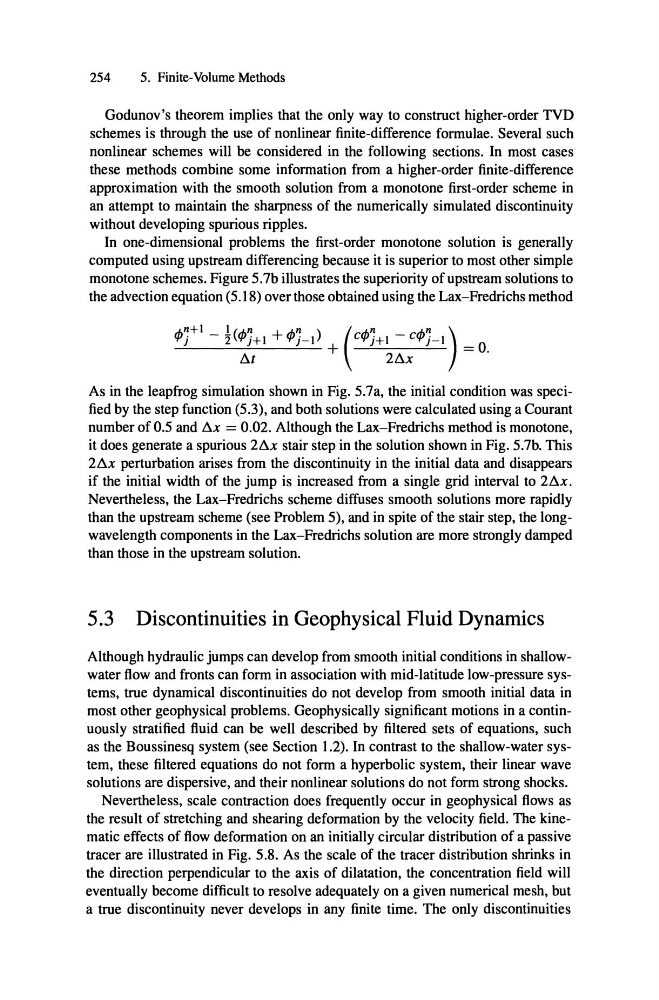
the advection equation (5.18) over those obtained using the Lax-Fredrichs method
As in the leapfrog simulation shown in Fig. 5.7a, the initial condition was specified by the step function (5.3), and both solutions were calculated using a Courant
number of 0.5 and tu = 0.02 . Although the Lax-Fredrichs method is monotone ,
it does generate a spurious
stair step in the solution shown in Fig. 5.7b. This
perturbation arises from the discontinuity in the initial data and disappears
if the initial width of the jump is increased from a single grid interval to
Nevertheless, the Lax-Fredrichs scheme diffuses smooth solutions more rapidly
than the upstream scheme (see Problem 5), and in spite of the stair step, the longwavelength components in the Lax-Fredrichs solution are more strongly damped
than those in the upstream solution.
5.3 Discontinuities in Geophysical Fluid Dynamics
Although hydraulic jumps can develop from smooth initial conditions in shaIlowwater flow and fronts can form in associat ion with mid-latitude low-pressure systems, true dynamical discontinuities do not develop from smooth initial data in
most other geophysical problems. Geophysically significant motions in a contin -
uously stratified fluid can be weIl described by filtered sets of equations, such
as the Boussinesq system (see Section 1.2). In contrast to the shaIlow-water system, these filtered equations do not form a hyperbolic system, their linear wave
solutions are dispersive, and their nonlinear solutions do not form strong shocks .
Nevertheless, scale contraction does frequently occur in geophysical flows as
the result of stretching and shearing deformation by the velocity field. The kinematic effects of flow deformation on an initially circular distribution of a passive
tracer are illustrated in Fig. 5.8. As the scale of the tracer distribution shrinks in
the direction perpendicular to the axis of dilatation, the concentration field will
eventually become difficult to resolve adequately on a given numerical mesh, but
a true discontinuity never develops in any finite time. The only discontinuities
5. Finite-Volume Methods
Godunov 's theorem implies that the only way to construct higher-order TVD
schemes is through the use of nonlinear finite-difference formulae. Several such
nonlinear schemes will be considered in the following sections. In most cases
these methods combine some information from a higher-order finite-difference
approximation with the smooth solution from a monotone first-order scheme in
an attempt to maintain the sharpness of the numerically simulated discontinuity
without developing spurious ripples .
In one-dimensional problems the first-order monotone solution is generally
computed using upstream differencing because it is superior to most other simple
monotone schemes. Figure 5.7b illustrates the superiority ofupstream solutions to
the advection equation (5.18) over those obtained using the Lax-Fredrichs method
As in the leapfrog simulation shown in Fig. 5.7a, the initial condition was specified by the step function (5.3), and both solutions were calculated using a Courant
number of 0.5 and tu = 0.02 . Although the Lax-Fredrichs method is monotone ,
it does generate a spurious
stair step in the solution shown in Fig. 5.7b. This
perturbation arises from the discontinuity in the initial data and disappears
if the initial width of the jump is increased from a single grid interval to
Nevertheless, the Lax-Fredrichs scheme diffuses smooth solutions more rapidly
than the upstream scheme (see Problem 5), and in spite of the stair step, the longwavelength components in the Lax-Fredrichs solution are more strongly damped
than those in the upstream solution.
5.3 Discontinuities in Geophysical Fluid Dynamics
Although hydraulic jumps can develop from smooth initial conditions in shaIlowwater flow and fronts can form in associat ion with mid-latitude low-pressure systems, true dynamical discontinuities do not develop from smooth initial data in
most other geophysical problems. Geophysically significant motions in a contin -
uously stratified fluid can be weIl described by filtered sets of equations, such
as the Boussinesq system (see Section 1.2). In contrast to the shaIlow-water system, these filtered equations do not form a hyperbolic system, their linear wave
solutions are dispersive, and their nonlinear solutions do not form strong shocks .
Nevertheless, scale contraction does frequently occur in geophysical flows as
the result of stretching and shearing deformation by the velocity field. The kinematic effects of flow deformation on an initially circular distribution of a passive
tracer are illustrated in Fig. 5.8. As the scale of the tracer distribution shrinks in
the direction perpendicular to the axis of dilatation, the concentration field will
eventually become difficult to resolve adequately on a given numerical mesh, but
a true discontinuity never develops in any finite time. The only discontinuities