

5.3 Discontinuities in Geophysical Fluid Dynamics
255
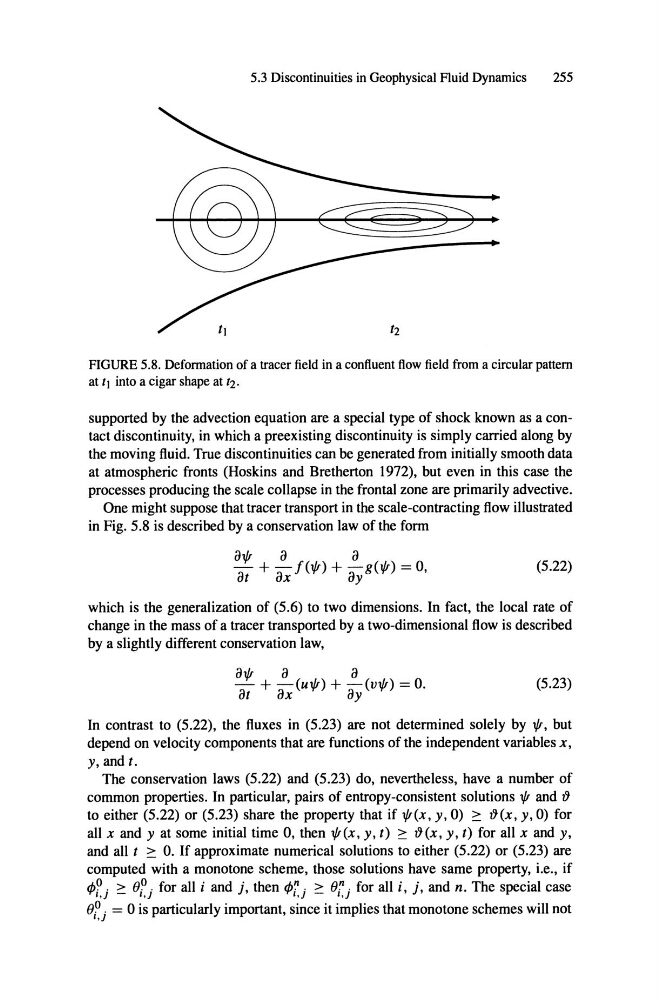
FIGURE 5.8. Deformation of a tracer field in a confluent flow field from a circular pattern
at I) into a cigar shape at 12.
supported by the adveetion equation are a special type of shoek known as a contaet diseontinuity, in which a preexisting diseontinuity is simply earried along by
the moving fluid. True diseontinuities ean be generated from initially smooth data
at atmospherie fronts (Hoskins and Bretherton 1972), but even in this ease the
proeesses producing the seale eollapse in the frontal zone are primarily adveetive.
One might suppose that tracer transport in the scale-contracting flow illustrated
in Fig. 5.8 is deseribed by a conservation law of the form
-
01/!
+ - /(1/!) + -gel{!) = 0,
0
0
(5.22)
ot
ox
oy
which is the generalization of (5.6) to two dimensions. In fact, the local rate of
change in the mass of a tracer transported by a two-dimensional flow is described
by a slightly different conservation law,
-
01/!
+ -(u1/!) + -(v1/!) = O.
0
0
(5.23)
ot
ox
oy
In contrast to (5.22), the fluxes in (5.23) are not determined solely by 1/!, but
depend on velocity eomponents that are functions of the independent variables x,
y , and t.
The conservation laws (5.22) and (5.23) do, nevertheless, have a number of
common properties. In particular, pairs of entropy-consistent solutions 1/! and tJ
to either (5.22) or (5.23) share the property that if 1/!(x, y, 0) ::: tJ(x, y, 0) for
all x and y at some initial time 0, then 1/!(x, y, r) ::: tJ(x, y, t) for all x and y,
and all t ::: O. If approximate numerieal solutions to either (5.22) or (5.23) are
computed with a monotone scheme, those solutions have same property, i.e., if
:::
for all i and j , then rfJi,j :::
for all i, j, and n. The special case
= °is particularly important, since it implies that monotone sehemes will not
255
FIGURE 5.8. Deformation of a tracer field in a confluent flow field from a circular pattern
at I) into a cigar shape at 12.
supported by the adveetion equation are a special type of shoek known as a contaet diseontinuity, in which a preexisting diseontinuity is simply earried along by
the moving fluid. True diseontinuities ean be generated from initially smooth data
at atmospherie fronts (Hoskins and Bretherton 1972), but even in this ease the
proeesses producing the seale eollapse in the frontal zone are primarily adveetive.
One might suppose that tracer transport in the scale-contracting flow illustrated
in Fig. 5.8 is deseribed by a conservation law of the form
-
01/!
+ - /(1/!) + -gel{!) = 0,
0
0
(5.22)
ot
ox
oy
which is the generalization of (5.6) to two dimensions. In fact, the local rate of
change in the mass of a tracer transported by a two-dimensional flow is described
by a slightly different conservation law,
-
01/!
+ -(u1/!) + -(v1/!) = O.
0
0
(5.23)
ot
ox
oy
In contrast to (5.22), the fluxes in (5.23) are not determined solely by 1/!, but
depend on velocity eomponents that are functions of the independent variables x,
y , and t.
The conservation laws (5.22) and (5.23) do, nevertheless, have a number of
common properties. In particular, pairs of entropy-consistent solutions 1/! and tJ
to either (5.22) or (5.23) share the property that if 1/!(x, y, 0) ::: tJ(x, y, 0) for
all x and y at some initial time 0, then 1/!(x, y, r) ::: tJ(x, y, t) for all x and y,
and all t ::: O. If approximate numerieal solutions to either (5.22) or (5.23) are
computed with a monotone scheme, those solutions have same property, i.e., if
:::
for all i and j , then rfJi,j :::
for all i, j, and n. The special case
= °is particularly important, since it implies that monotone sehemes will not