

5.2 Finite-Volume Methods and Convergence
253
(a)
(bl
-. . . . . . . . . . . . . ., l
........ \
.... '
-, \
h ....
,
I , ........ ....
0.5
x
0.5
x
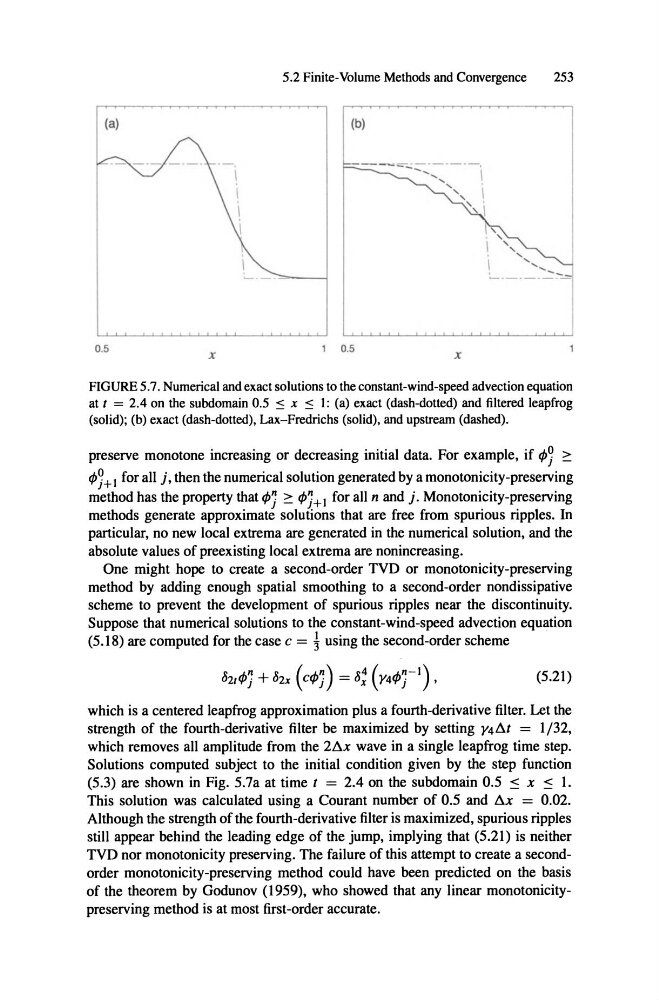
FIGURE 5.7. Numerical and exact solutions to the constant-wind-speed advection equation
at t = 2.4 on the subdomain 0.5 x 1: (a) exact (dash-dotted) and filtered leapfrog
(solid); (b) exact (dash-dotted), Lax-Fredrichs (solid), and upstream (dashed) .
preserve monotone increasing or decreasing initial data. For example, if
>
1 for an j, then the numerical solution generated by a monotonicity-preserving
method has the property that q,'J q,'J+1 for an n and j . Monotonicity-preserving
methods generate approximate solutions that are free from spurious ripples . In
particular, no new local extrema are generated in the numerical solution, and the
absolute values of preexisting local extrema are nonincreasing .
One might hope to create a second-order TVD or monotonicity-preserving
method by adding enough spatial smoothing to a second-order nondissipative
scheme to prevent the development of spurious ripples near the discontinuity.
Suppose that numerical solutions to the constant-wind-speed advection equation
(5.18) are computed for the case c = t using the second-order scheme
(5.21)
which is a centered leapfrog approximation plus a fourth-derivative filter. Let the
strength of the fourth-derivative filter be maximized by setting Y4ßt = 1/32,
which removes an amplitude from the 2ßx wave in a single leapfrog time step.
Solutions computed subject to the initial condition given by the step function
(5.3) are shown in Fig. 5.7a at time t = 2.4 on the subdomain 0.5
x
1.
This solution was calculated using a Courant number of 0.5 and ßx = 0.02.
Although the strength ofthe fourth-derivative filter is maximized, spurious ripples
still appear behind the leading edge of the jump, implying that (5.21) is neither
TVD nor monotonicity preserving. The failure of this attempt to create a secondorder monotonicity-preserving method could have been predicted on the basis
of the theorem by Godunov (1959), who showed that any linear monotonicitypreserving method is at most first-order accurate.
253
(a)
(bl
-. . . . . . . . . . . . . ., l
........ \
.... '
-, \
h ....
,
I , ........ ....
0.5
x
0.5
x
FIGURE 5.7. Numerical and exact solutions to the constant-wind-speed advection equation
at t = 2.4 on the subdomain 0.5 x 1: (a) exact (dash-dotted) and filtered leapfrog
(solid); (b) exact (dash-dotted), Lax-Fredrichs (solid), and upstream (dashed) .
preserve monotone increasing or decreasing initial data. For example, if
>
1 for an j, then the numerical solution generated by a monotonicity-preserving
method has the property that q,'J q,'J+1 for an n and j . Monotonicity-preserving
methods generate approximate solutions that are free from spurious ripples . In
particular, no new local extrema are generated in the numerical solution, and the
absolute values of preexisting local extrema are nonincreasing .
One might hope to create a second-order TVD or monotonicity-preserving
method by adding enough spatial smoothing to a second-order nondissipative
scheme to prevent the development of spurious ripples near the discontinuity.
Suppose that numerical solutions to the constant-wind-speed advection equation
(5.18) are computed for the case c = t using the second-order scheme
(5.21)
which is a centered leapfrog approximation plus a fourth-derivative filter. Let the
strength of the fourth-derivative filter be maximized by setting Y4ßt = 1/32,
which removes an amplitude from the 2ßx wave in a single leapfrog time step.
Solutions computed subject to the initial condition given by the step function
(5.3) are shown in Fig. 5.7a at time t = 2.4 on the subdomain 0.5
x
1.
This solution was calculated using a Courant number of 0.5 and ßx = 0.02.
Although the strength ofthe fourth-derivative filter is maximized, spurious ripples
still appear behind the leading edge of the jump, implying that (5.21) is neither
TVD nor monotonicity preserving. The failure of this attempt to create a secondorder monotonicity-preserving method could have been predicted on the basis
of the theorem by Godunov (1959), who showed that any linear monotonicitypreserving method is at most first-order accurate.