

250
5. Finite-Volume Methods
The possibility of numerical solutions converging to a function that is not a
weak solution to the goveming equation can be avoided by using finite-difference
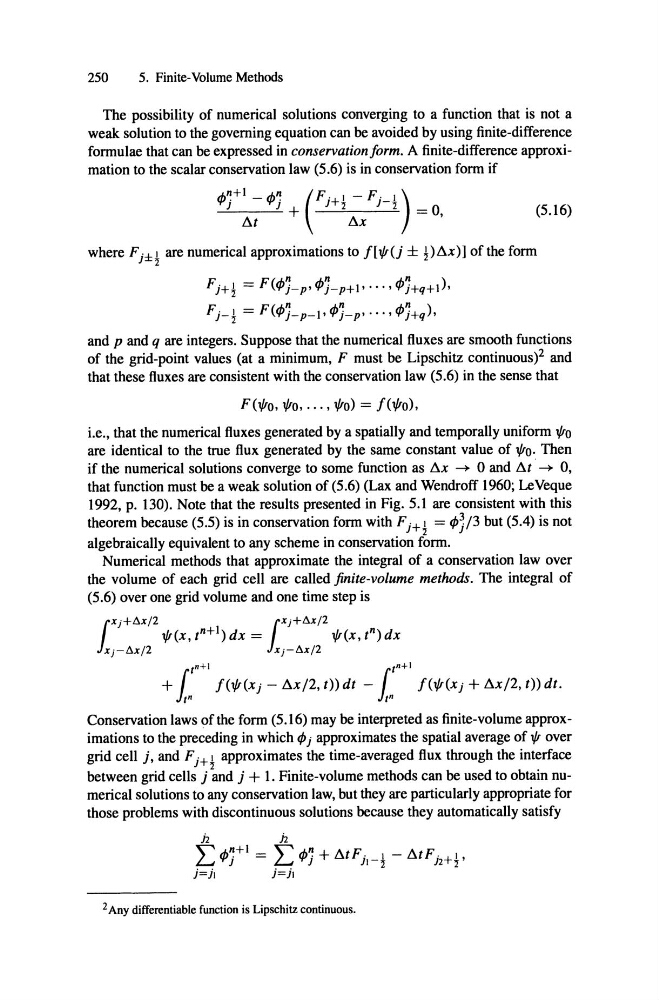
formulae that can be expressed in conservationforrn. A finite-difference approximation to the scalar conservation law (5.6) is in conservation form if
where
J
- J +
/)"t
(Fj+1 - Fj _l)
(5.16)
2:
2:
= 0,
/)"x
are numerical approximations to f[1/tU ± P/)"x)) ofthe form
= F( = F( and p and q are integers. Suppose that the numerical fluxes are smooth functions
of the grid-point values (at aminimum, F must be Lipschitz continuousj- and
that these fluxes are consistent with the conservation law (5.6) in the sense that
F(1/to, 1/to, ... , 1/to) = f(1/to),
i.e., that the numerical fluxes generated by a spatially and temporally uniform 1/to
are identical to the true flux generated by the same constant value of 1/to. Then
if the numerical solutions converge to some function as !i.x
0 and /)"t .
0,
that function must be a weak solution of (5.6) (Lax and Wendroff 1960; LeVeque
1992, p. 130). Note that the results presented in Fig. 5.1 are consistent with this
theorem because (5.5) is in conservation form with
= algebraically equivalent to any scheme in conservation form.
Numerical methods that approximate the integral of a conservation law over
the volume of each grid cell are called finite-volume rnethods. The integral of
(5.6) over one grid volume and one time step is
c:
r:
1/t(x,t
n
+
I)dx=
1/t(x,t
n)dx
x j-tix /2
x j-tix /2
+
f(1/f(Xj - /)"xI2, t» dt -1
,"+ 1
f(1/t(Xj + /)"xI2, t» dt ,
1
," +1
r n
t n
Conservation laws ofthe form (5.16) may be interpreted as finite-volume approximations to the preceding in which grid cell i. and
approximates the time-averaged flux through the interface
between grid cells j and j + I. Finite-volume methods can be used to obtain numerical solutions to any conservation law, but they are particularly appropriate for
those problems with discontinuous solutions because they automatically satisfy
h
h
= ' " A.'! + St F , I
'I'J
JI- 2:
- St F , +1
12 2:'
j=jl
' " 'I'J
j=jl
2Any differentiable function is Lipschitz continuous.
5. Finite-Volume Methods
The possibility of numerical solutions converging to a function that is not a
weak solution to the goveming equation can be avoided by using finite-difference
formulae that can be expressed in conservationforrn. A finite-difference approximation to the scalar conservation law (5.6) is in conservation form if
where
J
- J +
/)"t
(Fj+1 - Fj _l)
(5.16)
2:
2:
= 0,
/)"x
are numerical approximations to f[1/tU ± P/)"x)) ofthe form
= F( = F( and p and q are integers. Suppose that the numerical fluxes are smooth functions
of the grid-point values (at aminimum, F must be Lipschitz continuousj- and
that these fluxes are consistent with the conservation law (5.6) in the sense that
F(1/to, 1/to, ... , 1/to) = f(1/to),
i.e., that the numerical fluxes generated by a spatially and temporally uniform 1/to
are identical to the true flux generated by the same constant value of 1/to. Then
if the numerical solutions converge to some function as !i.x
0 and /)"t .
0,
that function must be a weak solution of (5.6) (Lax and Wendroff 1960; LeVeque
1992, p. 130). Note that the results presented in Fig. 5.1 are consistent with this
theorem because (5.5) is in conservation form with
= algebraically equivalent to any scheme in conservation form.
Numerical methods that approximate the integral of a conservation law over
the volume of each grid cell are called finite-volume rnethods. The integral of
(5.6) over one grid volume and one time step is
c:
r:
1/t(x,t
n
+
I)dx=
1/t(x,t
n)dx
x j-tix /2
x j-tix /2
+
f(1/f(Xj - /)"xI2, t» dt -1
,"+ 1
f(1/t(Xj + /)"xI2, t» dt ,
1
," +1
r n
t n
Conservation laws ofthe form (5.16) may be interpreted as finite-volume approximations to the preceding in which grid cell i. and
approximates the time-averaged flux through the interface
between grid cells j and j + I. Finite-volume methods can be used to obtain numerical solutions to any conservation law, but they are particularly appropriate for
those problems with discontinuous solutions because they automatically satisfy
h
h
= ' " A.'! + St F , I
'I'J
JI- 2:
- St F , +1
12 2:'
j=jl
' " 'I'J
j=jl
2Any differentiable function is Lipschitz continuous.