

5.2 Finite-Volume Methods and Convergence
251
which is a discrete approximation to an arbitrary member of the family of integral
equations (5.7) satisfied by any weak solution to the exact conservation law,
5.2.1 Monotone Schemes
There is no guarantee that a consistent finite-difference method in conservation
form will converge to a weak solution. The theorem of Lax and Wendroff assures
only that if the numerical solution does converge, it will converge to a weak solution. Convergence to the entropy-consistent weak solution is guaranteed whenever
a consistent method in conservation form is monotone (Kuznecov and Volosin
1976; Harten et al. 1976; Crandall and Majda 1980b). Recall that a real-valued
function is "monotone increasing" if g(x) S g(y) whenever x S y . A finitedifference method is monotone if cP'j+I is a monotone increasing function of each
grid-point value of cP appearing in the finite-difference formula. If the scheme is
expressed in the functional form
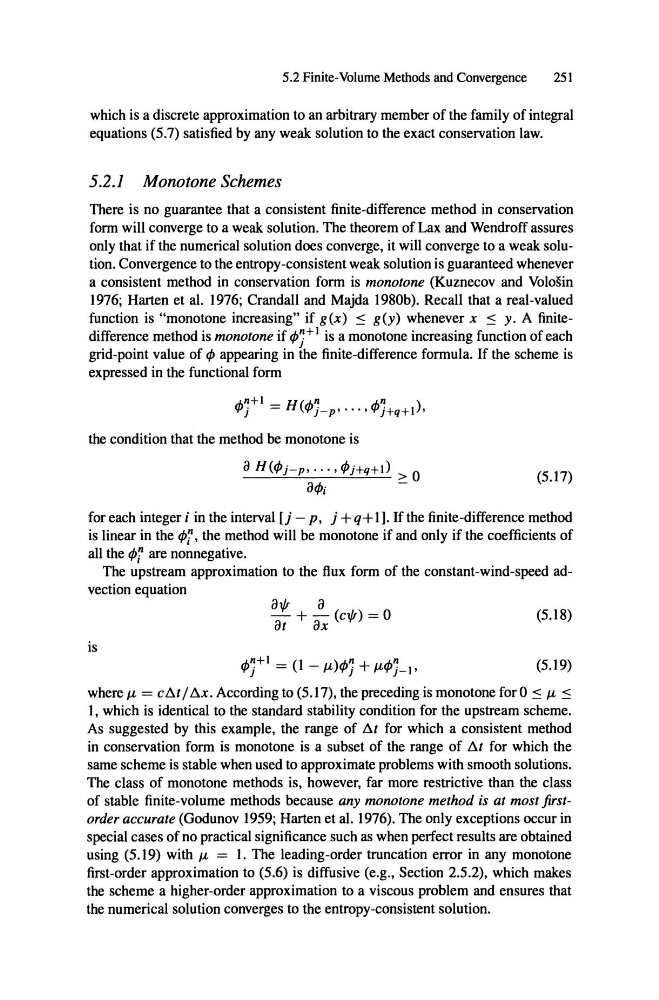
cP'j+l = H(cP'j_p" ' " cP'j+q+l)'
the condition that the method be monotone is
(5.17)
for each integer i in the interval [j - p , j +q+ I] . If the finite-difference method
is linear in the cPi, the method will be monotone if and only if the coefficients of
all the cPi are nonnegative.
The upstream approximation to the flux form of the constant-wind-speed advection equation
-
8y,
+ -
8 (ey,) = 0
(5.18)
8t
8x
(5.19)
cP'j+l = Cl - J-L)cP' j + J-LcP'j-l'
is
where J-L = e f1t/ Sx, According to (5.17) , the preceding is monotone for 0 S J-L S
1, which is identical to the standard stability condition for the upstream scheme.
As suggested by this examp1e, the range of f1t for which a consistent method
in conservation form is monotone is a subset of the range of f1t for which the
same scheme is stable when used to approximate problems with smooth solutions.
The dass of monotone methods is, however, far more restrictive than the dass
of stab1e finite-volume methods because any monotone method is at most first -
order aeeurate (Godunov 1959; Harten et al. 1976). The only exceptions occur in
special cases of no practical significance such as when perfect results are obtained
using (5.19) with J-L = 1. The leading-order truncation error in any monotone
first-order approximation to (5.6) is diffusive (e.g., Section 2.5.2), which makes
the scheme a higher-order approximation to a viscous problem and ensures that
the numerical solution converges to the entropy-consistent solution.
251
which is a discrete approximation to an arbitrary member of the family of integral
equations (5.7) satisfied by any weak solution to the exact conservation law,
5.2.1 Monotone Schemes
There is no guarantee that a consistent finite-difference method in conservation
form will converge to a weak solution. The theorem of Lax and Wendroff assures
only that if the numerical solution does converge, it will converge to a weak solution. Convergence to the entropy-consistent weak solution is guaranteed whenever
a consistent method in conservation form is monotone (Kuznecov and Volosin
1976; Harten et al. 1976; Crandall and Majda 1980b). Recall that a real-valued
function is "monotone increasing" if g(x) S g(y) whenever x S y . A finitedifference method is monotone if cP'j+I is a monotone increasing function of each
grid-point value of cP appearing in the finite-difference formula. If the scheme is
expressed in the functional form
cP'j+l = H(cP'j_p" ' " cP'j+q+l)'
the condition that the method be monotone is
(5.17)
for each integer i in the interval [j - p , j +q+ I] . If the finite-difference method
is linear in the cPi, the method will be monotone if and only if the coefficients of
all the cPi are nonnegative.
The upstream approximation to the flux form of the constant-wind-speed advection equation
-
8y,
+ -
8 (ey,) = 0
(5.18)
8t
8x
(5.19)
cP'j+l = Cl - J-L)cP' j + J-LcP'j-l'
is
where J-L = e f1t/ Sx, According to (5.17) , the preceding is monotone for 0 S J-L S
1, which is identical to the standard stability condition for the upstream scheme.
As suggested by this examp1e, the range of f1t for which a consistent method
in conservation form is monotone is a subset of the range of f1t for which the
same scheme is stable when used to approximate problems with smooth solutions.
The dass of monotone methods is, however, far more restrictive than the dass
of stab1e finite-volume methods because any monotone method is at most first -
order aeeurate (Godunov 1959; Harten et al. 1976). The only exceptions occur in
special cases of no practical significance such as when perfect results are obtained
using (5.19) with J-L = 1. The leading-order truncation error in any monotone
first-order approximation to (5.6) is diffusive (e.g., Section 2.5.2), which makes
the scheme a higher-order approximation to a viscous problem and ensures that
the numerical solution converges to the entropy-consistent solution.