

5.2 Finite-Volume Methods and Convergence
249
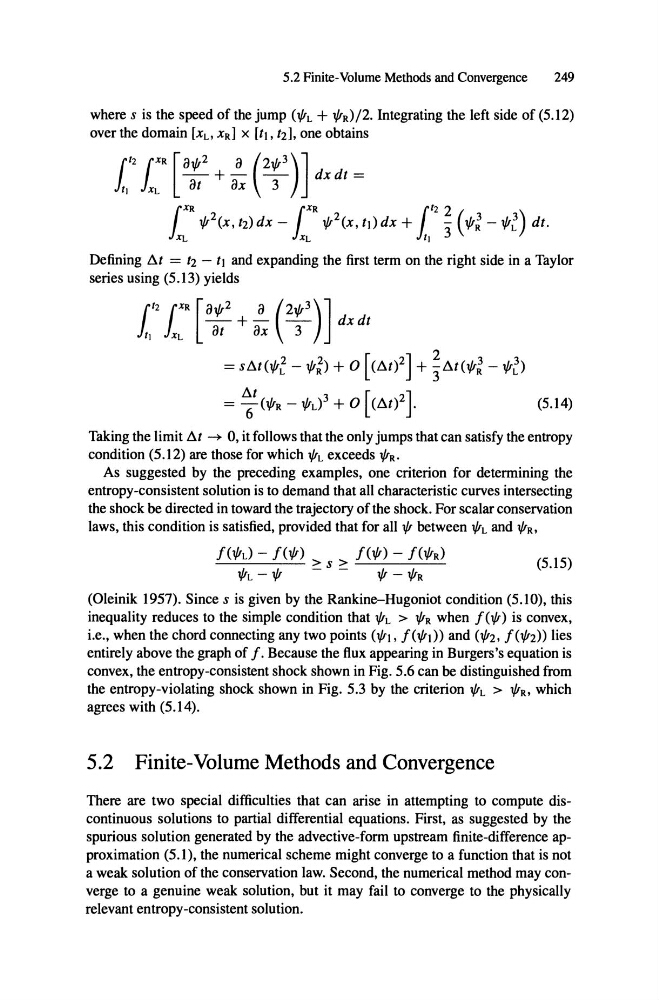
where s is the speed of the jump (1/IL + 1/IR)/2. Integrating the left side of (5.12)
over the domain [XL, XR] X [tl , t2], one obtains
l
/2
1
XR [a1/l2 - + - a (21/13)] -
dxdt=
I)
XL
at
ax 3
1/I2(x , t2) dx -
1/12(x, tI> dx + - (1/1; -1/1;:) dt.
XL
xL
I. 3
Defining l:i.t = t2 - t) and expanding the first term on the right side in a Taylor
series using (5.13) yields
l
/2
1
XR [a1/l2 - + - a (21/13)] -
dxdt
I)
XL
at ax 3
= sl:i.t(1/IC -1/1;) + 0 [(l:i.t)2] +
= (1/IR -1/Id 3 + 0 [(l:i.t)2J.
(5.14)
Taking the limit !:i.t -+ 0, it follows that the only jumps that can satisfy the entropy
condition (5.12) are those for which 1/IL exceeds 1/IR.
As suggested by the preceding examples, one criterion for determining the
entropy-consistent solution is to demand that all characteristic curves intersecting
the shock be directed in toward the trajectory of the shock . For scalar conservation
laws, this condition is satisfied, provided that for all 1/1 between 1/IL and 1/IR,
1(1/Id - 1(1/1) > s > 1(1/1) - 1(1/IR)
1/IL - 1/1
- -
1/1 - 1/IR
(5.15)
(Oleinik 1957). Since s is given by the Rankine-Hugoniot condition (5.10), this
inequality reduces to the simple condition that 1/IL > 1/IR when 1(1/1) is convex,
i.e., when the chord connecting any two points (1/11, /(1/11» and (1/12, 1(1/12» lies
entirely above the graph of I. Because the flux appearing in Burgers's equation is
convex, the entropy-consistent shock shown in Fig. 5.6 can be distinguished from
the entropy-violating shock shown in Fig. 5.3 by the criterion 1/IL > 1/IR' which
agrees with (5.14).
5.2 Finite-Volume Methods and Convergence
There are two special difficulties that can arise in attempting to compute discontinuous solutions to partial differential equations. First, as suggested by the
spurious solution generated by the advective -form upstream finite-difference approximation (5.1), the numerical scheme might converge to a function that is not
a weak solution of the conservation law. Second, the numerical method may converge to a genuine weak solution, but it may fail to converge to the physically
relevant entropy-consistent solution.
249
where s is the speed of the jump (1/IL + 1/IR)/2. Integrating the left side of (5.12)
over the domain [XL, XR] X [tl , t2], one obtains
l
/2
1
XR [a1/l2 - + - a (21/13)] -
dxdt=
I)
XL
at
ax 3
1/I2(x , t2) dx -
1/12(x, tI> dx + - (1/1; -1/1;:) dt.
XL
xL
I. 3
Defining l:i.t = t2 - t) and expanding the first term on the right side in a Taylor
series using (5.13) yields
l
/2
1
XR [a1/l2 - + - a (21/13)] -
dxdt
I)
XL
at ax 3
= sl:i.t(1/IC -1/1;) + 0 [(l:i.t)2] +
= (1/IR -1/Id 3 + 0 [(l:i.t)2J.
(5.14)
Taking the limit !:i.t -+ 0, it follows that the only jumps that can satisfy the entropy
condition (5.12) are those for which 1/IL exceeds 1/IR.
As suggested by the preceding examples, one criterion for determining the
entropy-consistent solution is to demand that all characteristic curves intersecting
the shock be directed in toward the trajectory of the shock . For scalar conservation
laws, this condition is satisfied, provided that for all 1/1 between 1/IL and 1/IR,
1(1/Id - 1(1/1) > s > 1(1/1) - 1(1/IR)
1/IL - 1/1
- -
1/1 - 1/IR
(5.15)
(Oleinik 1957). Since s is given by the Rankine-Hugoniot condition (5.10), this
inequality reduces to the simple condition that 1/IL > 1/IR when 1(1/1) is convex,
i.e., when the chord connecting any two points (1/11, /(1/11» and (1/12, 1(1/12» lies
entirely above the graph of I. Because the flux appearing in Burgers's equation is
convex, the entropy-consistent shock shown in Fig. 5.6 can be distinguished from
the entropy-violating shock shown in Fig. 5.3 by the criterion 1/IL > 1/IR' which
agrees with (5.14).
5.2 Finite-Volume Methods and Convergence
There are two special difficulties that can arise in attempting to compute discontinuous solutions to partial differential equations. First, as suggested by the
spurious solution generated by the advective -form upstream finite-difference approximation (5.1), the numerical scheme might converge to a function that is not
a weak solution of the conservation law. Second, the numerical method may converge to a genuine weak solution, but it may fail to converge to the physically
relevant entropy-consistent solution.