

(b)
248
5. Finite-Volume Methods
(a)
'---'--'--f<---L- - - " ' - - - - -- X
o
o
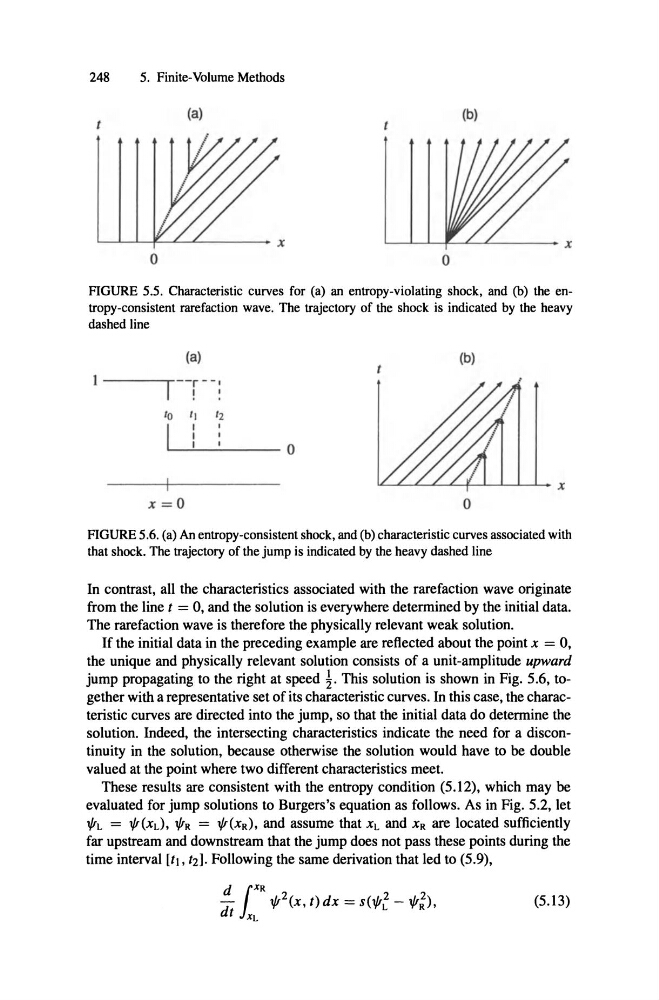
FIGURE 5.5. Characteristic curves for (a) an entropy-violating shock, and (b) the entropy-consistent rarefaction wave. The trajectory of the shock is indicated by the heavy
dashed line
X=o
(b)
o
'0
I
(a)
r
- - r --,
I
'
' I
' 2
I
I
1--=--'---I
I
I
0
FIGURE 5.6. (a) An entropy-consistent shock, and (b) characteristic curves associated with
that shock. The trajectory of the jump is indicated by the heavy dashed line
In contrast, all the characteristics associated with the rarefaction wave originate
from the line t = 0, and the solution is everywhere determined by the initial data.
The rarefaction wave is therefore the physically relevant weak solution.
If the initial data in the preceding example are reflected about the point x = 0,
the unique and physically relevant solution consists of a unit-amplitude upward
jump propagating to the right at speed !.This solution is shown in Fig. 5.6, together with a representative set of its characteristic curves . In this case, the characteristic curves are directed into the jump, so that the initial data do determine the
solution. Indeed, the intersecting characteristics indicate the need for a discon -
tinuity in the solution, because otherwise the solution would have to be double
valued at the point where two different characteristics meet.
These results are consistent with the entropy condition (5.12), which may be
evaluated for jump solutions to Burgers's equation as follows . As in Fig. 5.2, let
1/fL = 'I/J(XL), 'l/JR = 'I/J(XR), and assurne that XL and XR are located sufficiently
far upstream and downstream that the jump does not pass these points during the
time interval [t1 , t2]. Following the same derivation that led to (5.9),
(5.13)
248
5. Finite-Volume Methods
(a)
'---'--'--f<---L- - - " ' - - - - -- X
o
o
FIGURE 5.5. Characteristic curves for (a) an entropy-violating shock, and (b) the entropy-consistent rarefaction wave. The trajectory of the shock is indicated by the heavy
dashed line
X=o
(b)
o
'0
I
(a)
r
- - r --,
I
'
' I
' 2
I
I
1--=--'---I
I
I
0
FIGURE 5.6. (a) An entropy-consistent shock, and (b) characteristic curves associated with
that shock. The trajectory of the jump is indicated by the heavy dashed line
In contrast, all the characteristics associated with the rarefaction wave originate
from the line t = 0, and the solution is everywhere determined by the initial data.
The rarefaction wave is therefore the physically relevant weak solution.
If the initial data in the preceding example are reflected about the point x = 0,
the unique and physically relevant solution consists of a unit-amplitude upward
jump propagating to the right at speed !.This solution is shown in Fig. 5.6, together with a representative set of its characteristic curves . In this case, the characteristic curves are directed into the jump, so that the initial data do determine the
solution. Indeed, the intersecting characteristics indicate the need for a discon -
tinuity in the solution, because otherwise the solution would have to be double
valued at the point where two different characteristics meet.
These results are consistent with the entropy condition (5.12), which may be
evaluated for jump solutions to Burgers's equation as follows . As in Fig. 5.2, let
1/fL = 'I/J(XL), 'l/JR = 'I/J(XR), and assurne that XL and XR are located sufficiently
far upstream and downstream that the jump does not pass these points during the
time interval [t1 , t2]. Following the same derivation that led to (5.9),
(5.13)