

(al
5.1 Conservation Laws and Weak: Solutions
(bl
, , ,
247
x=O
x=O
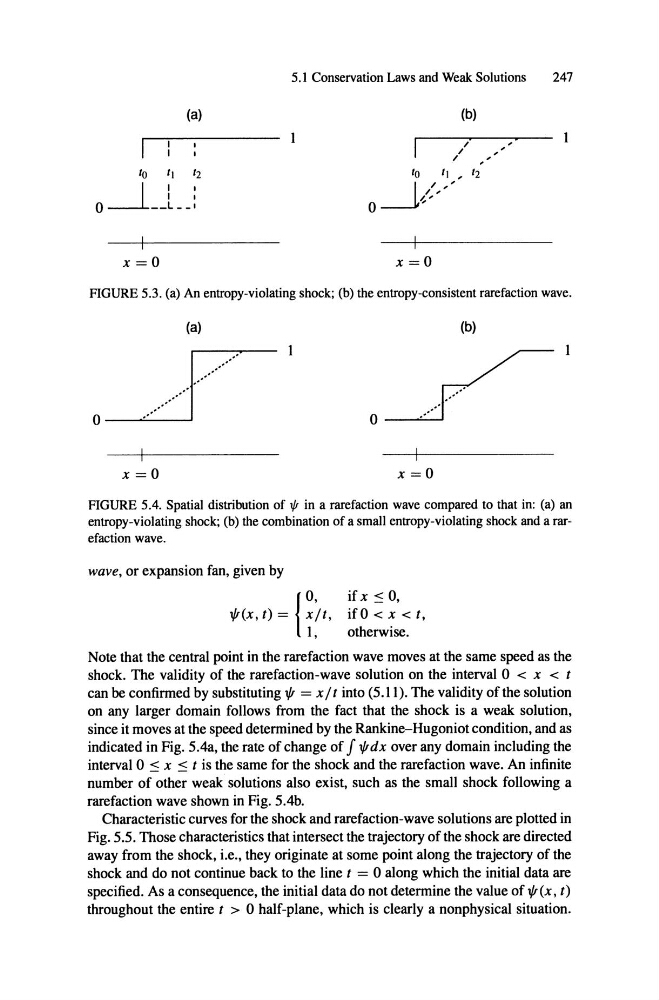
FIGURE 5.3. (a) An entropy-violating shock; (b) the entropy-consistent rarefaction wave.
. . . .
(al
....
.> I
0 - - = - - - -
x=O
o --"---'
x=O
(bl
FIGURE 5.4. Spatial distribution of 1/1 in a rarefaction wave compared to that in: (a) an
entropy-violating shock; (b) the combination of a small entropy-violating shock and a rarefaction wave.
wave, or expansion fan, given by
!
0,
xf t ,
I,
if x :5 0,
1/I(x , t) =
ifO < x< t ,
otherwise.
Note that the central point in the rarefaction wave moves at the same speed as the
shock. The validity of the rarefaction-wave solution on the interval 0 < x < t
can be confirmed by substituting 1/1 = x / t into (5. I I). The validity of the solution
on any larger domain follows from the fact that the shock is a weak solution,
since it moves at the speed determined by the Rankine-Hugoniot condition, and as
indicated in Fig. 5.4a, the rate of change of f 1/Idx over any domain including the
interval 0 :5 x :5 t is the same for the shock and the rarefaction wave. An infinite
number of other weak solutions also exist, such as the small shock following a
rarefaction wave shown in Fig. 5.4b.
Characteristic curves for the shock and rarefaction-wave solutions are plotted in
Fig. 5.5. Those characteristics that intersect the trajectory of the shock are directed
away from the shock, i.e., they originate at some point along the trajectory of the
shock and do not continue back to the line t = 0 along which the initial data are
specified. As a consequence, the initial data do not determine the value of 1/1 (x , t)
throughout the entire t > 0 half-plane, which is c1early a nonphysical situation.
5.1 Conservation Laws and Weak: Solutions
(bl
, , ,
247
x=O
x=O
FIGURE 5.3. (a) An entropy-violating shock; (b) the entropy-consistent rarefaction wave.
. . . .
(al
....
.> I
0 - - = - - - -
x=O
o --"---'
x=O
(bl
FIGURE 5.4. Spatial distribution of 1/1 in a rarefaction wave compared to that in: (a) an
entropy-violating shock; (b) the combination of a small entropy-violating shock and a rarefaction wave.
wave, or expansion fan, given by
!
0,
xf t ,
I,
if x :5 0,
1/I(x , t) =
ifO < x< t ,
otherwise.
Note that the central point in the rarefaction wave moves at the same speed as the
shock. The validity of the rarefaction-wave solution on the interval 0 < x < t
can be confirmed by substituting 1/1 = x / t into (5. I I). The validity of the solution
on any larger domain follows from the fact that the shock is a weak solution,
since it moves at the speed determined by the Rankine-Hugoniot condition, and as
indicated in Fig. 5.4a, the rate of change of f 1/Idx over any domain including the
interval 0 :5 x :5 t is the same for the shock and the rarefaction wave. An infinite
number of other weak solutions also exist, such as the small shock following a
rarefaction wave shown in Fig. 5.4b.
Characteristic curves for the shock and rarefaction-wave solutions are plotted in
Fig. 5.5. Those characteristics that intersect the trajectory of the shock are directed
away from the shock, i.e., they originate at some point along the trajectory of the
shock and do not continue back to the line t = 0 along which the initial data are
specified. As a consequence, the initial data do not determine the value of 1/1 (x , t)
throughout the entire t > 0 half-plane, which is c1early a nonphysical situation.