

IM
1.01
1.00
c·
C
0.99
""311146
1lI2A
229
4.5 The Finite-Element Method
WAVElENGTH ON THE CUBIC MESH
0.96 ' - ' ' -
----'- ' - _' ' -_ _- ' _ - ' ' - -_ _-'--'
WAV E NUMBEA ON THE CUBIC MESH
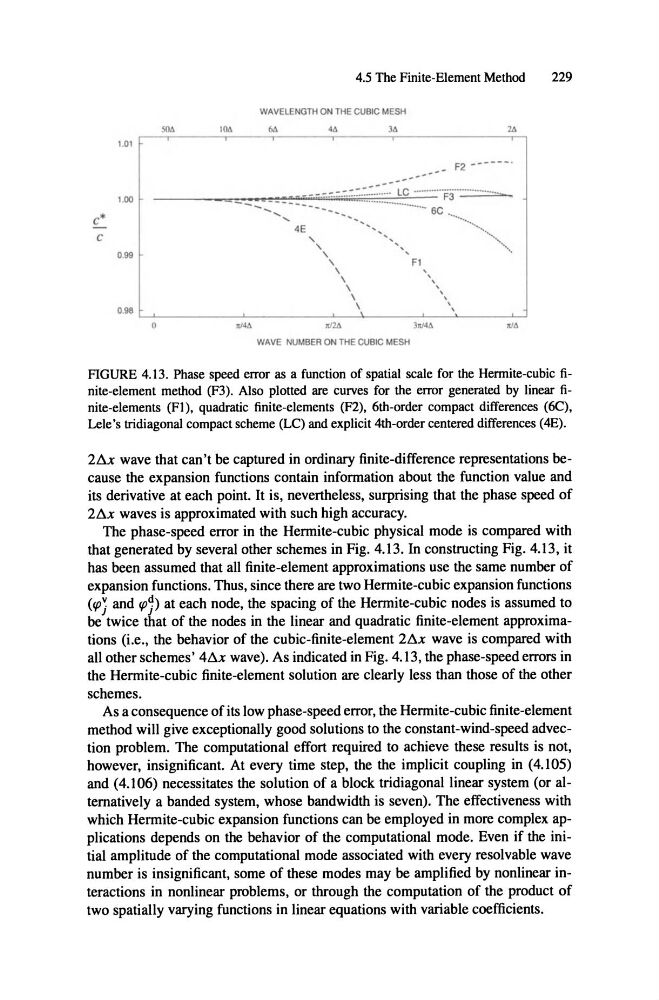
FlGURE 4.13. Phase speed error as a function of spatial scale for the Hermite-cubic finite-element method (F3). Also plotted are curves for the error generated by linear finite-elements (FI), quadratic finite-elements (F2), 6th-order compact differences (6C),
Lele's tridiagonal compact scheme (LC) and explicit 4th-order centered differences (4E).
2ßx wave that can 't be captured in ordinary finite-difference representations because the expansion functions contain information about the function value and
its derivative at each point. It is, nevertheless, surprising that the phase speed of
2ßx waves is approximated with such high accuracy.
The phase-speed error in the Hermite-cubic physical mode is compared with
that generated by several other schemes in Fig. 4.13. In constructing Fig . 4.13, it
has been assumed that all finite-element approximations use the same number of
expansion functions. Thus , since there are two Hermite-cubic expansion functions
('Pi and
at each node, the spacing of the Hermite-cubic nodes is assumed to
be twice that of the nodes in the linear and quadratic finite-element approximations (i.e. , the behavior of the cubic-finite-element 2ßx wave is compared with
all other schemes' 4ßx wave). As indicated in Fig. 4.13, the phase-speed errors in
the Hermite-cubic finite-element solution are c1early less than those of the other
schemes.
As a consequence of its low phase-speed error, the Hermite-cubic finite-element
method will give exceptionally good solutions to the constant-wind-speed advection problem. The computational effort required to achieve these results is not,
however, insignificant. At every time step, the the implicit coupling in (4.105)
and (4.106) necessitates the solution of a block tridiagonallinear system (or altematively a banded system, whose bandwidth is seven). The effectiveness with
which Hermite-cubic expansion functions can be employed in more complex applications depends on the behavior of the computational mode. Even if the initial amplitude of the computational mode associated with every resolvable wave
number is insignificant, some of these modes may be amplified by nonlinear interactions in nonlinear problems, or through the computation of the product of
two spatially varying functions in linear equations with variable coefficients.
1.01
1.00
c·
C
0.99
""311146
1lI2A
229
4.5 The Finite-Element Method
WAVElENGTH ON THE CUBIC MESH
0.96 ' - ' ' -
----'- ' - _' ' -_ _- ' _ - ' ' - -_ _-'--'
WAV E NUMBEA ON THE CUBIC MESH
FlGURE 4.13. Phase speed error as a function of spatial scale for the Hermite-cubic finite-element method (F3). Also plotted are curves for the error generated by linear finite-elements (FI), quadratic finite-elements (F2), 6th-order compact differences (6C),
Lele's tridiagonal compact scheme (LC) and explicit 4th-order centered differences (4E).
2ßx wave that can 't be captured in ordinary finite-difference representations because the expansion functions contain information about the function value and
its derivative at each point. It is, nevertheless, surprising that the phase speed of
2ßx waves is approximated with such high accuracy.
The phase-speed error in the Hermite-cubic physical mode is compared with
that generated by several other schemes in Fig. 4.13. In constructing Fig . 4.13, it
has been assumed that all finite-element approximations use the same number of
expansion functions. Thus , since there are two Hermite-cubic expansion functions
('Pi and
at each node, the spacing of the Hermite-cubic nodes is assumed to
be twice that of the nodes in the linear and quadratic finite-element approximations (i.e. , the behavior of the cubic-finite-element 2ßx wave is compared with
all other schemes' 4ßx wave). As indicated in Fig. 4.13, the phase-speed errors in
the Hermite-cubic finite-element solution are c1early less than those of the other
schemes.
As a consequence of its low phase-speed error, the Hermite-cubic finite-element
method will give exceptionally good solutions to the constant-wind-speed advection problem. The computational effort required to achieve these results is not,
however, insignificant. At every time step, the the implicit coupling in (4.105)
and (4.106) necessitates the solution of a block tridiagonallinear system (or altematively a banded system, whose bandwidth is seven). The effectiveness with
which Hermite-cubic expansion functions can be employed in more complex applications depends on the behavior of the computational mode. Even if the initial amplitude of the computational mode associated with every resolvable wave
number is insignificant, some of these modes may be amplified by nonlinear interactions in nonlinear problems, or through the computation of the product of
two spatially varying functions in linear equations with variable coefficients.