

228
4. Series-Expans ion Methods
WAVELENGTH
WAVEl ENGTH
504
106
M
., C*/C
46
36
P
- - - - - - -
21>
506
104
M
1.0
0.5
r a
- ' ,
46
36
21>
-p-0.0
-0.5
1.0
-3
-5
-7
, , , ,
, , , ,
, , , ,
, , , ,
-
- - - -
- ' ·C_
- - ,
"'46
3./46
"'21>
WAVE NUMBER
"'6
"'46
3./46
"' 21>
WAVE NUMBER
"'6
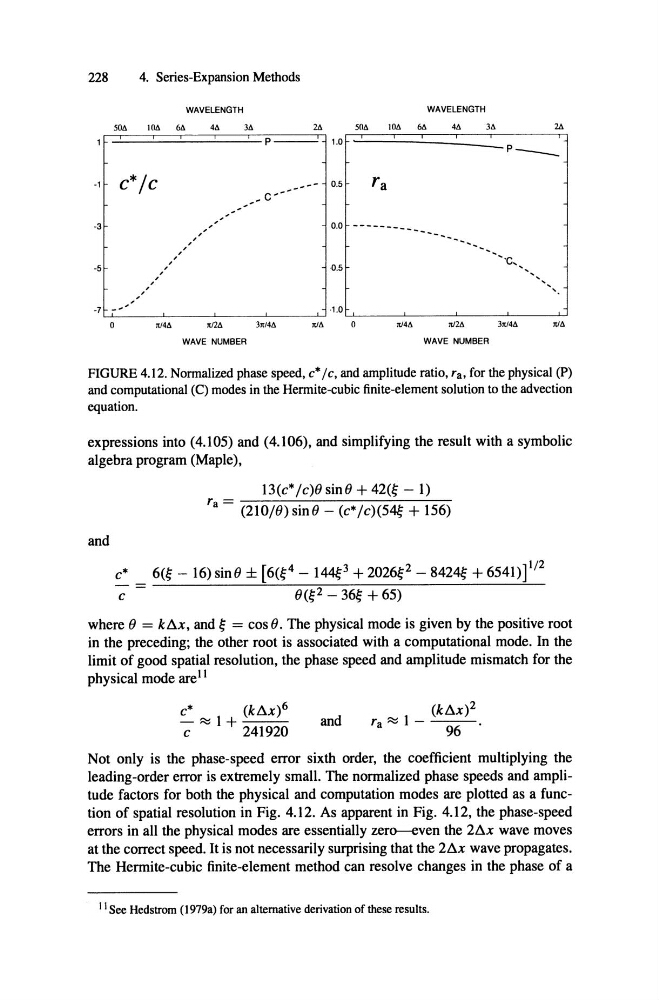
FIGURE 4.12. Nonnalized phase speed, e* j e, and amplitude ratio , ra, for the physical (P)
and computational (C) modes in the Hennite-cubic finite-elem ent solution to the advect ion
equation.
expressions into (4.105) and (4.106), and simplifying the result with a symbolic
algebra program (Maple),
- 1)
r a = (210j e) sin e _
+ 156)
and
- 16) sine ±
c*
c
-
-
+
+ 65)
-
+ 654l)f /2
where e = ktu , and = cos e.The physical mode is given by the positive root
in the preceding; the other root is associated with a computational mode. In the
limit of good spatial resolution, the phase speed and amplitude mismatch for the
physical mode are l !
(kß X)2
1- - - - .
r
a
and
Not only is the phase-speed error sixth order, the coefficient multiplying the
leading-order error is extremely smalI. The normalized phase speeds and amplitude factors for both the physical and computation modes are plotted as a function of spatial resolution in Fig. 4.12. As apparent in Fig. 4.12, the phase-speed
errors in all the physical modes are essentially zero--even the 2ßx wave moves
at the correct speed. It is not necessarily surprising that the 2ßx wave propagates.
The Hermite-cubic finite-element method can resolve changes in the phase of a
11See Hed strom (I 979 a) fOT an alternative derivation of these res ults.
4. Series-Expans ion Methods
WAVELENGTH
WAVEl ENGTH
504
106
M
., C*/C
46
36
P
- - - - - - -
21>
506
104
M
1.0
0.5
r a
- ' ,
46
36
21>
-p-0.0
-0.5
1.0
-3
-5
-7
, , , ,
, , , ,
, , , ,
, , , ,
-
- - - -
- ' ·C_
- - ,
"'46
3./46
"'21>
WAVE NUMBER
"'6
"'46
3./46
"' 21>
WAVE NUMBER
"'6
FIGURE 4.12. Nonnalized phase speed, e* j e, and amplitude ratio , ra, for the physical (P)
and computational (C) modes in the Hennite-cubic finite-elem ent solution to the advect ion
equation.
expressions into (4.105) and (4.106), and simplifying the result with a symbolic
algebra program (Maple),
- 1)
r a = (210j e) sin e _
+ 156)
and
- 16) sine ±
c*
c
-
-
+
+ 65)
-
+ 654l)f /2
where e = ktu , and = cos e.The physical mode is given by the positive root
in the preceding; the other root is associated with a computational mode. In the
limit of good spatial resolution, the phase speed and amplitude mismatch for the
physical mode are l !
(kß X)2
1- - - - .
r
a
and
Not only is the phase-speed error sixth order, the coefficient multiplying the
leading-order error is extremely smalI. The normalized phase speeds and amplitude factors for both the physical and computation modes are plotted as a function of spatial resolution in Fig. 4.12. As apparent in Fig. 4.12, the phase-speed
errors in all the physical modes are essentially zero--even the 2ßx wave moves
at the correct speed. It is not necessarily surprising that the 2ßx wave propagates.
The Hermite-cubic finite-element method can resolve changes in the phase of a
11See Hed strom (I 979 a) fOT an alternative derivation of these res ults.