

4.5 The Finite-Element Method
227
•
:
{
_:J
•
j-2
j -1
j+1
j+2
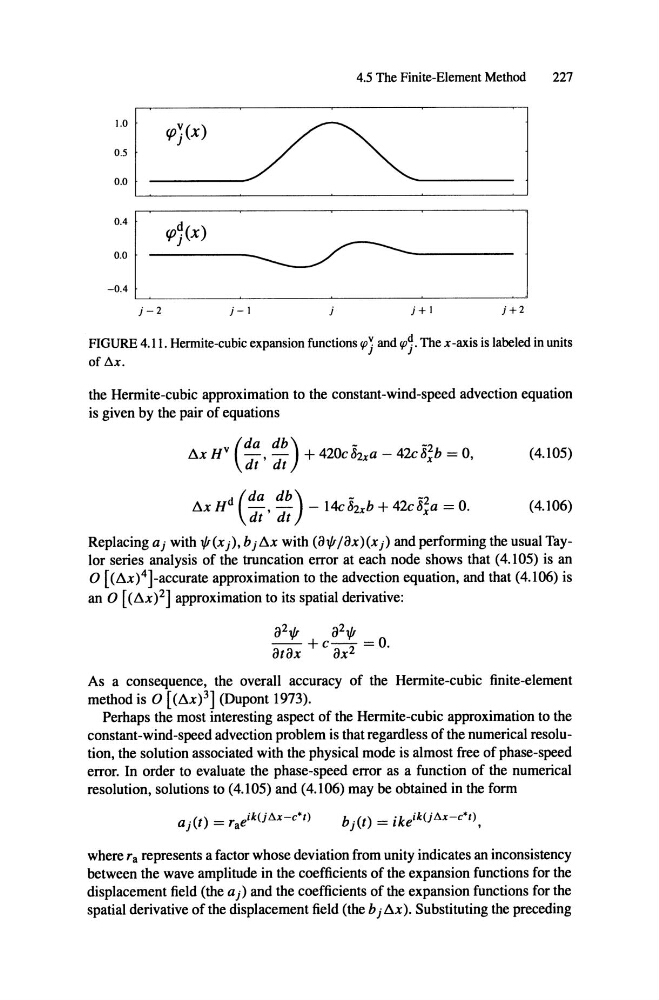
FIGURE 4.11. Hermite-cubic expansion functions rpj and 11' 1. The x-axis is labeled in units
of Sx,
the Hermite-cubic approximation to the constant-wind-speed advection equation
is given by the pair of equations
tu H (
(4.105)
V
dt dt
da
- ,
db)
-
+ 420co2xa - - 42co
-2
xb = 0,
tu H d (da - , - db) - 14co2xb - + 42co -2 xa = O.
dt dt
(4.106)
Replacing aj with 1/t(xj) , bjli.x with (a1/t/ax)(x j) and performing the usual Taylor series analysis of the truncation error at each node shows that (4.105) is an
o [(li.x)4]-accurate approximation to the advection equation, and that (4.106) is
an 0 [(li.x)2] approximation to its spatial derivative :
As a consequence, the overall accuracy of the Hermite-cubic finite-elernent
method is 0 [(li.x)3] (Dupont 1973).
Perhaps the most interesting aspect of the Hermite-cubic approximation to the
constant-wind-speed advection problem is that regardless of the numerical resolution, the solution associated with the physical mode is almost free of phase-speed
error. In order to evaluate the phase-speed error as a function of the numerical
resolution, solutions to (4.105) and (4.106) may be obtained in the form
bj(t) = ikeik(jC;.x- c·/ ) ,
where r« represents a factor whose deviation from unity indicates an inconsistency
between the wave amplitude in the coefficients of the expansion functions for the
displacement field (the a j) and the coefficients of the expansion functions for the
spatial derivative of the displacement field (the bj li.x ). Substituting the preceding
227
•
:
{
_:J
•
j-2
j -1
j+1
j+2
FIGURE 4.11. Hermite-cubic expansion functions rpj and 11' 1. The x-axis is labeled in units
of Sx,
the Hermite-cubic approximation to the constant-wind-speed advection equation
is given by the pair of equations
tu H (
(4.105)
V
dt dt
da
- ,
db)
-
+ 420co2xa - - 42co
-2
xb = 0,
tu H d (da - , - db) - 14co2xb - + 42co -2 xa = O.
dt dt
(4.106)
Replacing aj with 1/t(xj) , bjli.x with (a1/t/ax)(x j) and performing the usual Taylor series analysis of the truncation error at each node shows that (4.105) is an
o [(li.x)4]-accurate approximation to the advection equation, and that (4.106) is
an 0 [(li.x)2] approximation to its spatial derivative :
As a consequence, the overall accuracy of the Hermite-cubic finite-elernent
method is 0 [(li.x)3] (Dupont 1973).
Perhaps the most interesting aspect of the Hermite-cubic approximation to the
constant-wind-speed advection problem is that regardless of the numerical resolution, the solution associated with the physical mode is almost free of phase-speed
error. In order to evaluate the phase-speed error as a function of the numerical
resolution, solutions to (4.105) and (4.106) may be obtained in the form
bj(t) = ikeik(jC;.x- c·/ ) ,
where r« represents a factor whose deviation from unity indicates an inconsistency
between the wave amplitude in the coefficients of the expansion functions for the
displacement field (the a j) and the coefficients of the expansion functions for the
spatial derivative of the displacement field (the bj li.x ). Substituting the preceding