

4.5 The Finite-Element Method
215
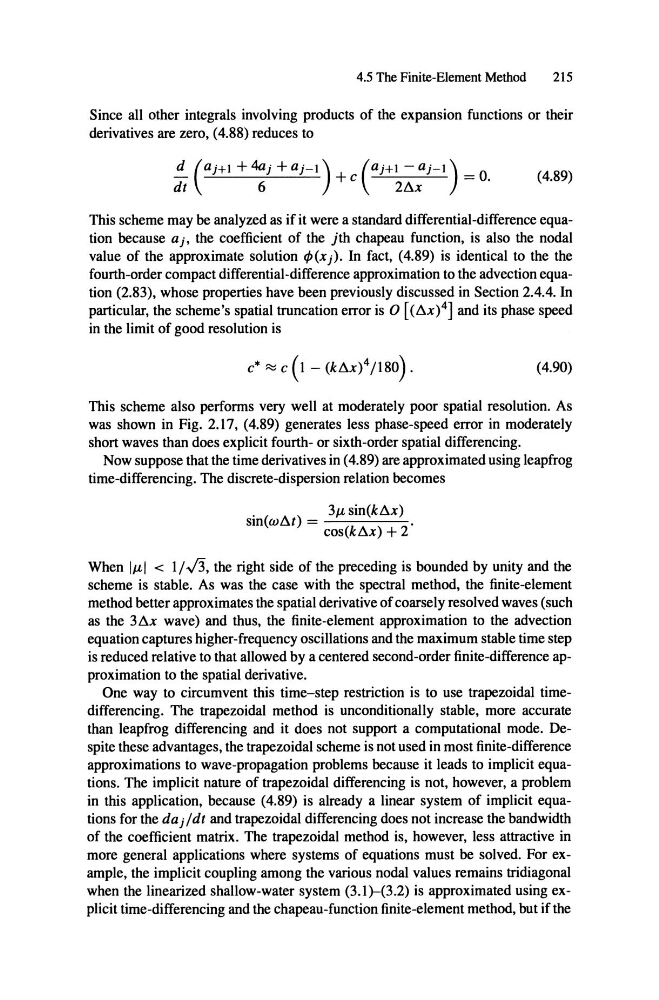
Since all other integrals involving products of the expansion functions or their
derivatives are zero, (4.88) reduces to
d (aj+1 + 4aj + aj _ l)
-
dt
+c (aj+1 - aj _ l) =Q
(4.89)
6
2ßx
This scheme may be analyzed as if it were a standard differential-difference equation because a j, the coefficient of the jth chapeau function, is also the nodal
value of the approximate solution ifJ (x j). In fact, (4.89) is identical to the the
fourth-order compact differential-difference approximation to the advection equation (2.83) , whose properties have been previously discussed in Section 2.4.4 . In
particular, the scheme's spatial truncation error is 0 [(ßx)4] and its phase speed
in the limit of good resolution is
(4.90)
This scheme also perforrns very weil at moderately poor spatial resolution. As
was shown in Fig. 2.17, (4.89) generates less phase-speed error in moderately
short waves than does explicit fourth - or sixth-order spatial differencing.
Now suppose that the time derivatives in (4.89) are approximated using leapfrog
time-differencing. The discrete -dispersion relation becomes
. (
)
31l sin(kßx)
sm wßt = cos(kßx) + 2
.
When IIlI < 1/,.[3, the right side of the preceding is bounded by unity and the
scheme is stable. As was the case with the spectral method, the finite-element
method better approximates the spatial derivative of coarsely reso1ved waves (such
as the 3ßx wave) and thus, the finite-element approximation to the advection
equation captures higher-frequency oscillations and the maximum stable time step
is reduced relative to that allowed by a centered second-order finite-difference approximation to the spatial derivative .
One way to circumvent this time-step restriction is to use trapezoidal timedifferencing. The trapezoidal method is unconditionally stable, more accurate
than leapfrog differencing and it does not support a computational mode. Despite these advantages, the trapezoidal scheme is not used in most finite-difference
approximations to wave-propagation problems because it leads to implicit equations . The implicit nature of trapezoidal differencing is not, however, a problem
in this application, because (4.89) is already a linear system of implicit equations for the da j / dt and trapezoidal differencing does not increase the bandwidth
of the coefficient matrix . The trapezoidal method is, however, less attractive in
more general applications where systems of equations must be solved. For example, the implicit coupling among the various nodal values remains tridiagonal
when the linearized shallow-water system (3.1)-(3.2) is approximated using explicit time-differencing and the chapeau-function finite-element method, but ifthe
215
Since all other integrals involving products of the expansion functions or their
derivatives are zero, (4.88) reduces to
d (aj+1 + 4aj + aj _ l)
-
dt
+c (aj+1 - aj _ l) =Q
(4.89)
6
2ßx
This scheme may be analyzed as if it were a standard differential-difference equation because a j, the coefficient of the jth chapeau function, is also the nodal
value of the approximate solution ifJ (x j). In fact, (4.89) is identical to the the
fourth-order compact differential-difference approximation to the advection equation (2.83) , whose properties have been previously discussed in Section 2.4.4 . In
particular, the scheme's spatial truncation error is 0 [(ßx)4] and its phase speed
in the limit of good resolution is
(4.90)
This scheme also perforrns very weil at moderately poor spatial resolution. As
was shown in Fig. 2.17, (4.89) generates less phase-speed error in moderately
short waves than does explicit fourth - or sixth-order spatial differencing.
Now suppose that the time derivatives in (4.89) are approximated using leapfrog
time-differencing. The discrete -dispersion relation becomes
. (
)
31l sin(kßx)
sm wßt = cos(kßx) + 2
.
When IIlI < 1/,.[3, the right side of the preceding is bounded by unity and the
scheme is stable. As was the case with the spectral method, the finite-element
method better approximates the spatial derivative of coarsely reso1ved waves (such
as the 3ßx wave) and thus, the finite-element approximation to the advection
equation captures higher-frequency oscillations and the maximum stable time step
is reduced relative to that allowed by a centered second-order finite-difference approximation to the spatial derivative .
One way to circumvent this time-step restriction is to use trapezoidal timedifferencing. The trapezoidal method is unconditionally stable, more accurate
than leapfrog differencing and it does not support a computational mode. Despite these advantages, the trapezoidal scheme is not used in most finite-difference
approximations to wave-propagation problems because it leads to implicit equations . The implicit nature of trapezoidal differencing is not, however, a problem
in this application, because (4.89) is already a linear system of implicit equations for the da j / dt and trapezoidal differencing does not increase the bandwidth
of the coefficient matrix . The trapezoidal method is, however, less attractive in
more general applications where systems of equations must be solved. For example, the implicit coupling among the various nodal values remains tridiagonal
when the linearized shallow-water system (3.1)-(3.2) is approximated using explicit time-differencing and the chapeau-function finite-element method, but ifthe