

214
4. Series-Expansion Methods
1.0
0.5
0.0
j-2
j - I
j+1
j+2
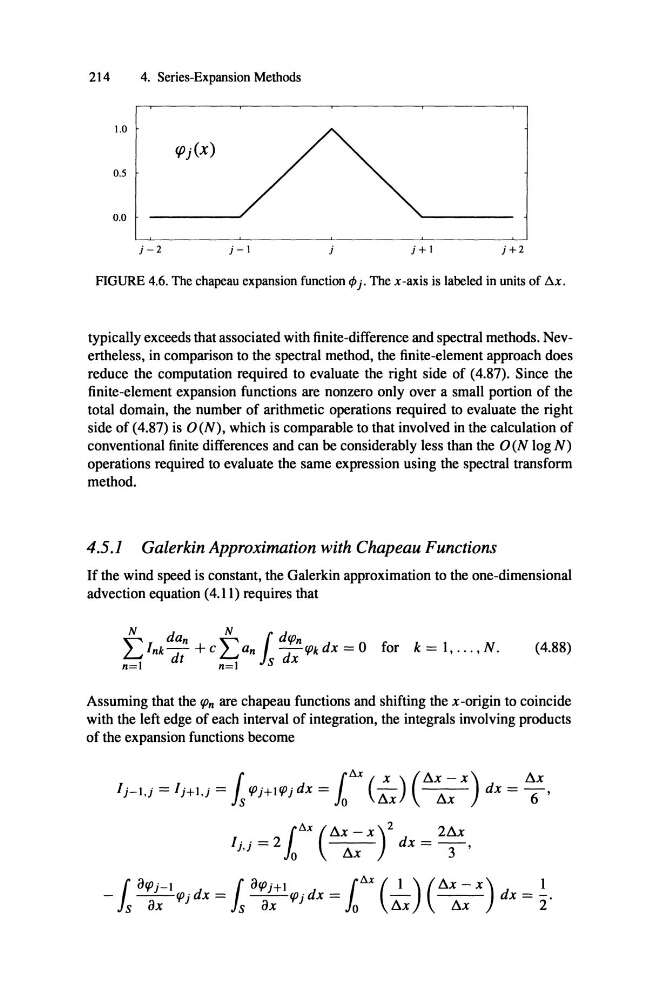
FIGURE 4.6. The chapeau expansion function c/Ji :The x-axis is labeled in units of ßx.
typically exceeds that associated with finite-difference and spectral methods. Nevertheless, in comparison to the spectral method, the finite-element approach does
reduce the computation required to evaluate the right side of (4.87). Since the
finite-elernent expansion functions are nonzero only over a small portion of the
total domain, the number of arithmetic operations required to evaluate the right
side of (4.87) is 0 (N), which is comparable to that involved in the calculation of
conventional finite differences and can be considerably less than the 0 (N log N)
operations required to evaluate the same expression using the spectral transform
method.
4.5.1 Galerkin Approximation with Chapeau Functions
If the wind speed is constant, the Galerkin approximation to the one-dimensional
advection equation (4.11) requires that
N
dan
N
1d( {Jn
L1nk-+cLan
-({Jkdx=O
n=1
dt
n=1
S dx
for k= 1•. .. , N .
(4.88)
Assuming that the ({Jn are chapeau functions and shifting the x-origin to coincide
with the left edge of each interval of integration, the integrals involving products
of the expansion functions become
Ij-J.j = Ij+J .j = i ({Jj+J({Jjdx = ll!.X (:x) (ß: x X) dx =
I . . = 2 t" (ßx - X)2 dx = 2ßx
J,J
10
ßx
3 •
-
1
--rpjdx =
a({Jj-J
1 --({Jjdx =
a({Jj+J
ll!.X ( 1 )
-
dx =-. 1
s ax
0
ßx
(ßx - X)
ßx
2
s Bx
4. Series-Expansion Methods
1.0
0.5
0.0
j-2
j - I
j+1
j+2
FIGURE 4.6. The chapeau expansion function c/Ji :The x-axis is labeled in units of ßx.
typically exceeds that associated with finite-difference and spectral methods. Nevertheless, in comparison to the spectral method, the finite-element approach does
reduce the computation required to evaluate the right side of (4.87). Since the
finite-elernent expansion functions are nonzero only over a small portion of the
total domain, the number of arithmetic operations required to evaluate the right
side of (4.87) is 0 (N), which is comparable to that involved in the calculation of
conventional finite differences and can be considerably less than the 0 (N log N)
operations required to evaluate the same expression using the spectral transform
method.
4.5.1 Galerkin Approximation with Chapeau Functions
If the wind speed is constant, the Galerkin approximation to the one-dimensional
advection equation (4.11) requires that
N
dan
N
1d( {Jn
L1nk-+cLan
-({Jkdx=O
n=1
dt
n=1
S dx
for k= 1•. .. , N .
(4.88)
Assuming that the ({Jn are chapeau functions and shifting the x-origin to coincide
with the left edge of each interval of integration, the integrals involving products
of the expansion functions become
Ij-J.j = Ij+J .j = i ({Jj+J({Jjdx = ll!.X (:x) (ß: x X) dx =
I . . = 2 t" (ßx - X)2 dx = 2ßx
J,J
10
ßx
3 •
-
1
--rpjdx =
a({Jj-J
1 --({Jjdx =
a({Jj+J
ll!.X ( 1 )
-
dx =-. 1
s ax
0
ßx
(ßx - X)
ßx
2
s Bx