

216
4. Series-Expansion Methods
leapfrog difference is replaced by the trapezoidal method, the u n +land h n +I become implicit functions of each other, and the resulting linear system has a larger
bandwidth.
4.5.2 Petrov-Galerkin and Taylor-Galerkin Methods
Another way to increase the maximum stable time step of finite-elernent approximations to wave-propagation problems is to generalize the orthogonality condition satisfied by the residual. As an alternative to the standard Galerkin requirement that the residual be orthogonal to each of the expansion functions, one may
define a different set of "test" functions and require the residual to be orthogonal to each of these test functions. This approach, known as the Petrov-Galerkin
method, can yield schemes that are stable for Courant numbers as large as unity,
and can greatly increase the accuracy of computations performed at Courant numbers near the stability limit. The Petrov-Galerkin method does not, however, share
all of the desirable conservation properties of the standard Galerkin method.
Let tJk be an arbitrary member of the set of test functions. If the time derivative
is approximated by a forward difference, the Petrov-Galerkin formula for the
differential-difference approximation to the general partial differential equation
(4.1) is
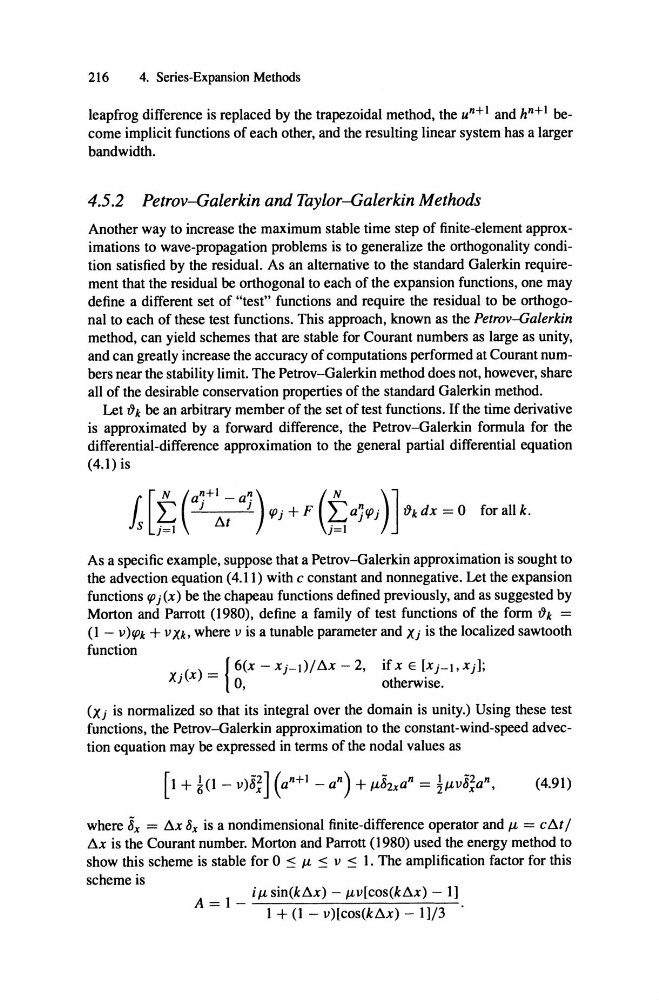
Mt a}i+F (taj.l)]u,dx 0 for all k
As a specific example, suppose that a Petrov-Galerkin approximation is sought to
the advection equation (4.11) with c constant and nonnegative. Let the expansion
functions f{J j (x) be the chapeau functions defined previously, and as suggested by
Morton and Parrott (1980), define a family of test functions of the form tJk =
(1 - V)f{Jk + VXk, where v is a tunable parameter and Xj is the localized sawtooth
function
Xj(X) = { 6(x - x j-»/ Sx - 2,
0,
ifx E [Xj_I ,Xj];
otherwise.
show this scheme is stable for 0
scheme is
(Xj is normalized so that its integralover the domain is unity.) Using these test
functions, the Petrov-Galerkin approximation to the constant-wind-speed advection equation may be expressed in terms of the nodal values as
(4.91)
where 8 x = ßx fix is a nondimensional finite-difference operator and J-L = eßt /
ßx is the Courant number. Morton and Parrott (1980) used the energy method to
J-L
v
1. The amplification factor for this
A = I -
iJ-Lsin(kßx) - J-Lv[cos(kßx) - I] .
1+(1 - v)[cos(kßx) - 1]/3
4. Series-Expansion Methods
leapfrog difference is replaced by the trapezoidal method, the u n +land h n +I become implicit functions of each other, and the resulting linear system has a larger
bandwidth.
4.5.2 Petrov-Galerkin and Taylor-Galerkin Methods
Another way to increase the maximum stable time step of finite-elernent approximations to wave-propagation problems is to generalize the orthogonality condition satisfied by the residual. As an alternative to the standard Galerkin requirement that the residual be orthogonal to each of the expansion functions, one may
define a different set of "test" functions and require the residual to be orthogonal to each of these test functions. This approach, known as the Petrov-Galerkin
method, can yield schemes that are stable for Courant numbers as large as unity,
and can greatly increase the accuracy of computations performed at Courant numbers near the stability limit. The Petrov-Galerkin method does not, however, share
all of the desirable conservation properties of the standard Galerkin method.
Let tJk be an arbitrary member of the set of test functions. If the time derivative
is approximated by a forward difference, the Petrov-Galerkin formula for the
differential-difference approximation to the general partial differential equation
(4.1) is
Mt a}i+F (taj.l)]u,dx 0 for all k
As a specific example, suppose that a Petrov-Galerkin approximation is sought to
the advection equation (4.11) with c constant and nonnegative. Let the expansion
functions f{J j (x) be the chapeau functions defined previously, and as suggested by
Morton and Parrott (1980), define a family of test functions of the form tJk =
(1 - V)f{Jk + VXk, where v is a tunable parameter and Xj is the localized sawtooth
function
Xj(X) = { 6(x - x j-»/ Sx - 2,
0,
ifx E [Xj_I ,Xj];
otherwise.
show this scheme is stable for 0
scheme is
(Xj is normalized so that its integralover the domain is unity.) Using these test
functions, the Petrov-Galerkin approximation to the constant-wind-speed advection equation may be expressed in terms of the nodal values as
(4.91)
where 8 x = ßx fix is a nondimensional finite-difference operator and J-L = eßt /
ßx is the Courant number. Morton and Parrott (1980) used the energy method to
J-L
v
1. The amplification factor for this
A = I -
iJ-Lsin(kßx) - J-Lv[cos(kßx) - I] .
1+(1 - v)[cos(kßx) - 1]/3