

212
4. Series-Expansion Methods
Tbe numerator in the preceding integrand is an ordinary binary product, and as
argued in connection with (4.65), it must be a polynomial of sufficiently low order that it can be integrated exactly by Gaussian quadrature over the same nodes
used for the other transforms . Since both U and V have zeros at Il = ± I, the
polynomial in the numerator has roots at Il = ± land must be exactly divisible
by (l -1l
2 ) . As a consequence the entire integrand in (4.85) is a polynomial that
can be integrated without error using Gaussian quadrature.
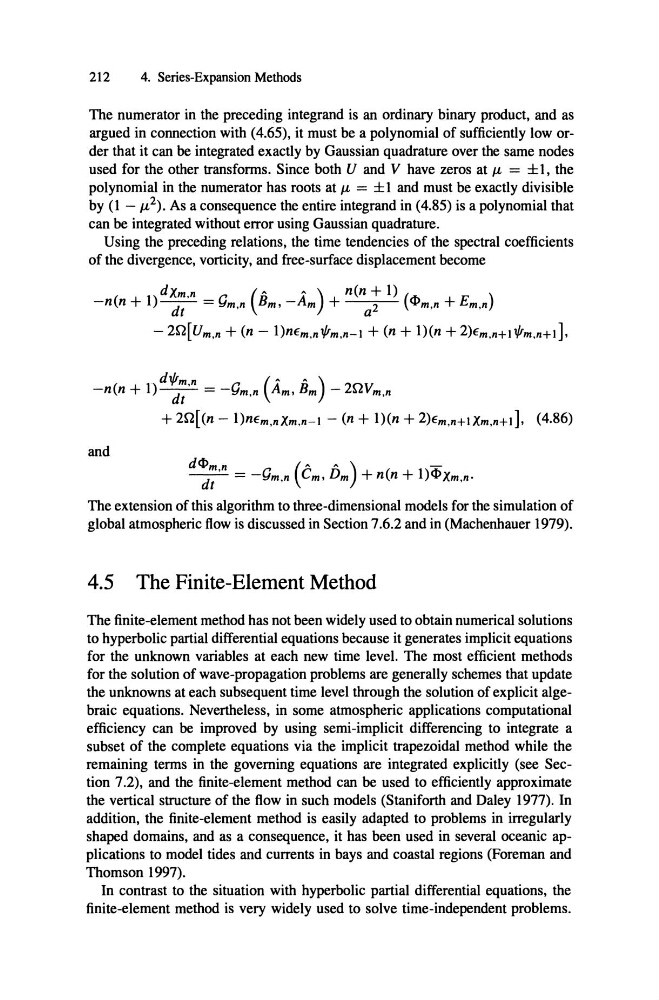
Using the preceding relations, the time tendencies of the spectral coefficients
of the divergence, vorticity, and free-surface displacement become
n(n+I)(
-n(n + I)d(" = gm,n Bm, -Am +
dXm.n
m,n + Em,n
)
a 2
- 2Q[Um,n + (n - l)nE m,n1f!m,n-l + (n + I)(n + 2)Em,n+l1f!m,n+I],
-n(n + 1 ) - - = -gm n Am, B m - 2QV m n
d1f!m ,n
( A A )
dt
'
.
+ 2Q[(n - l)nEm,nXm,n-1 - (n + IHn + 2)Em,n+lXm,n+I], (4.86)
and
dm .n
- - = -gm n Cm, Dm + n(n + 1)Xm n·
( A A)
-
dt
'
,
Tbe extension of this algorithm to three-dimensional models for the simulation of
global atmospheric flow is discussed in Section 7.6.2 and in (Machenhauer 1979).
4.5 The Finite-Element Method
Tbe finite-element method has not been widely used to obtain numerical solutions
to hyperbolic partial differential equations because it generates implicit equations
for the unknown variables at each new time level. Tbe most efficient methods
for the solution of wave-propagation problems are generally schemes that update
the unknowns at each subsequent time level through the solution of explicit algebraic equations . Nevertheless , in some atmospheric applications computational
efficiency can be improved by using semi-implicit differencing to integrate a
subset of the complete equations via the implicit trapezoidal method while the
remaining terms in the goveming equations are integrated explicitly (see Section 7.2), and the finite-element method can be used to efficiently approximate
the vertical structure of the flow in such models (Staniforth and Daley 1977). In
addition, the finite-element method is easily adapted to problems in irregularly
shaped domains, and as a consequence, it has been used in several oceanic applications to model tides and currents in bays and coastal regions (Foreman and
Tbomson 1997).
In contrast to the situation with hyperbolic partial differential equations, the
finite-element method is very widely used to solve time-independent problems.
4. Series-Expansion Methods
Tbe numerator in the preceding integrand is an ordinary binary product, and as
argued in connection with (4.65), it must be a polynomial of sufficiently low order that it can be integrated exactly by Gaussian quadrature over the same nodes
used for the other transforms . Since both U and V have zeros at Il = ± I, the
polynomial in the numerator has roots at Il = ± land must be exactly divisible
by (l -1l
2 ) . As a consequence the entire integrand in (4.85) is a polynomial that
can be integrated without error using Gaussian quadrature.
Using the preceding relations, the time tendencies of the spectral coefficients
of the divergence, vorticity, and free-surface displacement become
n(n+I)(
-n(n + I)d(" = gm,n Bm, -Am +
dXm.n
)
a 2
- 2Q[Um,n + (n - l)nE m,n1f!m,n-l + (n + I)(n + 2)Em,n+l1f!m,n+I],
-n(n + 1 ) - - = -gm n Am, B m - 2QV m n
d1f!m ,n
( A A )
dt
'
.
+ 2Q[(n - l)nEm,nXm,n-1 - (n + IHn + 2)Em,n+lXm,n+I], (4.86)
and
d
- - = -gm n Cm, Dm + n(n + 1)Xm n·
( A A)
-
dt
'
,
Tbe extension of this algorithm to three-dimensional models for the simulation of
global atmospheric flow is discussed in Section 7.6.2 and in (Machenhauer 1979).
4.5 The Finite-Element Method
Tbe finite-element method has not been widely used to obtain numerical solutions
to hyperbolic partial differential equations because it generates implicit equations
for the unknown variables at each new time level. Tbe most efficient methods
for the solution of wave-propagation problems are generally schemes that update
the unknowns at each subsequent time level through the solution of explicit algebraic equations . Nevertheless , in some atmospheric applications computational
efficiency can be improved by using semi-implicit differencing to integrate a
subset of the complete equations via the implicit trapezoidal method while the
remaining terms in the goveming equations are integrated explicitly (see Section 7.2), and the finite-element method can be used to efficiently approximate
the vertical structure of the flow in such models (Staniforth and Daley 1977). In
addition, the finite-element method is easily adapted to problems in irregularly
shaped domains, and as a consequence, it has been used in several oceanic applications to model tides and currents in bays and coastal regions (Foreman and
Tbomson 1997).
In contrast to the situation with hyperbolic partial differential equations, the
finite-element method is very widely used to solve time-independent problems.