

4.4 Spherical Hannonics
211
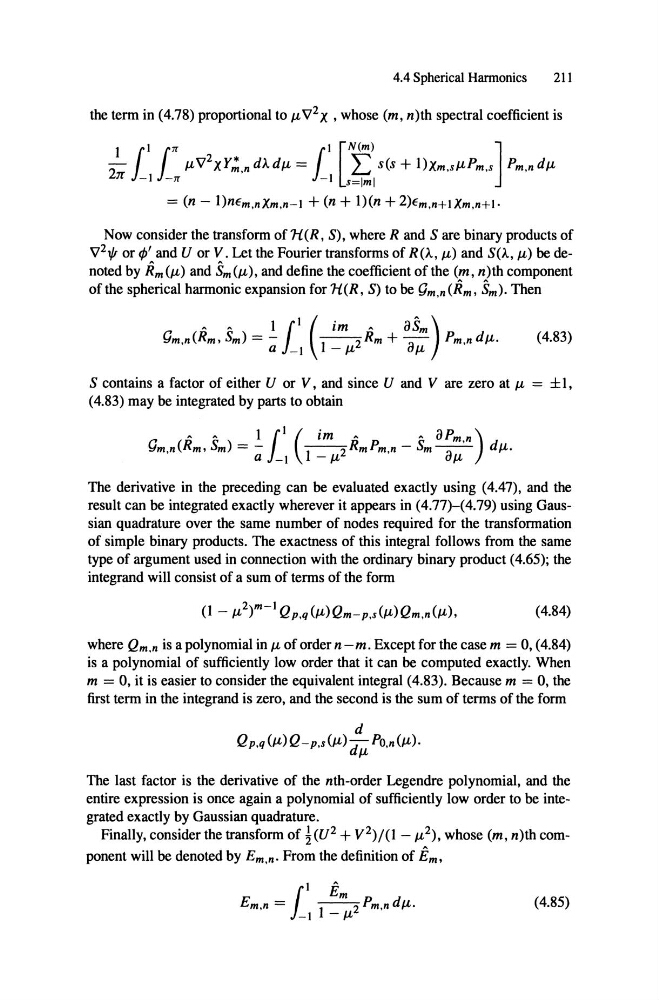
the term in (4.78) proportional to J-LV 2X , whose (m, n)th speetral eoeffieient is
- I
i
1
1
27r -I - Jr
d>"dJ-L =
[N L
1
1
]
s(s + I)Xm ,sJ-LPm,s Pm,n dJ-L
- I s= lml
= (n - l)nEm,nXm,n-1 + (n + l)(n + 2)Em,n+IXm,n+l.
Now eonsider the trans form of 1l(R, S) , where R and S are binary produets of
V
2
1/1 or,p' and U or Y. Let the Fourier transforms of R(>.. , J-L) and S(>", J-L) be denoted by R m (J-L) and Sm(J-L), and define the eoefficient of the (m, n)th eomponent
ofthe spherieal harmonie expansion forli(R , S) to be Ym,n(R m, Sm). Then
(4.83)
S eontains a faetor of either U or Y, and sinee U and Y are zero at J-L = ± I,
(4.83) may be integrated by parts to obtain
The derivative in the preeeding ean be evaluated exaetly using (4.47) , and the
result ean be integrated exaetly wherever it appears in (4.77)-(4.79) using Gaussian quadrature over the same number of nodes required for the transformation
of simple binary produets. The exaetness of this integral follows from the same
type of argument used in eonneetion with the ordinary binary produet (4.65); the
integrand will eonsist of a sum of terms of the form
(4.84)
where Qm,n is a polynomial in J-L of order n - m. Exeept for the ease m = 0, (4.84)
is a polynomial of sufficiently low order that it ean be eomputed exaetly. When
m = 0, it is easier to eonsider the equivalent integral (4.83) . Beeause m = 0, the
first term in the integrand is zero, and the seeond is the sum of terms of the form
(4.85)
ponent will be denoted by Em,n. From the definition of s.;
Em,n =
1
1
- - 2 r.: dJ-L .
s;
-II-J-L
The last faetor is the derivative of the nth -order Legendre polynomial, and the
entire expression is onee again a polynomial of sufficiently low order to be integrated exaetly by Gaussian quadrature.
Finally, eonsider the transform of t(U2 + y 2 ) / (l - J-L2), whose (m , n)th eom-
211
the term in (4.78) proportional to J-LV 2X , whose (m, n)th speetral eoeffieient is
- I
i
1
1
27r -I - Jr
d>"dJ-L =
[N
1
1
]
s(s + I)Xm ,sJ-LPm,s Pm,n dJ-L
- I s= lml
= (n - l)nEm,nXm,n-1 + (n + l)(n + 2)Em,n+IXm,n+l.
Now eonsider the trans form of 1l(R, S) , where R and S are binary produets of
V
2
1/1 or,p' and U or Y. Let the Fourier transforms of R(>.. , J-L) and S(>", J-L) be denoted by R m (J-L) and Sm(J-L), and define the eoefficient of the (m, n)th eomponent
ofthe spherieal harmonie expansion forli(R , S) to be Ym,n(R m, Sm). Then
(4.83)
S eontains a faetor of either U or Y, and sinee U and Y are zero at J-L = ± I,
(4.83) may be integrated by parts to obtain
The derivative in the preeeding ean be evaluated exaetly using (4.47) , and the
result ean be integrated exaetly wherever it appears in (4.77)-(4.79) using Gaussian quadrature over the same number of nodes required for the transformation
of simple binary produets. The exaetness of this integral follows from the same
type of argument used in eonneetion with the ordinary binary produet (4.65); the
integrand will eonsist of a sum of terms of the form
(4.84)
where Qm,n is a polynomial in J-L of order n - m. Exeept for the ease m = 0, (4.84)
is a polynomial of sufficiently low order that it ean be eomputed exaetly. When
m = 0, it is easier to eonsider the equivalent integral (4.83) . Beeause m = 0, the
first term in the integrand is zero, and the seeond is the sum of terms of the form
(4.85)
ponent will be denoted by Em,n. From the definition of s.;
Em,n =
1
1
- - 2 r.: dJ-L .
s;
-II-J-L
The last faetor is the derivative of the nth -order Legendre polynomial, and the
entire expression is onee again a polynomial of sufficiently low order to be integrated exaetly by Gaussian quadrature.
Finally, eonsider the transform of t(U2 + y 2 ) / (l - J-L2), whose (m , n)th eom-