

210
4. Series-Expansion Methods
expansion coefficients for U ja and V ja; then
U m . n = 2rr 1 1 _I
1
1 -
1f
1f
(Ö
X
öl -(I-/L 2 )Ö/L öt/J) Ym * ,ndld/L
= im Xm,n + (n - l)Em,nt/Jm,n-1 - (n + 2)E m,n+1 t/Jm ,n+l,
where the second equality follows from (4.47) and the orthogonality of the spherical harmonics. Similarly,
Vm ,n = imt/Jm,n - (n - l)Em,nXm,n-1 + (n + 2)E m,n+IXm,n+l.
Note that nonzero values of t/Jm,n and Xm ,n imply nonzero values of Um,n+1 and
Vm ,n+l, so the expansions for U and V must be truncated at one higher degree
than those for t/J and X, i.e.,
M
N(m)+1
U(Ä, /L) = aLL Um,nYm ,nO.. , /L),
m=-M n=lml
M
N(m)+1
V(Ä , /L) = aLL Vm,nYm ,n(Ä, /L) .
m=-M n=lml
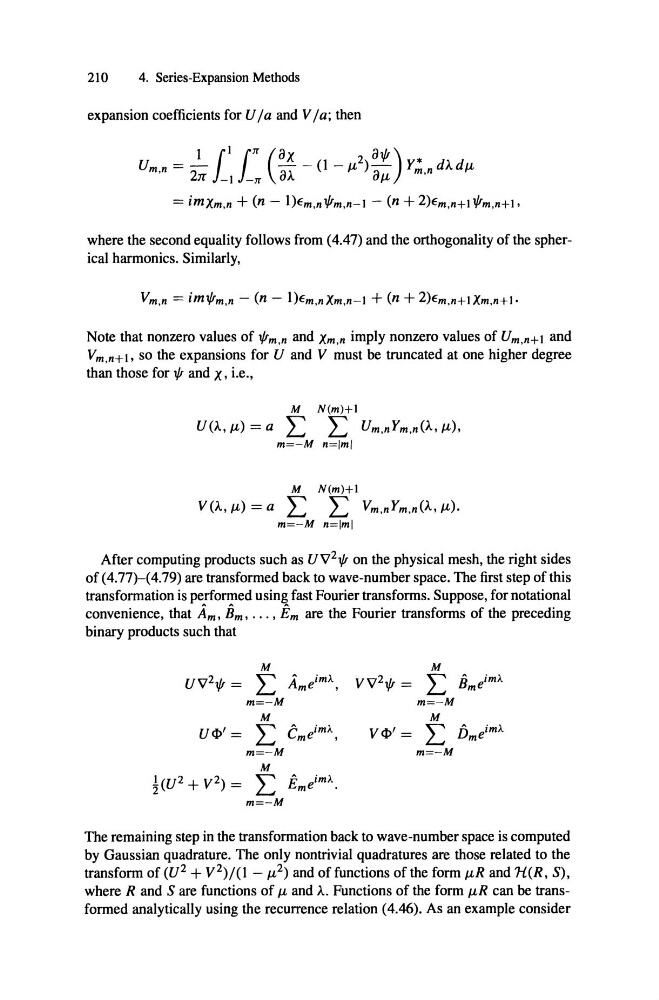
After computing products such as UV 2t/J on the physical mesh, the right sides
of (4.77)-(4.79) are transformed back to wave-number space. The first step of this
transformation is performed using fast Fourier transforms. Suppose, for notational
convenience, that Am, B m , . . . , E m are the Fourier transforms of the preceding
binary products such that
UV2t/J = L Ame imA,
m=-M
M
UcP' = L Cme imA ,
m=-M
+ V 2) = L Eme
imA
.
m=-M
M
M
VV2t/J = L Bme imA
m=-M
VcP' = L Dme
imA
m=-M
M
M
The remaining step in the transformation back to wave-nurnber space is computed
by Gaussian quadrature. The only nontrivial quadratures are those related to the
transform of (U 2 + V 2 ) j ( 1 - /L2) and of functions of the form /LR and 1t(R, S),
where Rand S are functions of /L and Ä. Functions of the form /LR can be transformed analytically using the recurrence relation (4.46) . As an example consider
4. Series-Expansion Methods
expansion coefficients for U ja and V ja; then
U m . n = 2rr 1 1 _I
1
1 -
1f
1f
(Ö
X
öl -(I-/L 2 )Ö/L öt/J) Ym * ,ndld/L
= im Xm,n + (n - l)Em,nt/Jm,n-1 - (n + 2)E m,n+1 t/Jm ,n+l,
where the second equality follows from (4.47) and the orthogonality of the spherical harmonics. Similarly,
Vm ,n = imt/Jm,n - (n - l)Em,nXm,n-1 + (n + 2)E m,n+IXm,n+l.
Note that nonzero values of t/Jm,n and Xm ,n imply nonzero values of Um,n+1 and
Vm ,n+l, so the expansions for U and V must be truncated at one higher degree
than those for t/J and X, i.e.,
M
N(m)+1
U(Ä, /L) = aLL Um,nYm ,nO.. , /L),
m=-M n=lml
M
N(m)+1
V(Ä , /L) = aLL Vm,nYm ,n(Ä, /L) .
m=-M n=lml
After computing products such as UV 2t/J on the physical mesh, the right sides
of (4.77)-(4.79) are transformed back to wave-number space. The first step of this
transformation is performed using fast Fourier transforms. Suppose, for notational
convenience, that Am, B m , . . . , E m are the Fourier transforms of the preceding
binary products such that
UV2t/J = L Ame imA,
m=-M
M
UcP' = L Cme imA ,
m=-M
+ V 2) = L Eme
imA
.
m=-M
M
M
VV2t/J = L Bme imA
m=-M
VcP' = L Dme
imA
m=-M
M
M
The remaining step in the transformation back to wave-nurnber space is computed
by Gaussian quadrature. The only nontrivial quadratures are those related to the
transform of (U 2 + V 2 ) j ( 1 - /L2) and of functions of the form /LR and 1t(R, S),
where Rand S are functions of /L and Ä. Functions of the form /LR can be transformed analytically using the recurrence relation (4.46) . As an example consider