

200
4. Series-Expansion Methods
not seem to be a clear consensus about which truncation is most suitable for use
in low-resolution atmospheric models. The triangular truncation is, however, the
universal choiee in high-resolution global weather forecasting.
4.4.2 Elimination ofthe Pole Problem
Explicit finite-difference approximations to the equations governing fluid motion
on a sphere can require very small time steps to maintain stability ifthe grid points
are distributed over the sphere on a uniform latitude-longitude mesh. This timestep restriction arises because the convergence of the meridians near the poles
greatly reduces the physieal distance between adjacent nodes on the same latitude
circle, and as a consequence, the CFL condition is far more restrictive near the
poles than in the tropies. Several approaches have been used to circumvent this
problem (Williamson 1979), but they all have at least one cumbersome aspect.
One of the most elegant solutions 10 the pole problem is obtained using spherical
harmonie expansion functions in a spectral or pseudospectral approximation.f
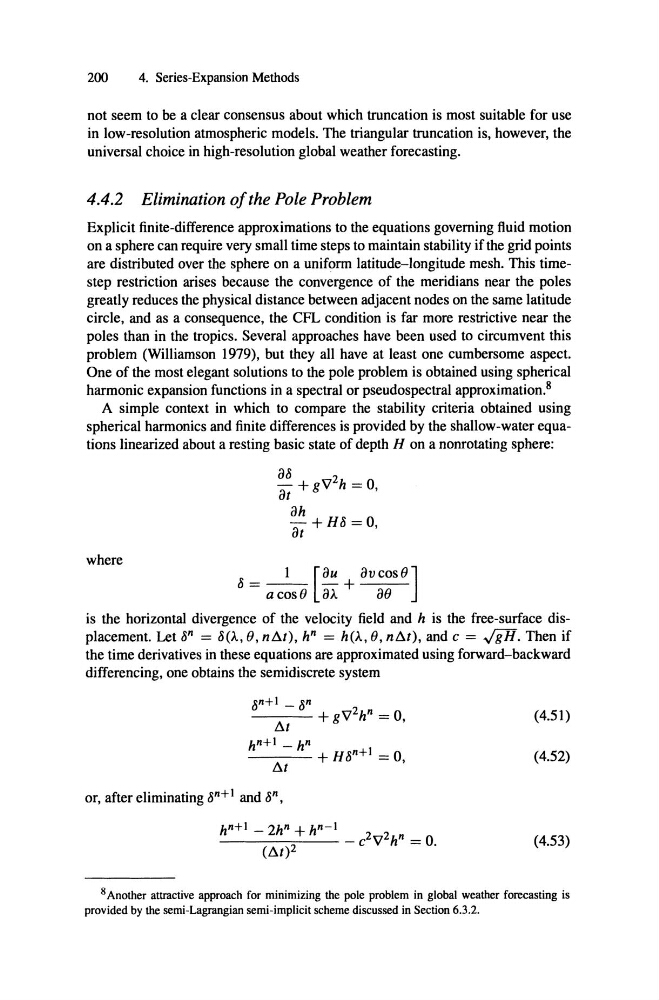
A simple context in which to compare the stability criteria obtained using
spherical harmonies and finite differences is provided by the shallow-water equations linearized about a resting basic state of depth H on a nonrotating sphere:
B8
2
- +gV h =0,
BI
Bh
-
Bt
+H8 =0,
where
8 = _1_ [BU + BVCOS()]
a cos () BA
B()
is the horizontal divergence of the velocity field and h is the free-surface displacement. Let 8 n = 8(A, (), n St'), h" = h(A , (), n!:1I), and c = JgH. Then if
the time derivatives in these equations are approximated using forward-backward
differencing, one obtains the semidiscrete system
(4.51)
(4.52)
or, after eliminating 8 n +I and 8 n ,
(4.53)
8 Another attractive approach for minimizing the pole problem in global weather forecasting is
provided by the semi-Lagrangian semi-implicit scheme discussed in Section 6.3.2.
4. Series-Expansion Methods
not seem to be a clear consensus about which truncation is most suitable for use
in low-resolution atmospheric models. The triangular truncation is, however, the
universal choiee in high-resolution global weather forecasting.
4.4.2 Elimination ofthe Pole Problem
Explicit finite-difference approximations to the equations governing fluid motion
on a sphere can require very small time steps to maintain stability ifthe grid points
are distributed over the sphere on a uniform latitude-longitude mesh. This timestep restriction arises because the convergence of the meridians near the poles
greatly reduces the physieal distance between adjacent nodes on the same latitude
circle, and as a consequence, the CFL condition is far more restrictive near the
poles than in the tropies. Several approaches have been used to circumvent this
problem (Williamson 1979), but they all have at least one cumbersome aspect.
One of the most elegant solutions 10 the pole problem is obtained using spherical
harmonie expansion functions in a spectral or pseudospectral approximation.f
A simple context in which to compare the stability criteria obtained using
spherical harmonies and finite differences is provided by the shallow-water equations linearized about a resting basic state of depth H on a nonrotating sphere:
B8
2
- +gV h =0,
BI
Bh
-
Bt
+H8 =0,
where
8 = _1_ [BU + BVCOS()]
a cos () BA
B()
is the horizontal divergence of the velocity field and h is the free-surface displacement. Let 8 n = 8(A, (), n St'), h" = h(A , (), n!:1I), and c = JgH. Then if
the time derivatives in these equations are approximated using forward-backward
differencing, one obtains the semidiscrete system
(4.51)
(4.52)
or, after eliminating 8 n +I and 8 n ,
(4.53)
8 Another attractive approach for minimizing the pole problem in global weather forecasting is
provided by the semi-Lagrangian semi-implicit scheme discussed in Section 6.3.2.