

TRIANGULAR
.'
- 7....
- -
-
11
M+-o
"--------+--- m
M
M
I < : : - - - - - t - - - -_
M
11I
11
.....
....
.... .'
.'
4.4 Spherical Hannonics
RIIOMIlOIDAL
199
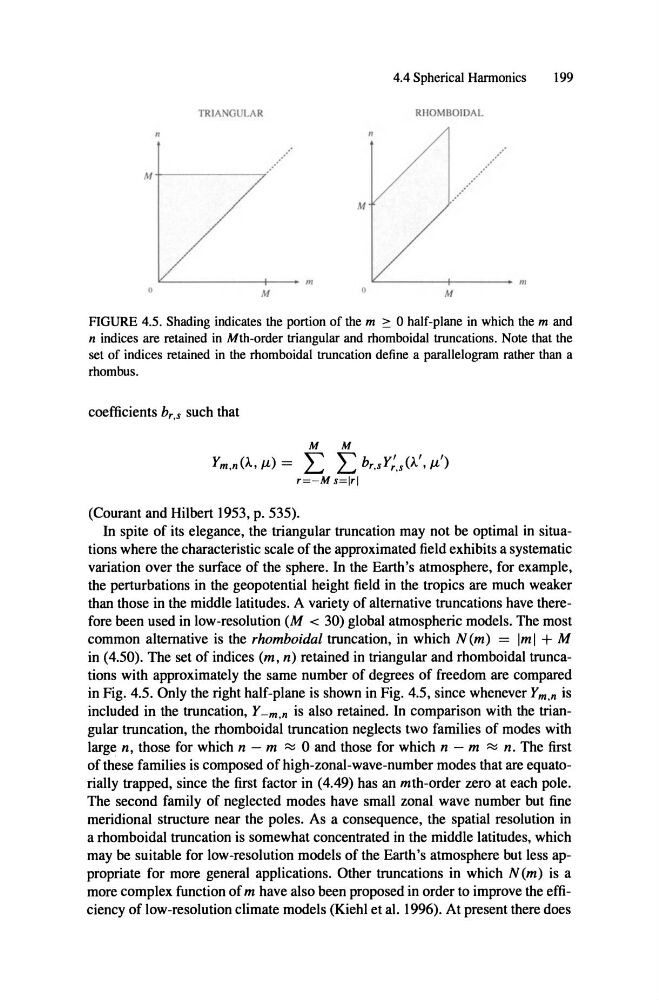
FIGURE 4.5. Shading indicates the portion of the m
0 half-plane in which the m and
n indices are retained in Mth-order triangular and rhomboidal truncations. Note that the
set of indices retained in the rhomboidal truncation define a parallelogram rather than a
rhombus.
coefficients br,s such that
M
M
Ym,n()., J-L) = L L br,sY:,s().', J-L')
r=-M s=lrl
(Courant and Hilbert 1953, p. 535) .
In spite of its elegance, the triangular truncation may not be optimal in situations where the characteristic scale of the approximated field exhibits a systematic
variation over the surface of the sphere. In the Earth's atmosphere, for example,
the perturbations in the geopotential height field in the tropics are much weaker
than those in the middle latitudes. A variety of alternative truncations have therefore been used in low-resolution (M < 30) global atmospheric models. The most
common alternative is the rhomboidal truncation, in which N (m) = ImI + M
in (4.50). The set of indices (m, n) retained in triangular and rhomboidal truncations with approximately the same number of degrees of freedom are compared
in Fig. 4.5. Only the right half-plane is shown in Fig. 4.5, since whenever Ym,n is
included in the truncation, Y-sm.n is also retained. In comparison with the triangular truncation, the rhomboidal truncation neglects two families of modes with
large n, those for which n - m
0 and those for which n - m
n. The first
of these families is composed of high-zonal-wave-nurnber modes that are equatorially trapped, since the first factor in (4.49) has an mth-order zero at each pole.
The second family of neglected modes have small zonal wave number but fine
meridional structure near the poles. As a consequence, the spatial resolution in
a rhomboidal truncation is somewhat concentrated in the middle latitudes, which
may be suitable for low-resolution models of the Earth's atmosphere but less appropriate for more general applications. Other truncations in which N (m) is a
more complex function of m have also been proposed in order to improve the efficiency of low-resolution climate models (Kiehl et al. 1996). At present there does
.'
- 7....
- -
-
11
M+-o
"--------+--- m
M
M
I < : : - - - - - t - - - -_
M
11I
11
.....
....
.... .'
.'
4.4 Spherical Hannonics
RIIOMIlOIDAL
199
FIGURE 4.5. Shading indicates the portion of the m
0 half-plane in which the m and
n indices are retained in Mth-order triangular and rhomboidal truncations. Note that the
set of indices retained in the rhomboidal truncation define a parallelogram rather than a
rhombus.
coefficients br,s such that
M
M
Ym,n()., J-L) = L L br,sY:,s().', J-L')
r=-M s=lrl
(Courant and Hilbert 1953, p. 535) .
In spite of its elegance, the triangular truncation may not be optimal in situations where the characteristic scale of the approximated field exhibits a systematic
variation over the surface of the sphere. In the Earth's atmosphere, for example,
the perturbations in the geopotential height field in the tropics are much weaker
than those in the middle latitudes. A variety of alternative truncations have therefore been used in low-resolution (M < 30) global atmospheric models. The most
common alternative is the rhomboidal truncation, in which N (m) = ImI + M
in (4.50). The set of indices (m, n) retained in triangular and rhomboidal truncations with approximately the same number of degrees of freedom are compared
in Fig. 4.5. Only the right half-plane is shown in Fig. 4.5, since whenever Ym,n is
included in the truncation, Y-sm.n is also retained. In comparison with the triangular truncation, the rhomboidal truncation neglects two families of modes with
large n, those for which n - m
0 and those for which n - m
n. The first
of these families is composed of high-zonal-wave-nurnber modes that are equatorially trapped, since the first factor in (4.49) has an mth-order zero at each pole.
The second family of neglected modes have small zonal wave number but fine
meridional structure near the poles. As a consequence, the spatial resolution in
a rhomboidal truncation is somewhat concentrated in the middle latitudes, which
may be suitable for low-resolution models of the Earth's atmosphere but less appropriate for more general applications. Other truncations in which N (m) is a
more complex function of m have also been proposed in order to improve the efficiency of low-resolution climate models (Kiehl et al. 1996). At present there does