

198
4. Series-Expansion Methods
n
PO.n
PI•n
P2,n
P3.n
3
ff( 51
.m
13 - 3Jl)
2
fs(3Jl 2 -I)
(5Jl2
T Jl I _Jl2
3)
(Jl-Jl
(I-Jl
2)
N/A
0
IrI'
I/.Ji
N/A
N/A
N/A
N/A
N/A
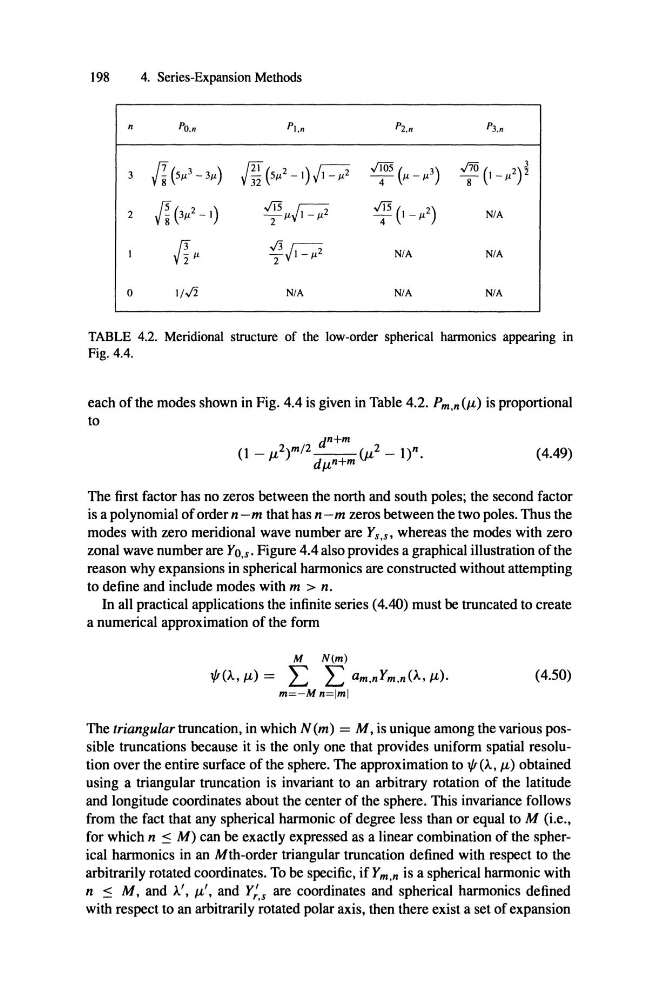
TABLE 4.2. Meridional structure of the low-order spherical hannonics appearing in
Fig.4.4.
each of the modes shown in Fig. 4.4 is given in Table 4.2 . Pm,n (J-L) is proportional
to
(4.49)
The first factor has no zeros between the north and south poles; the second factor
is a polynomial of order n-m that has n-m zeros between the two poles. Thus the
modes with zero meridional wave number are Y s • s , whereas the modes with zero
zonal wave number are YO. s • Figure 4.4 also provides a graphical illustration ofthe
reason why expansions in spherical harmonics are constructed without attempting
to define and include modes with m > n ,
In all practical applications the infinite series (4.40) must be truncated to create
a numerical approximation of the form
M N(m)
.."(),,, J-L) = L L am,nYm ,n()", J-L) .
m=-Mn=lml
(4.50)
The triangular truncation, in which N (m) = M, is unique among the various pos -
sible truncations because it is the only one that provides uniform spatial resolution over the entire surface ofthe sphere. The approximation to .."(),, , J-L) obtained
using a triangular truncation is invariant to an arbitrary rotation of the latitude
and longitude coordinates about the center of the sphere. This invariance follows
from the fact that any spherical harmonic of degree less than or equal to M (i.e.,
for which n .::: M) can be exactly expressed as a linear combination of the spherical harmonics in an Mth-order triangular truncation defined with respect to the
arbitrarily rotated coordinates. To be specific, if Ym,n is a spherical harmonic with
n .::: M, and ),,', J-L' , and Y:,s are coordinates and spherical harmonics defined
with respect to an arbitrarily rotated polar axis, then there exist a set of expansion
4. Series-Expansion Methods
n
PO.n
PI•n
P2,n
P3.n
3
ff( 51
.m
13 - 3Jl)
2
fs(3Jl 2 -I)
(5Jl2
T Jl I _Jl2
3)
(Jl-Jl
(I-Jl
2)
N/A
0
IrI'
I/.Ji
N/A
N/A
N/A
N/A
N/A
TABLE 4.2. Meridional structure of the low-order spherical hannonics appearing in
Fig.4.4.
each of the modes shown in Fig. 4.4 is given in Table 4.2 . Pm,n (J-L) is proportional
to
(4.49)
The first factor has no zeros between the north and south poles; the second factor
is a polynomial of order n-m that has n-m zeros between the two poles. Thus the
modes with zero meridional wave number are Y s • s , whereas the modes with zero
zonal wave number are YO. s • Figure 4.4 also provides a graphical illustration ofthe
reason why expansions in spherical harmonics are constructed without attempting
to define and include modes with m > n ,
In all practical applications the infinite series (4.40) must be truncated to create
a numerical approximation of the form
M N(m)
.."(),,, J-L) = L L am,nYm ,n()", J-L) .
m=-Mn=lml
(4.50)
The triangular truncation, in which N (m) = M, is unique among the various pos -
sible truncations because it is the only one that provides uniform spatial resolution over the entire surface ofthe sphere. The approximation to .."(),, , J-L) obtained
using a triangular truncation is invariant to an arbitrary rotation of the latitude
and longitude coordinates about the center of the sphere. This invariance follows
from the fact that any spherical harmonic of degree less than or equal to M (i.e.,
for which n .::: M) can be exactly expressed as a linear combination of the spherical harmonics in an Mth-order triangular truncation defined with respect to the
arbitrarily rotated coordinates. To be specific, if Ym,n is a spherical harmonic with
n .::: M, and ),,', J-L' , and Y:,s are coordinates and spherical harmonics defined
with respect to an arbitrarily rotated polar axis, then there exist a set of expansion