

4.4 Spherical Harrnonics
201
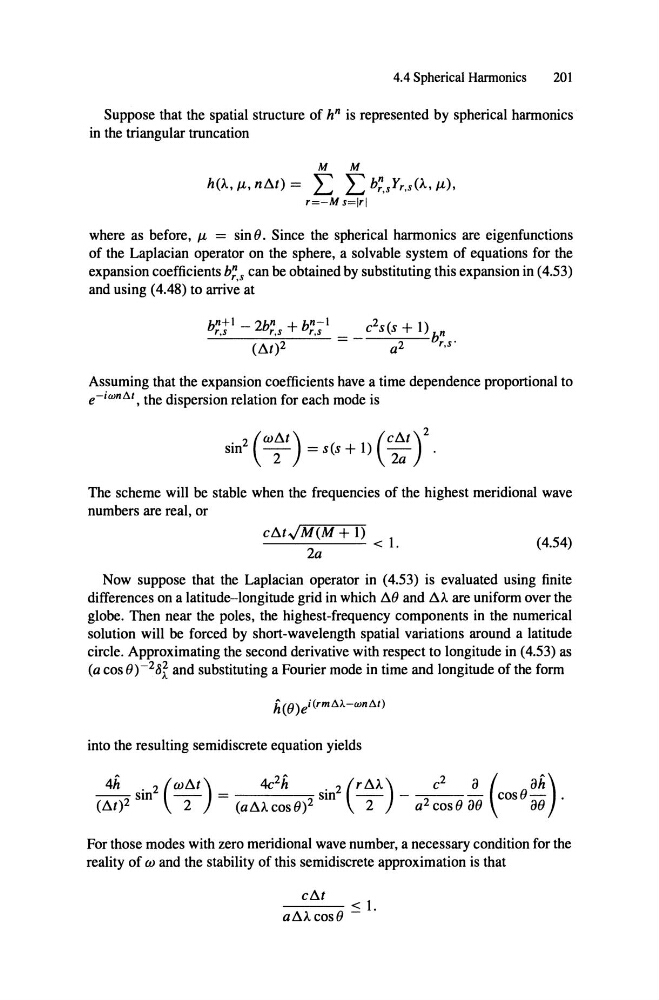
Suppose that the spatial structure of h" is represented by spherical harmonics
in the triangular truncation
jl),
r=-M s=lrl
where as before, jl = sin (). Since the spherical harmonics are eigenfunctions
of the Laplacian operator on the sphere, a solvable system of equations for the
expansion coefficients
can be obtained by substituting this expansion in (4.53)
and using (4.48) to arrive at
M
M
no; u, nLit) = L L
Assuming that the expansion coefficients have a time dependence proportional to
e- iwnl'>/, the dispersion relation for each mode is
sm . 2 (WLit) -2- = ses + I) (CLit)2 2a
The scheme will be stable when the frequencies of the highest meridional wave
numbers are real, or
cLitJM(M + I)
-----'-----<1.
2a
(4.54)
Now suppose that the Laplacian operator in (4.53) is evaluated using finite
differences on a latitude-longitude grid in which Li() and Li'A are uniform over the
globe. Then near the poles, the highest-frequency components in the numerical
solution will be forced by short-wavelength spatial variations around a latitude
circle. Approximating the second derivative with respect to longitude in (4.53) as
(a cos
and substituting a Fourier mode in time and longitude of the form
h«())ei(rml'>)..-wnM)
into the resulting semidiscrete equation yields
- - sm
4h . 2 (WLit) - -
(Lit)2
-
4c
2
h sm . 2 (r - -
Li'A) -
2
e
- a ( cos () - ah)
2
- (aLi'A cos ())2
a 2 cos () (J()
a() '
For those modes with zero meridional wave number, a necessary condition for the
reality of wand the stability of this semidiscrete approximation is that
eLit
- - - - < 1.
aLi'Acos() -
2
201
Suppose that the spatial structure of h" is represented by spherical harmonics
in the triangular truncation
jl),
r=-M s=lrl
where as before, jl = sin (). Since the spherical harmonics are eigenfunctions
of the Laplacian operator on the sphere, a solvable system of equations for the
expansion coefficients
can be obtained by substituting this expansion in (4.53)
and using (4.48) to arrive at
M
M
no; u, nLit) = L L
Assuming that the expansion coefficients have a time dependence proportional to
e- iwnl'>/, the dispersion relation for each mode is
sm . 2 (WLit) -2- = ses + I) (CLit)2 2a
The scheme will be stable when the frequencies of the highest meridional wave
numbers are real, or
cLitJM(M + I)
-----'-----<1.
2a
(4.54)
Now suppose that the Laplacian operator in (4.53) is evaluated using finite
differences on a latitude-longitude grid in which Li() and Li'A are uniform over the
globe. Then near the poles, the highest-frequency components in the numerical
solution will be forced by short-wavelength spatial variations around a latitude
circle. Approximating the second derivative with respect to longitude in (4.53) as
(a cos
and substituting a Fourier mode in time and longitude of the form
h«())ei(rml'>)..-wnM)
into the resulting semidiscrete equation yields
- - sm
4h . 2 (WLit) - -
(Lit)2
-
4c
2
h sm . 2 (r - -
Li'A) -
2
e
- a ( cos () - ah)
2
- (aLi'A cos ())2
a 2 cos () (J()
a() '
For those modes with zero meridional wave number, a necessary condition for the
reality of wand the stability of this semidiscrete approximation is that
eLit
- - - - < 1.
aLi'Acos() -
2