

128
3. Beyond the One-Way WaveEquation
02t W m . n- z
J + V0 2xWm n,
!
J + ozPm n -I = (b m n_ I}Z,
, !
,
!
02tbm,n + V02xbm,n + N
2{w m,nt = 0,
oxum,n + Ozwm,n = O.
(3.44)
(3.45)
(3.46)
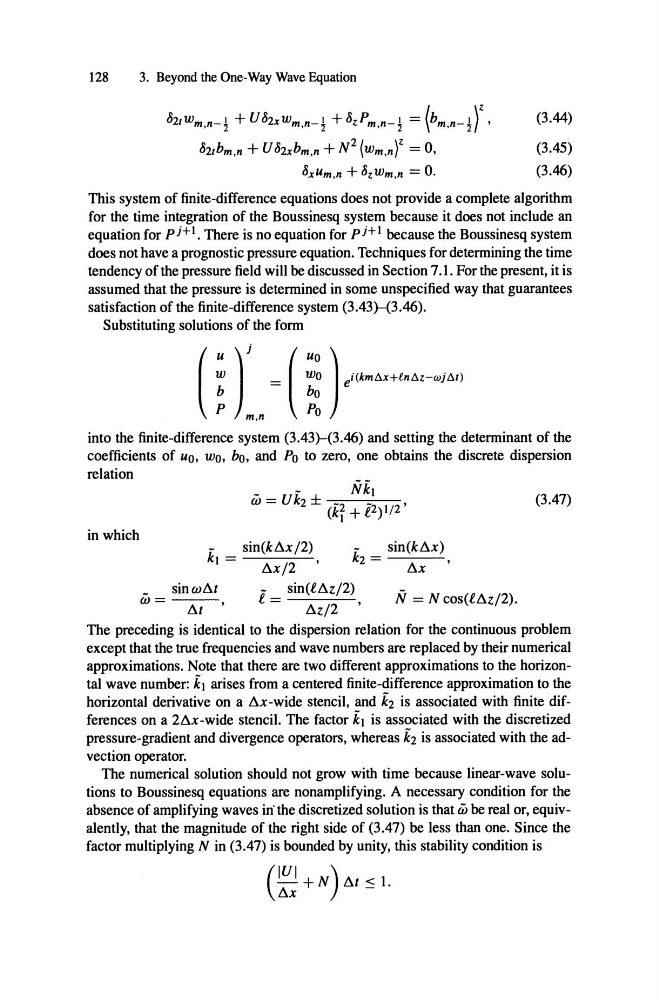
This system of finite-difference equations does not provide a complete algorithm
for the time integration of the Boussinesq system because it does not include an
equation for pHI. There is no equation for pi+ 1 because the Boussinesq system
does not have a prognostic pressure equation . Techniques for determining the time
tendency of the pressure field will be discussed in Section 7.1. For the present, it is
assumed that the pressure is determined in some unspec ified way that guarantees
satisfaction of the finite-difference system (3.43)-(3.46).
Substituting solutions of the form
_
-
Nkl
ca = V k2 ± -2 -
(k l + l2)1/2
,
(3.47)
(
)
••
(
)
into the finite-difference system (3.43)-(3.46) and setting the determinant of the
coefficients of uo, Wo , bo, and Po to zero, one obtains the discrete dispersion
relation
in which
-
kl =
sin(kßx/2)
-
, k 2 =
sin(kßx)
ßx/2
ßx
,
w = sinwßt
ßt
l = sin(lßz/2) ,
ßz/2
N = N cos(lßz/2) .
The preceding is identical to the dispersion relation for the continuous problem
except that the true frequencies and wave numbers are replaced by their numerical
approximations. Note that there are two different approximations to the horizontal wave number: kl arises from a centered finite-difference approximation to the
horizontal derivative on a ßx-wide stencil, and k2 is associated with finite differences on a 2ßx-wide stencil. The factor kl is associated with the discretized
pressure-gradient and divergence operators, whereas k2 is associated with the advection operator.
The numerical solution should not grow with time because linear-wave solutions to Boussinesq equations are nonamplifying. A necessary condition for the
absence of amplifying waves in' the discretized solution is that iiJ be real or, equivalently, that the magnitude of the right side of (3.47) be less than one. Since the
factor multiplying N in (3.47) is bounded by unity, this stability condition is
3. Beyond the One-Way WaveEquation
02t W m . n- z
J + V0 2xWm n,
!
J + ozPm n -I = (b m n_ I}Z,
, !
,
!
02tbm,n + V02xbm,n + N
2{w m,nt = 0,
oxum,n + Ozwm,n = O.
(3.44)
(3.45)
(3.46)
This system of finite-difference equations does not provide a complete algorithm
for the time integration of the Boussinesq system because it does not include an
equation for pHI. There is no equation for pi+ 1 because the Boussinesq system
does not have a prognostic pressure equation . Techniques for determining the time
tendency of the pressure field will be discussed in Section 7.1. For the present, it is
assumed that the pressure is determined in some unspec ified way that guarantees
satisfaction of the finite-difference system (3.43)-(3.46).
Substituting solutions of the form
_
-
Nkl
ca = V k2 ± -2 -
(k l + l2)1/2
,
(3.47)
(
)
••
(
)
into the finite-difference system (3.43)-(3.46) and setting the determinant of the
coefficients of uo, Wo , bo, and Po to zero, one obtains the discrete dispersion
relation
in which
-
kl =
sin(kßx/2)
-
, k 2 =
sin(kßx)
ßx/2
ßx
,
w = sinwßt
ßt
l = sin(lßz/2) ,
ßz/2
N = N cos(lßz/2) .
The preceding is identical to the dispersion relation for the continuous problem
except that the true frequencies and wave numbers are replaced by their numerical
approximations. Note that there are two different approximations to the horizontal wave number: kl arises from a centered finite-difference approximation to the
horizontal derivative on a ßx-wide stencil, and k2 is associated with finite differences on a 2ßx-wide stencil. The factor kl is associated with the discretized
pressure-gradient and divergence operators, whereas k2 is associated with the advection operator.
The numerical solution should not grow with time because linear-wave solutions to Boussinesq equations are nonamplifying. A necessary condition for the
absence of amplifying waves in' the discretized solution is that iiJ be real or, equivalently, that the magnitude of the right side of (3.47) be less than one. Since the
factor multiplying N in (3.47) is bounded by unity, this stability condition is