

(3.14)
(3.15)
114
3. Beyondthe One-WayWave Equation
system with U = 0 may be written for the staggered mesh as
OZtUj + goxh j = 0,
OZthj+! + HOxuj+! =0.
The diserete-dispersion relation for the solution to these equations is
smw!1t .
= ± - - sm
2cIlt . (k!1X) - -
(3.16)
!1x
2
,
from which it follows that (3.14) and (3.15) are stable when [cIlt / S x I <
The maximum time step available for integrations on the staggered mesh is only
one-half that whieh may be used on the unstaggered mesh . The more stringent
restrietion on the time step is, however, not entirely bad, beeause shorter time
steps are generally required by spatial differencing sehemes that more faithfully
eapture the high-frequency eomponents ofthe solution. Analysis ofthe truneation
error shows that both the staggered and the unstaggered sehemes are 0 [(!1x)Z]
and that the leading-order truneation error is smaller for the staggered scheme.
A more revealing eomparison of the aeeuraey of eaeh sehe me is provided by
examining their diserete dispersion relations in the limit of good temporal resolution (w!1t
0). Let Cu and C s denote the phase speeds of the numerieal solutions
on the unstaggered and staggered meshes, respeetively, then
Cu = - - sm
c . k !1x
k!1x
and
2c . (k!1X)
Cs = k!1x sm -2- .
Curves showing Cu and Cs are plotted as a funetion of spatial resolution in Fig. 3.2.
Also plotted in Fig. 3.2 is the phase-speed obtained when the explicit fourth-order
differenee (2.6) is used to approximate the spatial derivatives on the unstaggered
mesh . As evident in Fig . 3.2, the phase-speed error in the poorly resolved waves
is greatly redueed on the staggered mesh. In particular, the 2!1x wave propagates
at 64% of the eorreet speed on the staggered mesh but remains stationary on the
unstaggered mesh.
Substantial improvements in the group velocity of the shortest waves are also
aehieved using the staggered mesh. Assuming good temporal resolution, the group
veloe ities of the right-moving wave for the second-order sehemes on the unstaggered and staggered meshes are, respeetively,
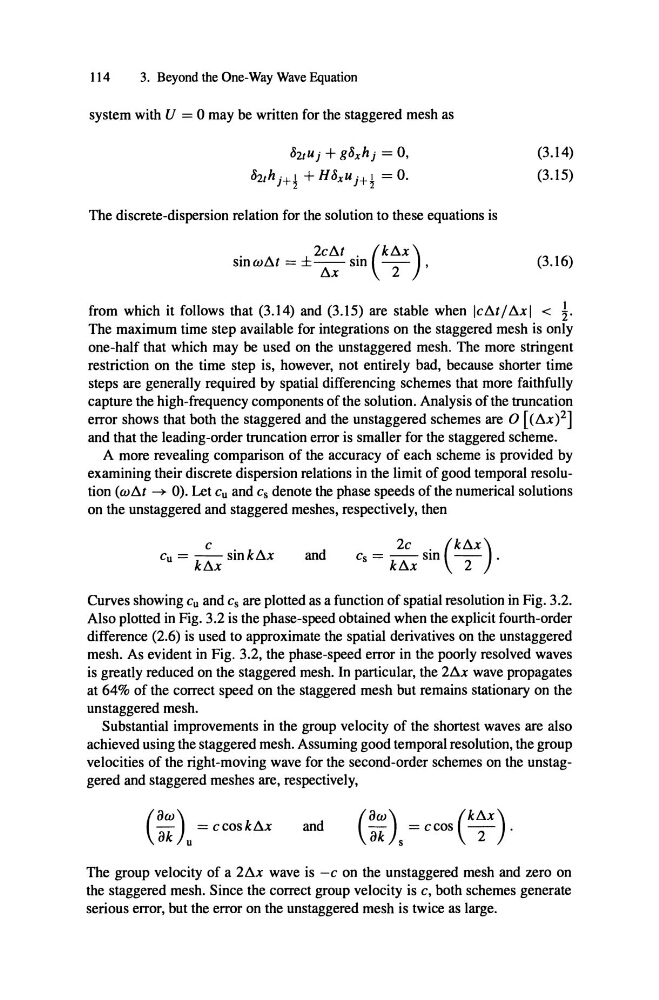
( aw ) = ceosk!1x
ak u
and
The group velocity of a 2!1x wave is -c on the unstaggered mesh and zero on
the staggered mesh. Sinee the eorreet group velocity is c, both sehemes generate
serious error, but the error on the unstaggered mesh is twice as large .
(3.15)
114
3. Beyondthe One-WayWave Equation
system with U = 0 may be written for the staggered mesh as
OZtUj + goxh j = 0,
OZthj+! + HOxuj+! =0.
The diserete-dispersion relation for the solution to these equations is
smw!1t .
= ± - - sm
2cIlt . (k!1X) - -
(3.16)
!1x
2
,
from which it follows that (3.14) and (3.15) are stable when [cIlt / S x I <
The maximum time step available for integrations on the staggered mesh is only
one-half that whieh may be used on the unstaggered mesh . The more stringent
restrietion on the time step is, however, not entirely bad, beeause shorter time
steps are generally required by spatial differencing sehemes that more faithfully
eapture the high-frequency eomponents ofthe solution. Analysis ofthe truneation
error shows that both the staggered and the unstaggered sehemes are 0 [(!1x)Z]
and that the leading-order truneation error is smaller for the staggered scheme.
A more revealing eomparison of the aeeuraey of eaeh sehe me is provided by
examining their diserete dispersion relations in the limit of good temporal resolution (w!1t
0). Let Cu and C s denote the phase speeds of the numerieal solutions
on the unstaggered and staggered meshes, respeetively, then
Cu = - - sm
c . k !1x
k!1x
and
2c . (k!1X)
Cs = k!1x sm -2- .
Curves showing Cu and Cs are plotted as a funetion of spatial resolution in Fig. 3.2.
Also plotted in Fig. 3.2 is the phase-speed obtained when the explicit fourth-order
differenee (2.6) is used to approximate the spatial derivatives on the unstaggered
mesh . As evident in Fig . 3.2, the phase-speed error in the poorly resolved waves
is greatly redueed on the staggered mesh. In particular, the 2!1x wave propagates
at 64% of the eorreet speed on the staggered mesh but remains stationary on the
unstaggered mesh.
Substantial improvements in the group velocity of the shortest waves are also
aehieved using the staggered mesh. Assuming good temporal resolution, the group
veloe ities of the right-moving wave for the second-order sehemes on the unstaggered and staggered meshes are, respeetively,
( aw ) = ceosk!1x
ak u
and
The group velocity of a 2!1x wave is -c on the unstaggered mesh and zero on
the staggered mesh. Sinee the eorreet group velocity is c, both sehemes generate
serious error, but the error on the unstaggered mesh is twice as large .