

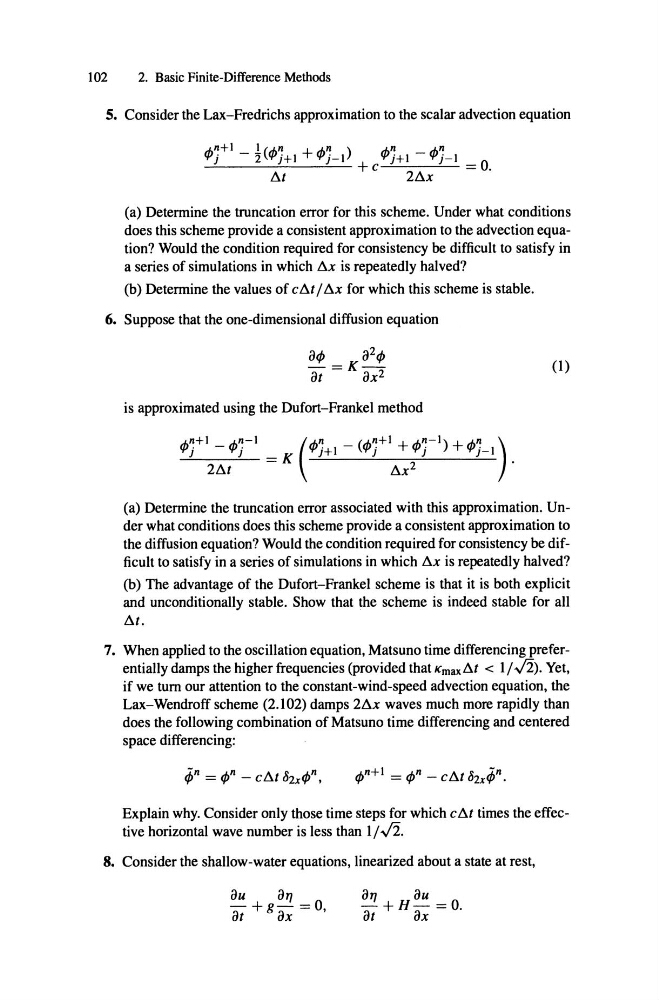
5. Consider the Lax-Fredrichs approximation to the scalar advection equation
(a) Determine the truncation error for this scheme. Under what conditions
does this scheme provide a consistent approximation to the advection equation? Would the condition required for consistency be difficult to satisfy in
aseries of simulations in which Sx is repeatedly halved?
(b) Determine the values of eilt / Ilx for which this scheme is stable .
(1)
is approximated using the Dufort-Frankel method
(a) Determine the truncation error associated with this approximation. Under what conditions does this scheme provide a consistent approximation to
the diffusion equation? Would the condition required for consistency be difficult to satisfy in aseries of simulations in which Ilx is repeatedly halved?
(b) The advantage of the Dufort-Frankel scheme is that it is both explicit
and unconditionally stable. Show that the scheme is indeed stable for all
Ilt.
7. When applied to the oscillation equation, Matsuno time differencing preferentially damps the higher frequencies (provided that K max Ilt < 1/-./2). Yet,
if we turn our attention to the constant-wind-speed advection equation, the
Lax-Wendroff scheme (2.102) damps 21lx waves much more rapidly than
does the following combination of Matsuno time differencing and centered
space differencing:
Explain why. Consider only those time steps for which eilt times the effective horizontal wave number is less than 1/-./2.
8. Consider the shallow-water equations, linearized about astate at rest,
8u
81] _ 0
8t + g Bx - ,
81]
8u
-+H-=O.
8t
8x
(a) Determine the truncation error for this scheme. Under what conditions
does this scheme provide a consistent approximation to the advection equation? Would the condition required for consistency be difficult to satisfy in
aseries of simulations in which Sx is repeatedly halved?
(b) Determine the values of eilt / Ilx for which this scheme is stable .
(1)
is approximated using the Dufort-Frankel method
(a) Determine the truncation error associated with this approximation. Under what conditions does this scheme provide a consistent approximation to
the diffusion equation? Would the condition required for consistency be difficult to satisfy in aseries of simulations in which Ilx is repeatedly halved?
(b) The advantage of the Dufort-Frankel scheme is that it is both explicit
and unconditionally stable. Show that the scheme is indeed stable for all
Ilt.
7. When applied to the oscillation equation, Matsuno time differencing preferentially damps the higher frequencies (provided that K max Ilt < 1/-./2). Yet,
if we turn our attention to the constant-wind-speed advection equation, the
Lax-Wendroff scheme (2.102) damps 21lx waves much more rapidly than
does the following combination of Matsuno time differencing and centered
space differencing:
Explain why. Consider only those time steps for which eilt times the effective horizontal wave number is less than 1/-./2.
8. Consider the shallow-water equations, linearized about astate at rest,
8u
81] _ 0
8t + g Bx - ,
81]
8u
-+H-=O.
8t
8x