

Problems
103
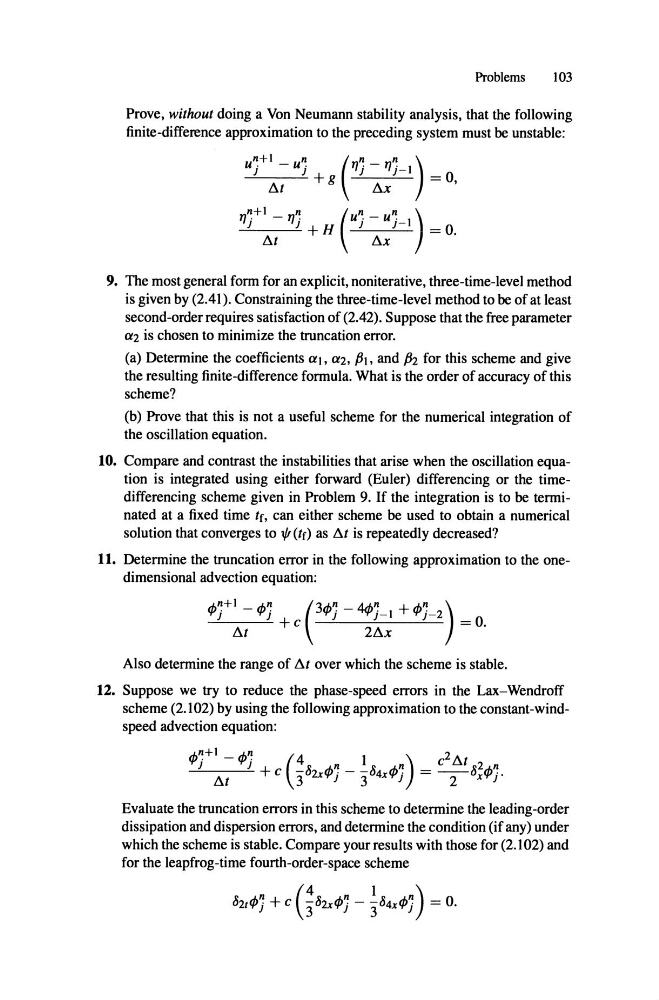
Prove, without doing a Von Neumann stability analysis, that the following
finite-difference approximation to the preceding system must be unstable:
-
-
)
J
J
J + g J J -I = 0,
!:lt
-
!:lx
- )
J -I
= O.
J + H J
!:lt
!:lx
9. The most general form for an explicit , noniterative, three-time-level method
is given by (2.41). Constraining the three-time -level method to be of at least
second-order requires satisfaction of (2.42). Suppose that the free parameter
a2 is chosen to minimize the truncation error.
(a) Determine the coefficients al, a2, ßI , and ß2 for this scheme and give
the resulting finite-difference formula. What is the order of accuracy of this
scheme?
(b) Prove that this is not a useful scheme for the numerical integration of
the oscillation equation.
10. Compare and contrast the instabilities that arise when the oscillation equation is integrated using either forward (Euler) differencing or the timedifferencing scheme given in Problem 9. If the integration is to be terminated at a fixed time tt. can either scheme be used to obtain a numerical
solution that converges to 1/!(tr) as !:lt is repeatedly decreased?
cP'/l - cP' J + c (3cP'J - 4' J-I + cP' J-2) = O.
!:lt
2!:lx
Also determine the range of !:lt over which the scheme is stable.
12. Suppose we try to reduce the phase-speed errors in the Lax-Wendroff
scheme (2.102) by using the following approximation to the constant-windspeed advection equation:
'I'j
",n+1 _ 'I'j »»
!:lt
( 4
n
I
n )
c 2 !:lt 2 n
+ C 382xcPj - 384xcPj = -2-8xcP j'
Evaluate the truncation errors in this scheme to determine the leading-order
dissipation and dispersion errors, and determine the condition (if any) under
which the scheme is stable . Compare your results with those for (2.102) and
for the leapfrog-time fourth-order-space scheme
103
Prove, without doing a Von Neumann stability analysis, that the following
finite-difference approximation to the preceding system must be unstable:
-
-
)
J
J
J + g J J -I = 0,
!:lt
-
!:lx
- )
J -I
= O.
J + H J
!:lt
!:lx
9. The most general form for an explicit , noniterative, three-time-level method
is given by (2.41). Constraining the three-time -level method to be of at least
second-order requires satisfaction of (2.42). Suppose that the free parameter
a2 is chosen to minimize the truncation error.
(a) Determine the coefficients al, a2, ßI , and ß2 for this scheme and give
the resulting finite-difference formula. What is the order of accuracy of this
scheme?
(b) Prove that this is not a useful scheme for the numerical integration of
the oscillation equation.
10. Compare and contrast the instabilities that arise when the oscillation equation is integrated using either forward (Euler) differencing or the timedifferencing scheme given in Problem 9. If the integration is to be terminated at a fixed time tt. can either scheme be used to obtain a numerical
solution that converges to 1/!(tr) as !:lt is repeatedly decreased?
cP'/l - cP' J + c (3cP'J - 4' J-I + cP' J-2) = O.
!:lt
2!:lx
Also determine the range of !:lt over which the scheme is stable.
12. Suppose we try to reduce the phase-speed errors in the Lax-Wendroff
scheme (2.102) by using the following approximation to the constant-windspeed advection equation:
'I'j
",n+1 _ 'I'j »»
!:lt
( 4
n
I
n )
c 2 !:lt 2 n
+ C 382xcPj - 384xcPj = -2-8xcP j'
Evaluate the truncation errors in this scheme to determine the leading-order
dissipation and dispersion errors, and determine the condition (if any) under
which the scheme is stable . Compare your results with those for (2.102) and
for the leapfrog-time fourth-order-space scheme