

Problems
10I
Problems
1. Suppose that I (x) is to be represented at discrete points x j on an uneven
mesh and that I:i.l : i = x j - X j -I. Use Taylor series expansions to derive a
second-order finite-difference approximation to df/dx using a three-point
stencil of the form
afi+1 + ßli + YIj-I.
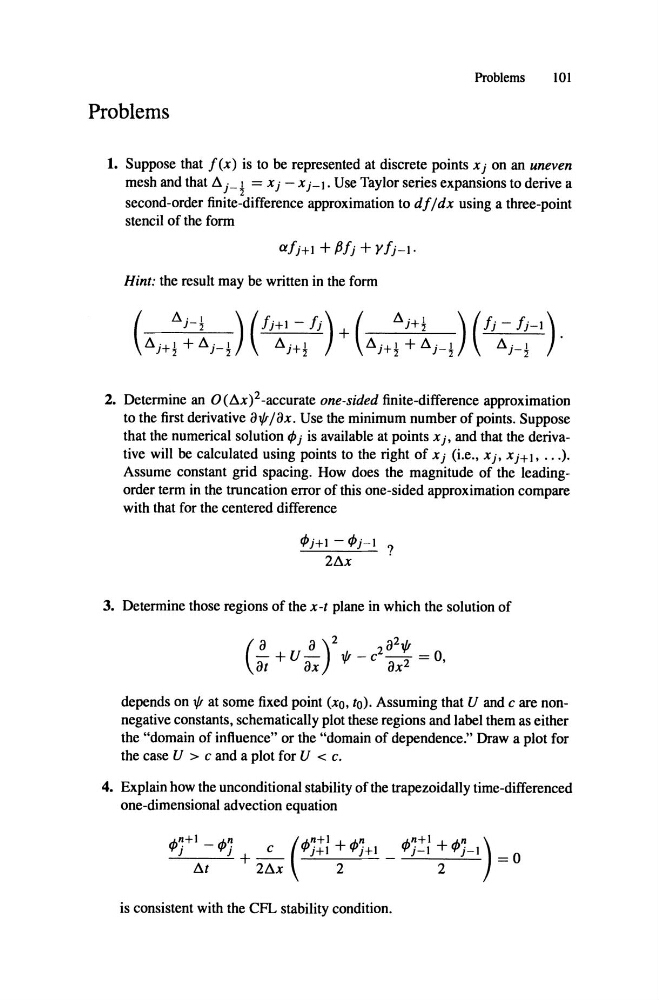
Hint: the result may be written in the form
?
2. Determine an O(l:i.x)2-accurate one-sided finite-difference approximation
to the first derivative a1{r/ax. Use the minimum number of points. Suppose
that the numerical solution ifJj is available at points x l» and that the derivative will be calculated using points to the right of x j (i.e., xi - xi+ I, . . .).
Assume constant grid spacing. How does the magnitude of the leadingorder term in the truncation error of this one-sided approximation compare
with that for the centered difference
ifJi+1 - ifJj-1
2l:i.x
3. Determine those regions of the x -t plane in which the solution of
( - +
a
a )2 2 a21{r
1{r - c -
ax 2 = 0,
U -
Bx
at
depends on 1{r at some fixed point (xo, to). Assuming that U and c are nonnegative constants , schematically plot these regions and label them as either
the "domain of inftuence" or the "domain of dependence." Draw a plot for
the case U > C and a plot for U < c.
4. Explain how the unconditional stability ofthe trapezoidally time-differenced
one-dimensional advection equation
is consistent with the eFL stability condition.
10I
Problems
1. Suppose that I (x) is to be represented at discrete points x j on an uneven
mesh and that I:i.l : i = x j - X j -I. Use Taylor series expansions to derive a
second-order finite-difference approximation to df/dx using a three-point
stencil of the form
afi+1 + ßli + YIj-I.
Hint: the result may be written in the form
?
2. Determine an O(l:i.x)2-accurate one-sided finite-difference approximation
to the first derivative a1{r/ax. Use the minimum number of points. Suppose
that the numerical solution ifJj is available at points x l» and that the derivative will be calculated using points to the right of x j (i.e., xi - xi+ I, . . .).
Assume constant grid spacing. How does the magnitude of the leadingorder term in the truncation error of this one-sided approximation compare
with that for the centered difference
ifJi+1 - ifJj-1
2l:i.x
3. Determine those regions of the x -t plane in which the solution of
( - +
a
a )2 2 a21{r
1{r - c -
ax 2 = 0,
U -
Bx
at
depends on 1{r at some fixed point (xo, to). Assuming that U and c are nonnegative constants , schematically plot these regions and label them as either
the "domain of inftuence" or the "domain of dependence." Draw a plot for
the case U > C and a plot for U < c.
4. Explain how the unconditional stability ofthe trapezoidally time-differenced
one-dimensional advection equation
is consistent with the eFL stability condition.