

The External, Musculoskeletal and Neuro-Anatomy of Sea Turtles
45
first lateral as well as the first vertebral. The olive ridley has more than five normal
vertebral scutes (not including irregular or supernumerary scutes) and usually six
or more pairs of lateral scutes (Pritchard, 1979; Pritchard, 1997; Wyneken, 2001).
The head of the leatherback appears to be covered with smooth skin, except in
hatchlings, which have small round scales on the lateral face and throat. Cheloniids
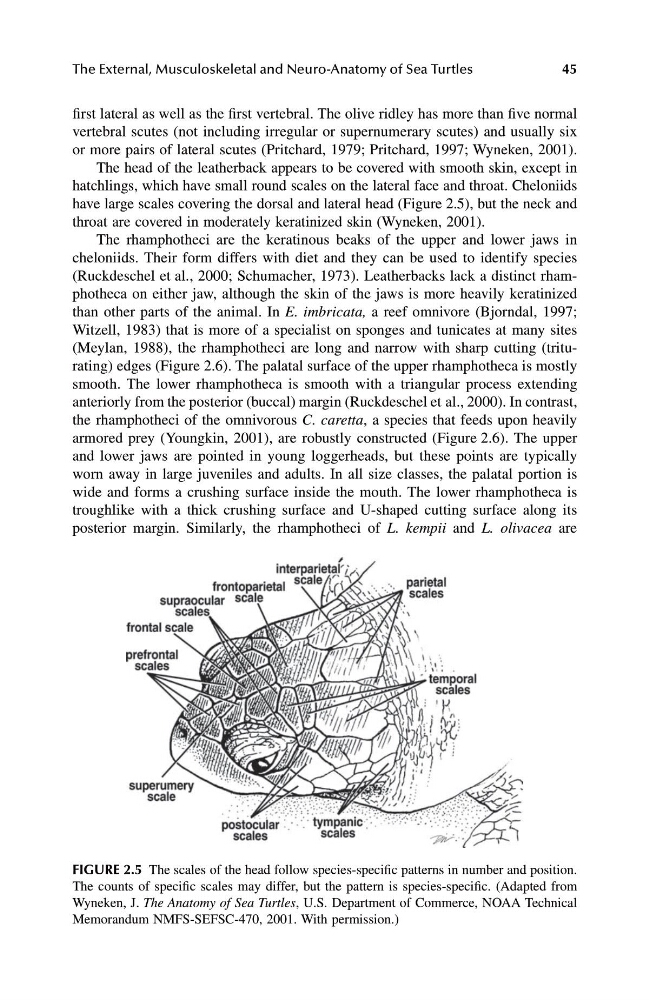
have large scales covering the dorsal and lateral head (Figure 2.5), but the neck and
throat are covered in moderately keratinized skin (Wyneken, 2001).
The rhamphotheci are the keratinous beaks of the upper and lower jaws in
cheloniids. Their form differs with diet and they can be used to identify species
(Ruckdeschel et al., 2000; Schumacher, 1973). Leatherbacks lack a distinct rhamphotheca on either jaw, although the skin of the jaws is more heavily keratinized
than other parts of the animal. In E. imbricata, a reef omnivore (Bjorndal, 1997;
Witzell, 1983) that is more of a specialist on sponges and tunicates at many sites
(Meylan, 1988), the rhamphotheci are long and narrow with sharp cutting (triturating) edges (Figure 2.6). The palatal surface of the upper rhamphotheca is mostly
smooth. The lower rhamphotheca is smooth with a triangular process extending
anteriorly from the posterior (buccal) margin (Ruckdeschel et al., 2000). In contrast,
the rhamphotheci of the omnivorous C. caretta , a species that feeds upon heavily
armored prey (Youngkin, 2001), are robustly constructed (Figure 2.6). The upper
and lower jaws are pointed in young loggerheads, but these points are typically
worn away in large juveniles and adults. In all size classes, the palatal portion is
wide and forms a crushing surface inside the mouth. The lower rhamphotheca is
troughlike with a thick crushing surface and U-shaped cutting surface along its
posterior margin. Similarly, the rhamphotheci of L. kempii and L. olivacea are
FIGURE 2.5 The scales of the head follow species-specific patterns in number and position.
The counts of specific scales may differ, but the pattern is species-specific. (Adapted from
Wyneken, J. The Anatomy of Sea Turtles , U.S. Department of Commerce, NOAA Technical
Memorandum NMFS-SEFSC-470, 2001. With permission.)
1123_C02.fm Page 45 Friday, November 15, 2002 11:16 AM
45
first lateral as well as the first vertebral. The olive ridley has more than five normal
vertebral scutes (not including irregular or supernumerary scutes) and usually six
or more pairs of lateral scutes (Pritchard, 1979; Pritchard, 1997; Wyneken, 2001).
The head of the leatherback appears to be covered with smooth skin, except in
hatchlings, which have small round scales on the lateral face and throat. Cheloniids
have large scales covering the dorsal and lateral head (Figure 2.5), but the neck and
throat are covered in moderately keratinized skin (Wyneken, 2001).
The rhamphotheci are the keratinous beaks of the upper and lower jaws in
cheloniids. Their form differs with diet and they can be used to identify species
(Ruckdeschel et al., 2000; Schumacher, 1973). Leatherbacks lack a distinct rhamphotheca on either jaw, although the skin of the jaws is more heavily keratinized
than other parts of the animal. In E. imbricata, a reef omnivore (Bjorndal, 1997;
Witzell, 1983) that is more of a specialist on sponges and tunicates at many sites
(Meylan, 1988), the rhamphotheci are long and narrow with sharp cutting (triturating) edges (Figure 2.6). The palatal surface of the upper rhamphotheca is mostly
smooth. The lower rhamphotheca is smooth with a triangular process extending
anteriorly from the posterior (buccal) margin (Ruckdeschel et al., 2000). In contrast,
the rhamphotheci of the omnivorous C. caretta , a species that feeds upon heavily
armored prey (Youngkin, 2001), are robustly constructed (Figure 2.6). The upper
and lower jaws are pointed in young loggerheads, but these points are typically
worn away in large juveniles and adults. In all size classes, the palatal portion is
wide and forms a crushing surface inside the mouth. The lower rhamphotheca is
troughlike with a thick crushing surface and U-shaped cutting surface along its
posterior margin. Similarly, the rhamphotheci of L. kempii and L. olivacea are
FIGURE 2.5 The scales of the head follow species-specific patterns in number and position.
The counts of specific scales may differ, but the pattern is species-specific. (Adapted from
Wyneken, J. The Anatomy of Sea Turtles , U.S. Department of Commerce, NOAA Technical
Memorandum NMFS-SEFSC-470, 2001. With permission.)
1123_C02.fm Page 45 Friday, November 15, 2002 11:16 AM