

46
Biology of Sea Turtles, Vol. II
robust with thick, sharp-edged alveolar surfaces and are pointed anteriorly at the
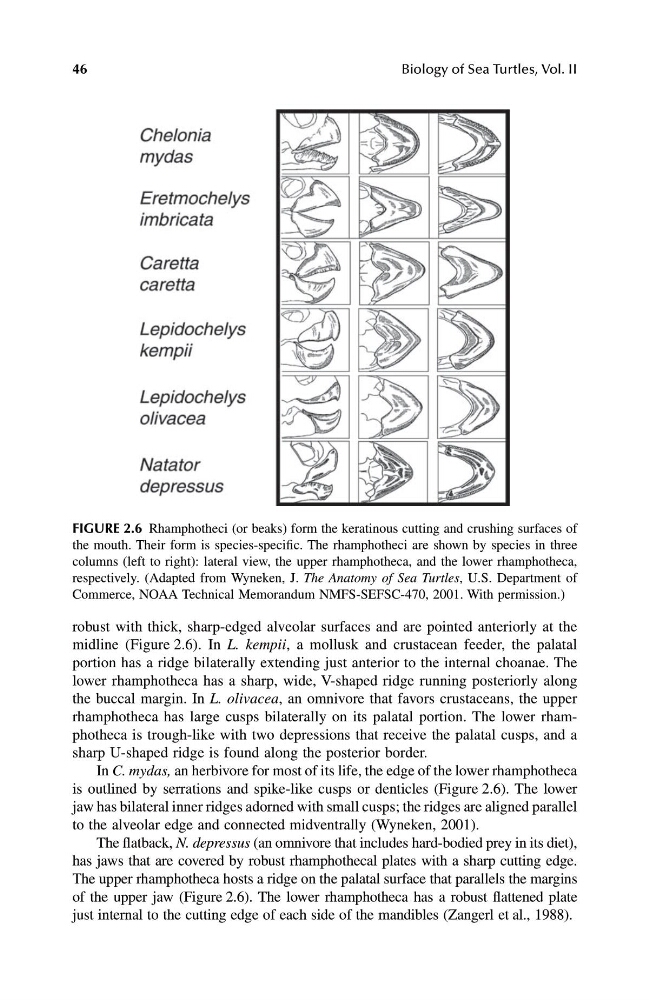
midline (Figure 2.6). In L. kempii , a mollusk and crustacean feeder, the palatal
portion has a ridge bilaterally extending just anterior to the internal choanae. The
lower rhamphotheca has a sharp, wide, V-shaped ridge running posteriorly along
the buccal margin. In L. olivacea , an omnivore that favors crustaceans, the upper
rhamphotheca has large cusps bilaterally on its palatal portion. The lower rhamphotheca is trough-like with two depressions that receive the palatal cusps, and a
sharp U-shaped ridge is found along the posterior border.
In C. mydas, an herbivore for most of its life, the edge of the lower rhamphotheca
is outlined by serrations and spike-like cusps or denticles (Figure 2.6). The lower
jaw has bilateral inner ridges adorned with small cusps; the ridges are aligned parallel
to the alveolar edge and connected midventrally (Wyneken, 2001).
The flatback, N. depressus (an omnivore that includes hard-bodied prey in its diet),
has jaws that are covered by robust rhamphothecal plates with a sharp cutting edge.
The upper rhamphotheca hosts a ridge on the palatal surface that parallels the margins
of the upper jaw (Figure 2.6). The lower rhamphotheca has a robust flattened plate
just internal to the cutting edge of each side of the mandibles (Zangerl et al., 1988).
FIGURE 2.6 Rhamphotheci (or beaks) form the keratinous cutting and crushing surfaces of
the mouth. Their form is species-specific. The rhamphotheci are shown by species in three
columns (left to right): lateral view, the upper rhamphotheca, and the lower rhamphotheca,
respectively. (Adapted from Wyneken, J. The Anatomy of Sea Turtles , U.S. Department of
Commerce, NOAA Technical Memorandum NMFS-SEFSC-470, 2001. With permission.)
1123_C02.fm Page 46 Friday, November 15, 2002 11:16 AM
Biology of Sea Turtles, Vol. II
robust with thick, sharp-edged alveolar surfaces and are pointed anteriorly at the
midline (Figure 2.6). In L. kempii , a mollusk and crustacean feeder, the palatal
portion has a ridge bilaterally extending just anterior to the internal choanae. The
lower rhamphotheca has a sharp, wide, V-shaped ridge running posteriorly along
the buccal margin. In L. olivacea , an omnivore that favors crustaceans, the upper
rhamphotheca has large cusps bilaterally on its palatal portion. The lower rhamphotheca is trough-like with two depressions that receive the palatal cusps, and a
sharp U-shaped ridge is found along the posterior border.
In C. mydas, an herbivore for most of its life, the edge of the lower rhamphotheca
is outlined by serrations and spike-like cusps or denticles (Figure 2.6). The lower
jaw has bilateral inner ridges adorned with small cusps; the ridges are aligned parallel
to the alveolar edge and connected midventrally (Wyneken, 2001).
The flatback, N. depressus (an omnivore that includes hard-bodied prey in its diet),
has jaws that are covered by robust rhamphothecal plates with a sharp cutting edge.
The upper rhamphotheca hosts a ridge on the palatal surface that parallels the margins
of the upper jaw (Figure 2.6). The lower rhamphotheca has a robust flattened plate
just internal to the cutting edge of each side of the mandibles (Zangerl et al., 1988).
FIGURE 2.6 Rhamphotheci (or beaks) form the keratinous cutting and crushing surfaces of
the mouth. Their form is species-specific. The rhamphotheci are shown by species in three
columns (left to right): lateral view, the upper rhamphotheca, and the lower rhamphotheca,
respectively. (Adapted from Wyneken, J. The Anatomy of Sea Turtles , U.S. Department of
Commerce, NOAA Technical Memorandum NMFS-SEFSC-470, 2001. With permission.)
1123_C02.fm Page 46 Friday, November 15, 2002 11:16 AM