

44
Biology of Sea Turtles, Vol. II
plastron has weakly developed ridges. The functional significance of the unique
leatherback shell design has not been studied.
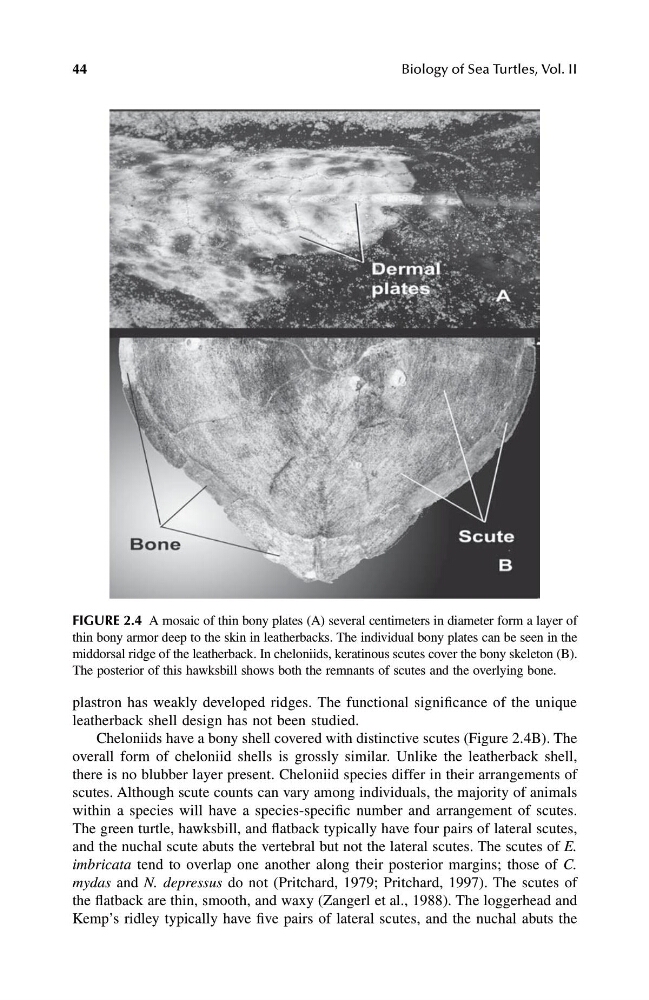
Cheloniids have a bony shell covered with distinctive scutes (Figure 2.4B). The
overall form of cheloniid shells is grossly similar. Unlike the leatherback shell,
there is no blubber layer present. Cheloniid species differ in their arrangements of
scutes. Although scute counts can vary among individuals, the majority of animals
within a species will have a species-specific number and arrangement of scutes.
The green turtle, hawksbill, and flatback typically have four pairs of lateral scutes,
and the nuchal scute abuts the vertebral but not the lateral scutes. The scutes of E.
imbricata tend to overlap one another along their posterior margins; those of C.
mydas and N. depressus do not (Pritchard, 1979; Pritchard, 1997). The scutes of
the flatback are thin, smooth, and waxy (Zangerl et al., 1988). The loggerhead and
Kemp’s ridley typically have five pairs of lateral scutes, and the nuchal abuts the
FIGURE 2.4 A mosaic of thin bony plates (A) several centimeters in diameter form a layer of
thin bony armor deep to the skin in leatherbacks. The individual bony plates can be seen in the
middorsal ridge of the leatherback. In cheloniids, keratinous scutes cover the bony skeleton (B).
The posterior of this hawksbill shows both the remnants of scutes and the overlying bone.
1123_C02.fm Page 44 Friday, November 15, 2002 11:16 AM
Biology of Sea Turtles, Vol. II
plastron has weakly developed ridges. The functional significance of the unique
leatherback shell design has not been studied.
Cheloniids have a bony shell covered with distinctive scutes (Figure 2.4B). The
overall form of cheloniid shells is grossly similar. Unlike the leatherback shell,
there is no blubber layer present. Cheloniid species differ in their arrangements of
scutes. Although scute counts can vary among individuals, the majority of animals
within a species will have a species-specific number and arrangement of scutes.
The green turtle, hawksbill, and flatback typically have four pairs of lateral scutes,
and the nuchal scute abuts the vertebral but not the lateral scutes. The scutes of E.
imbricata tend to overlap one another along their posterior margins; those of C.
mydas and N. depressus do not (Pritchard, 1979; Pritchard, 1997). The scutes of
the flatback are thin, smooth, and waxy (Zangerl et al., 1988). The loggerhead and
Kemp’s ridley typically have five pairs of lateral scutes, and the nuchal abuts the
FIGURE 2.4 A mosaic of thin bony plates (A) several centimeters in diameter form a layer of
thin bony armor deep to the skin in leatherbacks. The individual bony plates can be seen in the
middorsal ridge of the leatherback. In cheloniids, keratinous scutes cover the bony skeleton (B).
The posterior of this hawksbill shows both the remnants of scutes and the overlying bone.
1123_C02.fm Page 44 Friday, November 15, 2002 11:16 AM