

214
The Biology of Sea Turtles, Vol. II
the turtle, the ovary may also contain mature follicles, corpora hemorrhagia, corpora
albicantia, corpora lutea, and/or atretic follicles (Color Figure 7.8).
Each corpus luteum results from the stromal tissue that surrounded the oocyte
before it was ovulated. Immediately after ovulation the ovarian tissue collapses
to form a crater that is maintained during the preparation and gestation of the
eggs prior to oviposition, then progressively degenerates. Progesterone is produced by the corpus luteum and is modulated through the hypothalamus. It
inhibits follicular development and ovulation until about 40 h following oviposition (Owens, 1997). Eventually, the fluid-filled vesicle is absorbed and each
corpus luteum appears to be drawn nearly closed, leaving white lines radiating
outward from the small crater. Atretic follicles (corpora atretica) are follicles
that were not ovulated. They are eventually invaded by stromal tissue and their
contents are absorbed, leaving a scar in the ovary that becomes progressively
smaller over several years.
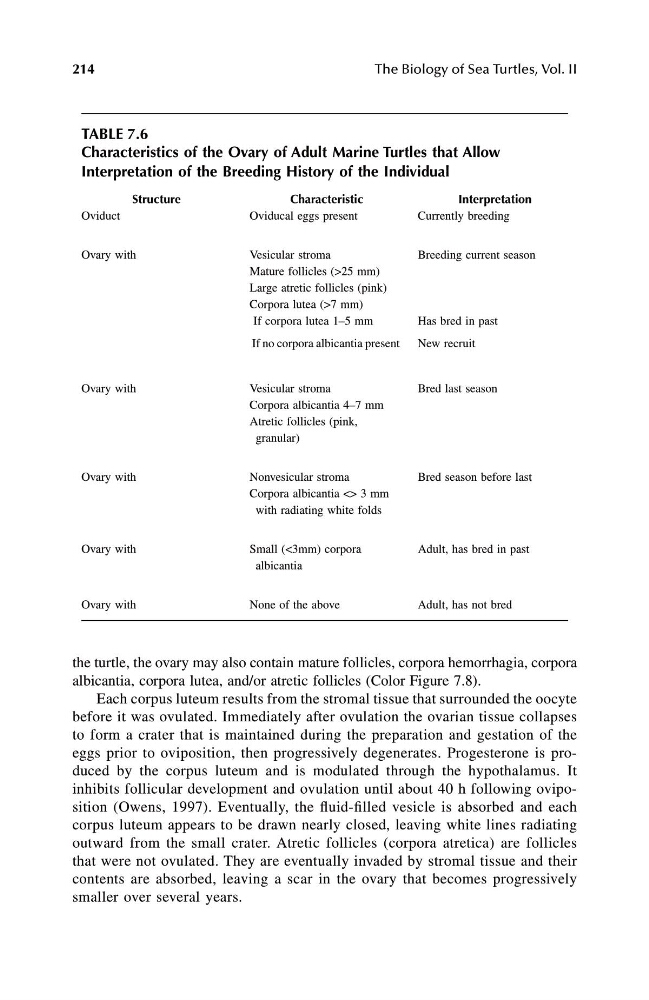
TABLE 7.6
Characteristics of the Ovary of Adult Marine Turtles that Allow
Interpretation of the Breeding History of the Individual
Structure
Characteristic
Interpretation
Oviduct
Oviducal eggs present
Currently breeding
Ovary with
Vesicular stroma
Mature follicles (>25 mm)
Large atretic follicles (pink)
Corpora lutea (>7 mm)
Breeding current season
If corpora lutea 1–5 mm
Has bred in past
If no corpora albicantia present New recruit
Ovary with
Vesicular stroma
Corpora albicantia 4–7 mm
Atretic follicles (pink,
granular)
Bred last season
Ovary with
Nonvesicular stroma
Corpora albicantia <> 3 mm
with radiating white folds
Bred season before last
Ovary with
Small (<3mm) corpora
albicantia
Adult, has bred in past
Ovary with
None of the above
Adult, has not bred
1123 book.book Page 214 Monday, November 11, 2002 11:11 AM
The Biology of Sea Turtles, Vol. II
the turtle, the ovary may also contain mature follicles, corpora hemorrhagia, corpora
albicantia, corpora lutea, and/or atretic follicles (Color Figure 7.8).
Each corpus luteum results from the stromal tissue that surrounded the oocyte
before it was ovulated. Immediately after ovulation the ovarian tissue collapses
to form a crater that is maintained during the preparation and gestation of the
eggs prior to oviposition, then progressively degenerates. Progesterone is produced by the corpus luteum and is modulated through the hypothalamus. It
inhibits follicular development and ovulation until about 40 h following oviposition (Owens, 1997). Eventually, the fluid-filled vesicle is absorbed and each
corpus luteum appears to be drawn nearly closed, leaving white lines radiating
outward from the small crater. Atretic follicles (corpora atretica) are follicles
that were not ovulated. They are eventually invaded by stromal tissue and their
contents are absorbed, leaving a scar in the ovary that becomes progressively
smaller over several years.
TABLE 7.6
Characteristics of the Ovary of Adult Marine Turtles that Allow
Interpretation of the Breeding History of the Individual
Structure
Characteristic
Interpretation
Oviduct
Oviducal eggs present
Currently breeding
Ovary with
Vesicular stroma
Mature follicles (>25 mm)
Large atretic follicles (pink)
Corpora lutea (>7 mm)
Breeding current season
If corpora lutea 1–5 mm
Has bred in past
If no corpora albicantia present New recruit
Ovary with
Vesicular stroma
Corpora albicantia 4–7 mm
Atretic follicles (pink,
granular)
Bred last season
Ovary with
Nonvesicular stroma
Corpora albicantia <> 3 mm
with radiating white folds
Bred season before last
Ovary with
Small (<3mm) corpora
albicantia
Adult, has bred in past
Ovary with
None of the above
Adult, has not bred
1123 book.book Page 214 Monday, November 11, 2002 11:11 AM