

Ontogeny of Marine Turtle Gonads
213
the average for the breeding population, but greater than the minimum breeding size
(Limpus, 1990; 1992; Limpus and Reed, 1985).
Several investigators have described the adult reproductive structures ( C. mydas :
Aitken et al., 1976; Owens, 1980, personal observations; L. olivacea: Owens, 1980;
Caretta and Natator: personal observations). Various combinations of the size and
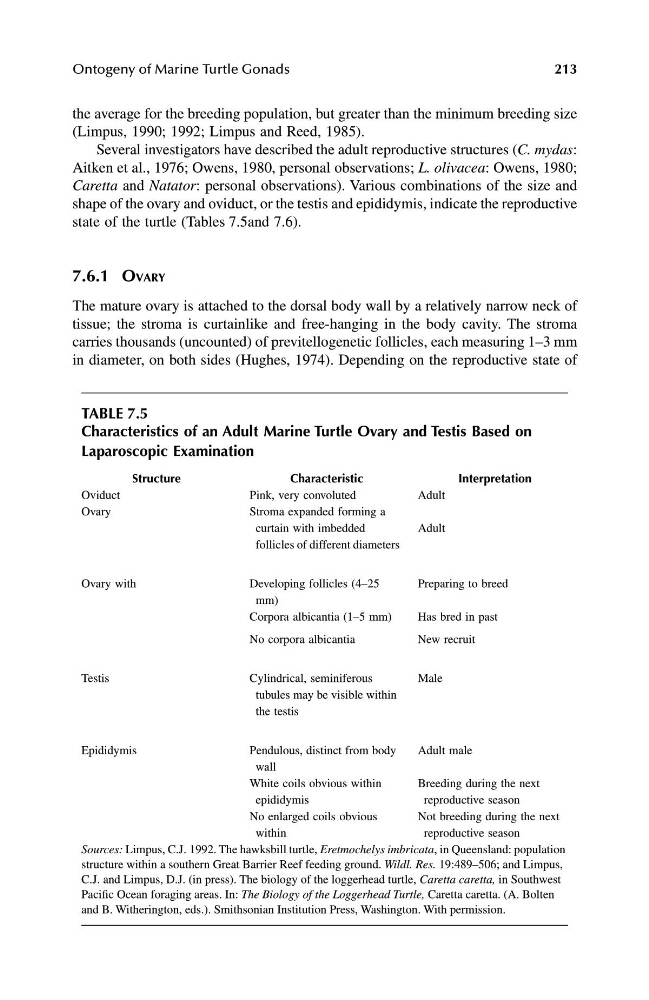
shape of the ovary and oviduct, or the testis and epididymis, indicate the reproductive
state of the turtle (Tables 7.5and 7.6).
7.6.1 OVARY
The mature ovary is attached to the dorsal body wall by a relatively narrow neck of
tissue; the stroma is curtainlike and free-hanging in the body cavity. The stroma
carries thousands (uncounted) of previtellogenetic follicles, each measuring 1–3 mm
in diameter, on both sides (Hughes, 1974). Depending on the reproductive state of
TABLE 7.5
Characteristics of an Adult Marine Turtle Ovary and Testis Based on
Laparoscopic Examination
Structure
Characteristic
Interpretation
Oviduct
Pink, very convoluted
Adult
Ovary
Stroma expanded forming a
curtain with imbedded
follicles of different diameters
Adult
Ovary with
Developing follicles (4–25
mm)
Preparing to breed
Corpora albicantia (1–5 mm)
Has bred in past
No corpora albicantia
New recruit
Testis
Cylindrical, seminiferous
tubules may be visible within
the testis
Male
Epididymis
Pendulous, distinct from body
wall
Adult male
White coils obvious within
epididymis
Breeding during the next
reproductive season
No enlarged coils obvious
within
Not breeding during the next
reproductive season
Sources: Limpus, C.J. 1992. The hawksbill turtle, Eretmochelys imbricata, in Queensland: population
structure within a southern Great Barrier Reef feeding ground. Wildl. Res. 19:489–506; and Limpus,
C.J. and Limpus, D.J. (in press). The biology of the loggerhead turtle, Caretta caretta, in Southwest
Pacific Ocean foraging areas. In: The Biology of the Loggerhead Turtle, Caretta caretta. (A. Bolten
and B. Witherington, eds.). Smithsonian Institution Press, Washington. With permission.
1123 book.book Page 213 Monday, November 11, 2002 11:11 AM
213
the average for the breeding population, but greater than the minimum breeding size
(Limpus, 1990; 1992; Limpus and Reed, 1985).
Several investigators have described the adult reproductive structures ( C. mydas :
Aitken et al., 1976; Owens, 1980, personal observations; L. olivacea: Owens, 1980;
Caretta and Natator: personal observations). Various combinations of the size and
shape of the ovary and oviduct, or the testis and epididymis, indicate the reproductive
state of the turtle (Tables 7.5and 7.6).
7.6.1 OVARY
The mature ovary is attached to the dorsal body wall by a relatively narrow neck of
tissue; the stroma is curtainlike and free-hanging in the body cavity. The stroma
carries thousands (uncounted) of previtellogenetic follicles, each measuring 1–3 mm
in diameter, on both sides (Hughes, 1974). Depending on the reproductive state of
TABLE 7.5
Characteristics of an Adult Marine Turtle Ovary and Testis Based on
Laparoscopic Examination
Structure
Characteristic
Interpretation
Oviduct
Pink, very convoluted
Adult
Ovary
Stroma expanded forming a
curtain with imbedded
follicles of different diameters
Adult
Ovary with
Developing follicles (4–25
mm)
Preparing to breed
Corpora albicantia (1–5 mm)
Has bred in past
No corpora albicantia
New recruit
Testis
Cylindrical, seminiferous
tubules may be visible within
the testis
Male
Epididymis
Pendulous, distinct from body
wall
Adult male
White coils obvious within
epididymis
Breeding during the next
reproductive season
No enlarged coils obvious
within
Not breeding during the next
reproductive season
Sources: Limpus, C.J. 1992. The hawksbill turtle, Eretmochelys imbricata, in Queensland: population
structure within a southern Great Barrier Reef feeding ground. Wildl. Res. 19:489–506; and Limpus,
C.J. and Limpus, D.J. (in press). The biology of the loggerhead turtle, Caretta caretta, in Southwest
Pacific Ocean foraging areas. In: The Biology of the Loggerhead Turtle, Caretta caretta. (A. Bolten
and B. Witherington, eds.). Smithsonian Institution Press, Washington. With permission.
1123 book.book Page 213 Monday, November 11, 2002 11:11 AM