

178
The Biology of Sea Turtles, Vol. II
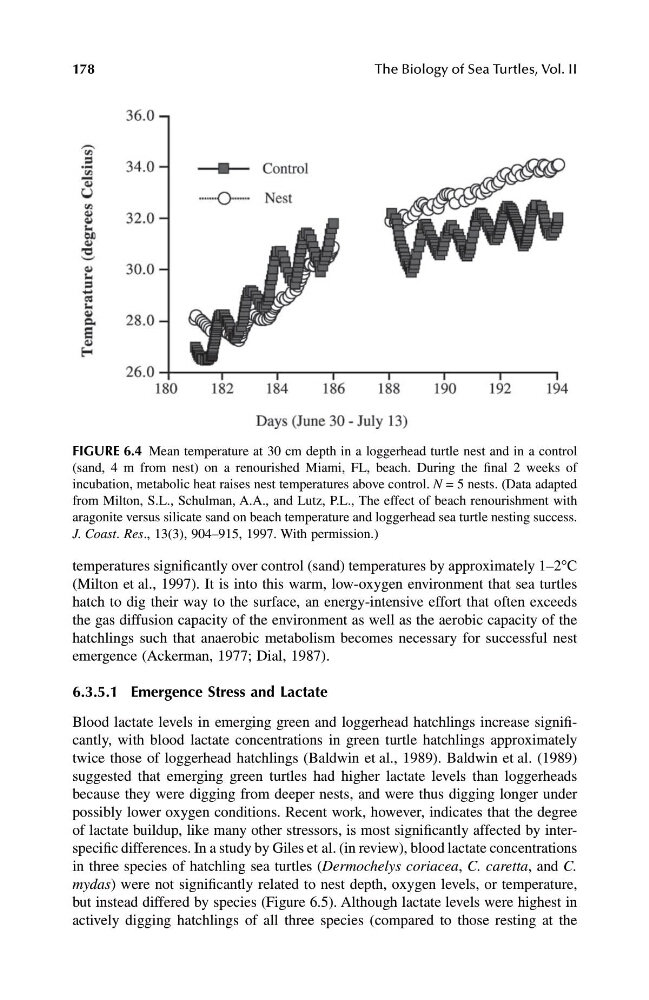
temperatures significantly over control (sand) temperatures by approximately 1–2 ∞ C
(Milton et al., 1997). It is into this warm, low-oxygen environment that sea turtles
hatch to dig their way to the surface, an energy-intensive effort that often exceeds
the gas diffusion capacity of the environment as well as the aerobic capacity of the
hatchlings such that anaerobic metabolism becomes necessary for successful nest
emergence (Ackerman, 1977; Dial, 1987).
6.3.5.1 Emergence Stress and Lactate
Blood lactate levels in emerging green and loggerhead hatchlings increase significantly, with blood lactate concentrations in green turtle hatchlings approximately
twice those of loggerhead hatchlings (Baldwin et al., 1989). Baldwin et al. (1989)
suggested that emerging green turtles had higher lactate levels than loggerheads
because they were digging from deeper nests, and were thus digging longer under
possibly lower oxygen conditions. Recent work, however, indicates that the degree
of lactate buildup, like many other stressors, is most significantly affected by interspecific differences. In a study by Giles et al. (in review), blood lactate concentrations
in three species of hatchling sea turtles ( Dermochelys coriacea , C. caretta , and C.
mydas ) were not significantly related to nest depth, oxygen levels, or temperature,
but instead differed by species (Figure 6.5). Although lactate levels were highest in
actively digging hatchlings of all three species (compared to those resting at the
FIGURE 6.4 Mean temperature at 30 cm depth in a loggerhead turtle nest and in a control
(sand, 4 m from nest) on a renourished Miami, FL, beach. During the final 2 weeks of
incubation, metabolic heat raises nest temperatures above control. N = 5 nests. (Data adapted
from Milton, S.L., Schulman, A.A., and Lutz, P.L., The effect of beach renourishment with
aragonite versus silicate sand on beach temperature and loggerhead sea turtle nesting success.
J. Coast . Res ., 13(3), 904–915, 1997. With permission.)
1123 book.book Page 178 Monday, November 11, 2002 11:11 AM
The Biology of Sea Turtles, Vol. II
temperatures significantly over control (sand) temperatures by approximately 1–2 ∞ C
(Milton et al., 1997). It is into this warm, low-oxygen environment that sea turtles
hatch to dig their way to the surface, an energy-intensive effort that often exceeds
the gas diffusion capacity of the environment as well as the aerobic capacity of the
hatchlings such that anaerobic metabolism becomes necessary for successful nest
emergence (Ackerman, 1977; Dial, 1987).
6.3.5.1 Emergence Stress and Lactate
Blood lactate levels in emerging green and loggerhead hatchlings increase significantly, with blood lactate concentrations in green turtle hatchlings approximately
twice those of loggerhead hatchlings (Baldwin et al., 1989). Baldwin et al. (1989)
suggested that emerging green turtles had higher lactate levels than loggerheads
because they were digging from deeper nests, and were thus digging longer under
possibly lower oxygen conditions. Recent work, however, indicates that the degree
of lactate buildup, like many other stressors, is most significantly affected by interspecific differences. In a study by Giles et al. (in review), blood lactate concentrations
in three species of hatchling sea turtles ( Dermochelys coriacea , C. caretta , and C.
mydas ) were not significantly related to nest depth, oxygen levels, or temperature,
but instead differed by species (Figure 6.5). Although lactate levels were highest in
actively digging hatchlings of all three species (compared to those resting at the
FIGURE 6.4 Mean temperature at 30 cm depth in a loggerhead turtle nest and in a control
(sand, 4 m from nest) on a renourished Miami, FL, beach. During the final 2 weeks of
incubation, metabolic heat raises nest temperatures above control. N = 5 nests. (Data adapted
from Milton, S.L., Schulman, A.A., and Lutz, P.L., The effect of beach renourishment with
aragonite versus silicate sand on beach temperature and loggerhead sea turtle nesting success.
J. Coast . Res ., 13(3), 904–915, 1997. With permission.)
1123 book.book Page 178 Monday, November 11, 2002 11:11 AM