

Physiological and Genetic Responses to Environmental Stress
177
Although the precise etiology of GTFP is still under investigation, the disease
has been linked to environmentally challenged habitats, and immunosuppression is
strongly correlated with fibropapillomas in green turtles (Cray et al., 2001; Aguirre
et al., 1994; Aguirre and Lutz, in press). Chronic stress, whether caused by environmental pollutants, parasites, or biotoxins, affects the immunological response
of reptiles; thus, stressed sea turtles are likely to be less able to withstand the
primary etiological factor for GTFP. There is convincing evidence of a virus as the
transmissible causal factor for GTFP. Early work focused on papillomavirus (Jacobson et al., 1989), but recent work by Brown et al. (1999) failed to detect papillomavirus in freshly isolated tumor samples. More recently, a strong correlation has
been detected between the presence of chelonian herpesvirus and papilloma (Lackovich et al., 1999), which has been supported by molecular (polymerase chain
reaction) investigations (Lu et al., 2000; Quackenbush et al., 2001); papillomavirus
was also detected.
6.3.5 E FFECTS OF E NVIRONMENTAL S TRESSORS ON H ATCHLINGS
Hatchlings must endure unique physiological stresses in emerging from the nest and
swimming in the frenzy period away from shore to the open ocean gyres. Until
hatching, the nest environment is controlled primarily by physical factors: the temperature, hydric environment, and gas exchange processes of the beach material (for
a review, see Ackerman, 1997). As the embryos grow, they both consume more
oxygen and produce more carbon dioxide, resulting in a hypoxic, hypercapnic nest
environment. In addition, as the metabolic rate of the clutch increases with development, metabolic heat output increases as well (Figure 6.4), enough to raise nest
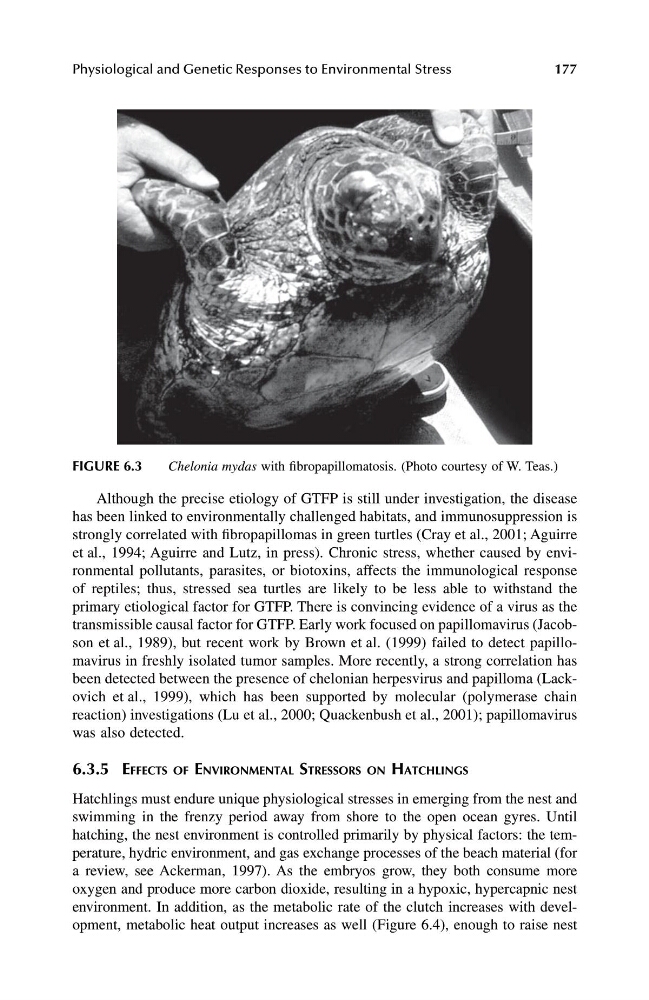
FIGURE 6.3
Chelonia mydas with fibropapillomatosis. (Photo courtesy of W. Teas.)
1123 book.book Page 177 Monday, November 11, 2002 11:11 AM
177
Although the precise etiology of GTFP is still under investigation, the disease
has been linked to environmentally challenged habitats, and immunosuppression is
strongly correlated with fibropapillomas in green turtles (Cray et al., 2001; Aguirre
et al., 1994; Aguirre and Lutz, in press). Chronic stress, whether caused by environmental pollutants, parasites, or biotoxins, affects the immunological response
of reptiles; thus, stressed sea turtles are likely to be less able to withstand the
primary etiological factor for GTFP. There is convincing evidence of a virus as the
transmissible causal factor for GTFP. Early work focused on papillomavirus (Jacobson et al., 1989), but recent work by Brown et al. (1999) failed to detect papillomavirus in freshly isolated tumor samples. More recently, a strong correlation has
been detected between the presence of chelonian herpesvirus and papilloma (Lackovich et al., 1999), which has been supported by molecular (polymerase chain
reaction) investigations (Lu et al., 2000; Quackenbush et al., 2001); papillomavirus
was also detected.
6.3.5 E FFECTS OF E NVIRONMENTAL S TRESSORS ON H ATCHLINGS
Hatchlings must endure unique physiological stresses in emerging from the nest and
swimming in the frenzy period away from shore to the open ocean gyres. Until
hatching, the nest environment is controlled primarily by physical factors: the temperature, hydric environment, and gas exchange processes of the beach material (for
a review, see Ackerman, 1997). As the embryos grow, they both consume more
oxygen and produce more carbon dioxide, resulting in a hypoxic, hypercapnic nest
environment. In addition, as the metabolic rate of the clutch increases with development, metabolic heat output increases as well (Figure 6.4), enough to raise nest
FIGURE 6.3
Chelonia mydas with fibropapillomatosis. (Photo courtesy of W. Teas.)
1123 book.book Page 177 Monday, November 11, 2002 11:11 AM