

Physiological and Genetic Responses to Environmental Stress
179
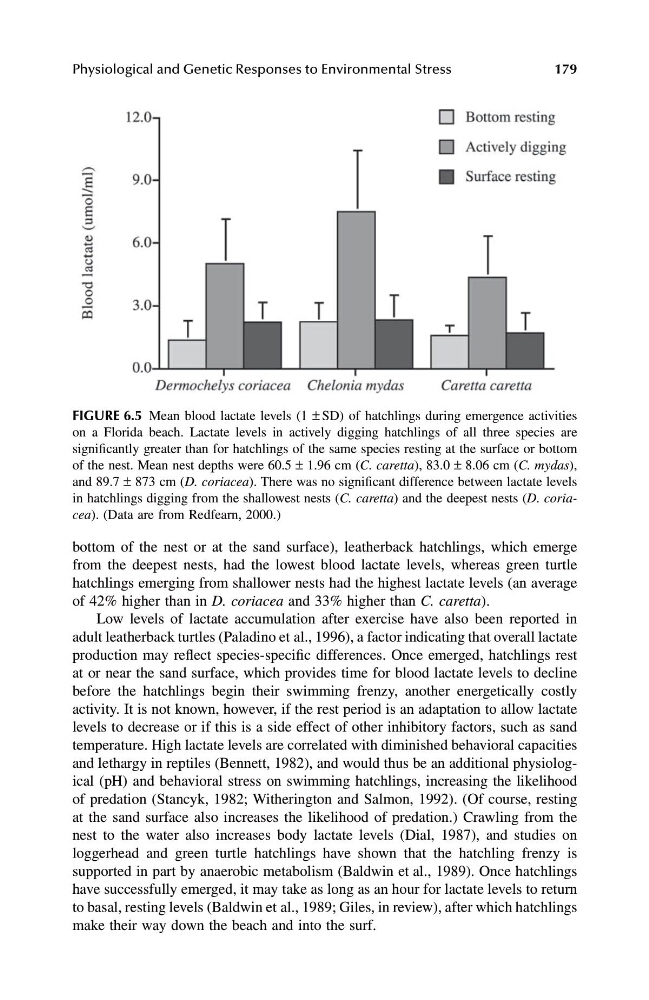
bottom of the nest or at the sand surface), leatherback hatchlings, which emerge
from the deepest nests, had the lowest blood lactate levels, whereas green turtle
hatchlings emerging from shallower nests had the highest lactate levels (an average
of 42% higher than in D. coriacea and 33% higher than C. caretta).
Low levels of lactate accumulation after exercise have also been reported in
adult leatherback turtles (Paladino et al., 1996), a factor indicating that overall lactate
production may reflect species-specific differences. Once emerged, hatchlings rest
at or near the sand surface, which provides time for blood lactate levels to decline
before the hatchlings begin their swimming frenzy, another energetically costly
activity. It is not known, however, if the rest period is an adaptation to allow lactate
levels to decrease or if this is a side effect of other inhibitory factors, such as sand
temperature. High lactate levels are correlated with diminished behavioral capacities
and lethargy in reptiles (Bennett, 1982), and would thus be an additional physiological (pH) and behavioral stress on swimming hatchlings, increasing the likelihood
of predation (Stancyk, 1982; Witherington and Salmon, 1992). (Of course, resting
at the sand surface also increases the likelihood of predation.) Crawling from the
nest to the water also increases body lactate levels (Dial, 1987), and studies on
loggerhead and green turtle hatchlings have shown that the hatchling frenzy is
supported in part by anaerobic metabolism (Baldwin et al., 1989). Once hatchlings
have successfully emerged, it may take as long as an hour for lactate levels to return
to basal, resting levels (Baldwin et al., 1989; Giles, in review), after which hatchlings
make their way down the beach and into the surf.
FIGURE 6.5 Mean blood lactate levels (1 ± SD) of hatchlings during emergence activities
on a Florida beach. Lactate levels in actively digging hatchlings of all three species are
significantly greater than for hatchlings of the same species resting at the surface or bottom
of the nest. Mean nest depths were 60.5 ± 1.96 cm (C. caretta), 83.0 ± 8.06 cm (C. mydas),
and 89.7 ± 873 cm (D. coriacea). There was no significant difference between lactate levels
in hatchlings digging from the shallowest nests (C. caretta) and the deepest nests (D. coriacea). (Data are from Redfearn, 2000.)
1123 book.book Page 179 Monday, November 11, 2002 11:11 AM
179
bottom of the nest or at the sand surface), leatherback hatchlings, which emerge
from the deepest nests, had the lowest blood lactate levels, whereas green turtle
hatchlings emerging from shallower nests had the highest lactate levels (an average
of 42% higher than in D. coriacea and 33% higher than C. caretta).
Low levels of lactate accumulation after exercise have also been reported in
adult leatherback turtles (Paladino et al., 1996), a factor indicating that overall lactate
production may reflect species-specific differences. Once emerged, hatchlings rest
at or near the sand surface, which provides time for blood lactate levels to decline
before the hatchlings begin their swimming frenzy, another energetically costly
activity. It is not known, however, if the rest period is an adaptation to allow lactate
levels to decrease or if this is a side effect of other inhibitory factors, such as sand
temperature. High lactate levels are correlated with diminished behavioral capacities
and lethargy in reptiles (Bennett, 1982), and would thus be an additional physiological (pH) and behavioral stress on swimming hatchlings, increasing the likelihood
of predation (Stancyk, 1982; Witherington and Salmon, 1992). (Of course, resting
at the sand surface also increases the likelihood of predation.) Crawling from the
nest to the water also increases body lactate levels (Dial, 1987), and studies on
loggerhead and green turtle hatchlings have shown that the hatchling frenzy is
supported in part by anaerobic metabolism (Baldwin et al., 1989). Once hatchlings
have successfully emerged, it may take as long as an hour for lactate levels to return
to basal, resting levels (Baldwin et al., 1989; Giles, in review), after which hatchlings
make their way down the beach and into the surf.
FIGURE 6.5 Mean blood lactate levels (1 ± SD) of hatchlings during emergence activities
on a Florida beach. Lactate levels in actively digging hatchlings of all three species are
significantly greater than for hatchlings of the same species resting at the surface or bottom
of the nest. Mean nest depths were 60.5 ± 1.96 cm (C. caretta), 83.0 ± 8.06 cm (C. mydas),
and 89.7 ± 873 cm (D. coriacea). There was no significant difference between lactate levels
in hatchlings digging from the shallowest nests (C. caretta) and the deepest nests (D. coriacea). (Data are from Redfearn, 2000.)
1123 book.book Page 179 Monday, November 11, 2002 11:11 AM