

72
Biology of Sea Turtles, Vol. II
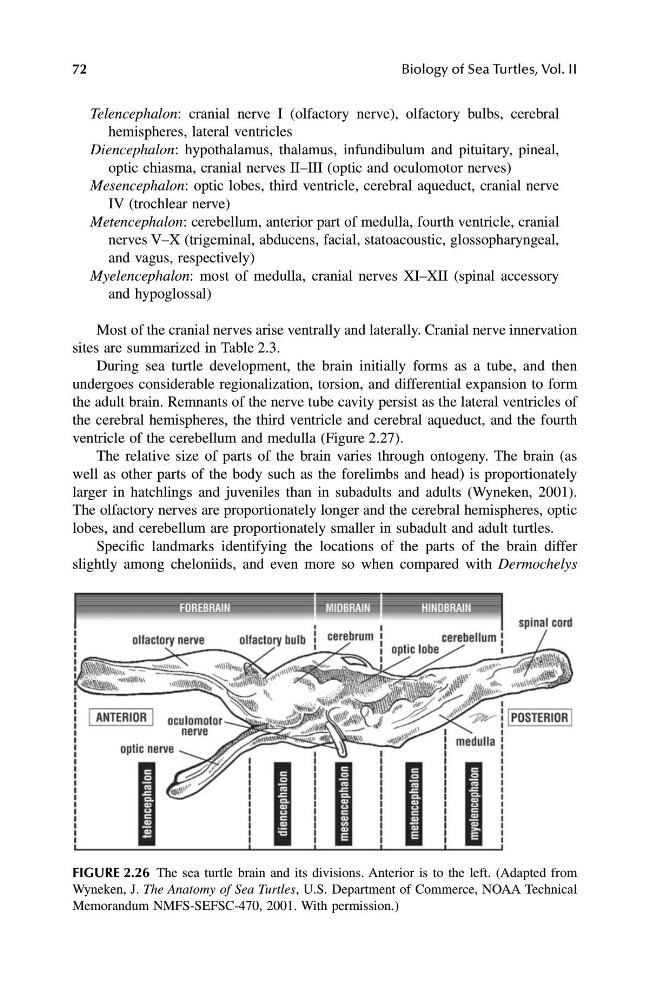
Telencephalon: cranial nerve I (olfactory nerve), olfactory bulbs, cerebral
hemispheres, lateral ventricles
Diencephalon: hypothalamus, thalamus, infundibulum and pituitary, pineal,
optic chiasma, cranial nerves II–III (optic and oculomotor nerves)
Mesencephalon: optic lobes, third ventricle, cerebral aqueduct, cranial nerve
IV (trochlear nerve)
Metencephalon: cerebellum, anterior part of medulla, fourth ventricle, cranial
nerves V–X (trigeminal, abducens, facial, statoacoustic, glossopharyngeal,
and vagus, respectively)
Myelencephalon: most of medulla, cranial nerves XI–XII (spinal accessory
and hypoglossal)
Most of the cranial nerves arise ventrally and laterally. Cranial nerve innervation
sites are summarized in Table 2.3.
During sea turtle development, the brain initially forms as a tube, and then
undergoes considerable regionalization, torsion, and differential expansion to form
the adult brain. Remnants of the nerve tube cavity persist as the lateral ventricles of
the cerebral hemispheres, the third ventricle and cerebral aqueduct, and the fourth
ventricle of the cerebellum and medulla (Figure 2.27).
The relative size of parts of the brain varies through ontogeny. The brain (as
well as other parts of the body such as the forelimbs and head) is proportionately
larger in hatchlings and juveniles than in subadults and adults (Wyneken, 2001).
The olfactory nerves are proportionately longer and the cerebral hemispheres, optic
lobes, and cerebellum are proportionately smaller in subadult and adult turtles.
Specific landmarks identifying the locations of the parts of the brain differ
slightly among cheloniids, and even more so when compared with Dermochelys
FIGURE 2.26 The sea turtle brain and its divisions. Anterior is to the left. (Adapted from
Wyneken, J. The Anatomy of Sea Turtles, U.S. Department of Commerce, NOAA Technical
Memorandum NMFS-SEFSC-470, 2001. With permission.)
1123_C02.fm Page 72 Friday, November 15, 2002 11:16 AM
Biology of Sea Turtles, Vol. II
Telencephalon: cranial nerve I (olfactory nerve), olfactory bulbs, cerebral
hemispheres, lateral ventricles
Diencephalon: hypothalamus, thalamus, infundibulum and pituitary, pineal,
optic chiasma, cranial nerves II–III (optic and oculomotor nerves)
Mesencephalon: optic lobes, third ventricle, cerebral aqueduct, cranial nerve
IV (trochlear nerve)
Metencephalon: cerebellum, anterior part of medulla, fourth ventricle, cranial
nerves V–X (trigeminal, abducens, facial, statoacoustic, glossopharyngeal,
and vagus, respectively)
Myelencephalon: most of medulla, cranial nerves XI–XII (spinal accessory
and hypoglossal)
Most of the cranial nerves arise ventrally and laterally. Cranial nerve innervation
sites are summarized in Table 2.3.
During sea turtle development, the brain initially forms as a tube, and then
undergoes considerable regionalization, torsion, and differential expansion to form
the adult brain. Remnants of the nerve tube cavity persist as the lateral ventricles of
the cerebral hemispheres, the third ventricle and cerebral aqueduct, and the fourth
ventricle of the cerebellum and medulla (Figure 2.27).
The relative size of parts of the brain varies through ontogeny. The brain (as
well as other parts of the body such as the forelimbs and head) is proportionately
larger in hatchlings and juveniles than in subadults and adults (Wyneken, 2001).
The olfactory nerves are proportionately longer and the cerebral hemispheres, optic
lobes, and cerebellum are proportionately smaller in subadult and adult turtles.
Specific landmarks identifying the locations of the parts of the brain differ
slightly among cheloniids, and even more so when compared with Dermochelys
FIGURE 2.26 The sea turtle brain and its divisions. Anterior is to the left. (Adapted from
Wyneken, J. The Anatomy of Sea Turtles, U.S. Department of Commerce, NOAA Technical
Memorandum NMFS-SEFSC-470, 2001. With permission.)
1123_C02.fm Page 72 Friday, November 15, 2002 11:16 AM