

3.1 Infrastructure standards
59
The current UML syntax allows for only one return value. If there are multiple return values they can be put in the parameter list with an "out" direction. Modified
persistent objects that appear in the parameter list are implied to be "inout". All other
parameters are "in".
Relationships and associations
A relationship in UML is a ratified semantic connection among model elements.
Generalization, dependency, and refinement are class-to-class relationships. In the
19100 family of standards, they are used according to the standard UML notation
and usage.
Association, aggregation, and composition are object-to-object relationships. An
association is used to describe a relationship between two or more classes. An aggregation is a relationship between two classes, in which one of the classes plays the
role of a container and the other plays the role of a content. A composition is a
strong aggregation. In a composition, if a container object is deleted, then all of its
content objects are deleted as weIl.
----_.[>
-<>
•
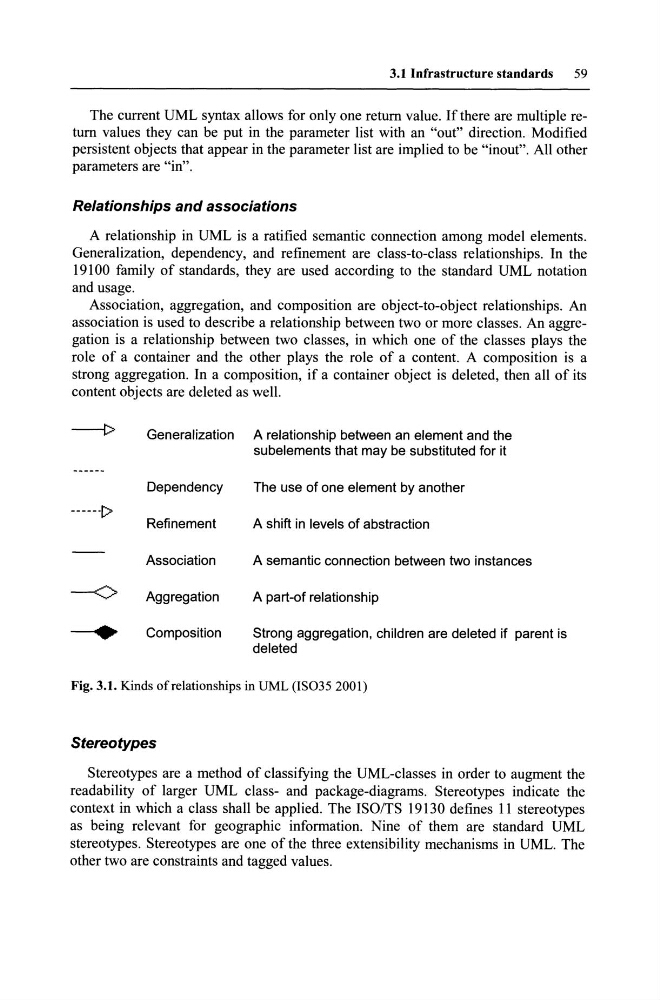
Generalization A relationship between an element and the
subelements that may be substituted for it
Dependency
Refinement
Association
Aggregation
Composition
The use of one element by another
A shift in levels of abstraction
A semantic connection between two instances
A part-of relationship
Strong aggregation, children are deleted if parent is
deleted
Fig. 3.1. Kinds ofrelationships in UML (IS035 2001)
Stereotypes
Stereotypes are a method of classifying the UML-classes in order to augment the
readability of larger UML class- and package-diagrams. Stereotypes indicate the
context in which a class shall be applied. The ISO/TS 19130 defines 11 stereotypes
as being relevant for geographie information. Nine of them are standard UML
stereotypes. Stereotypes are one of the three extensibility mechanisms in UML. The
other two are constraints and tagged values.
59
The current UML syntax allows for only one return value. If there are multiple return values they can be put in the parameter list with an "out" direction. Modified
persistent objects that appear in the parameter list are implied to be "inout". All other
parameters are "in".
Relationships and associations
A relationship in UML is a ratified semantic connection among model elements.
Generalization, dependency, and refinement are class-to-class relationships. In the
19100 family of standards, they are used according to the standard UML notation
and usage.
Association, aggregation, and composition are object-to-object relationships. An
association is used to describe a relationship between two or more classes. An aggregation is a relationship between two classes, in which one of the classes plays the
role of a container and the other plays the role of a content. A composition is a
strong aggregation. In a composition, if a container object is deleted, then all of its
content objects are deleted as weIl.
----_.[>
-<>
•
Generalization A relationship between an element and the
subelements that may be substituted for it
Dependency
Refinement
Association
Aggregation
Composition
The use of one element by another
A shift in levels of abstraction
A semantic connection between two instances
A part-of relationship
Strong aggregation, children are deleted if parent is
deleted
Fig. 3.1. Kinds ofrelationships in UML (IS035 2001)
Stereotypes
Stereotypes are a method of classifying the UML-classes in order to augment the
readability of larger UML class- and package-diagrams. Stereotypes indicate the
context in which a class shall be applied. The ISO/TS 19130 defines 11 stereotypes
as being relevant for geographie information. Nine of them are standard UML
stereotypes. Stereotypes are one of the three extensibility mechanisms in UML. The
other two are constraints and tagged values.