

1.5 Cultural and linguistic adaptability
23
In the field of metadata, the following strategies are suggested to address cultural
and linguistic adaptability requirements. The ISO/TC211 has primarily implemented
the methods in ISO 19115 (Metadata) and ISO 19135 (Procedures for registration of
geographical information items).
1. The use of an identifier as pivot between linguistic equivalencies
An identifier is defined as "a sequence of characters, capable of uniquely identifying that with which it is associated, within a specified context. A name should not be
used as an identifier because it is not linguistically neutral." (ISOIEC33 2003).
The standard ISO 19135 (Procedures for registration of geographie information)
will ease the use of identifiers by establishing registers.
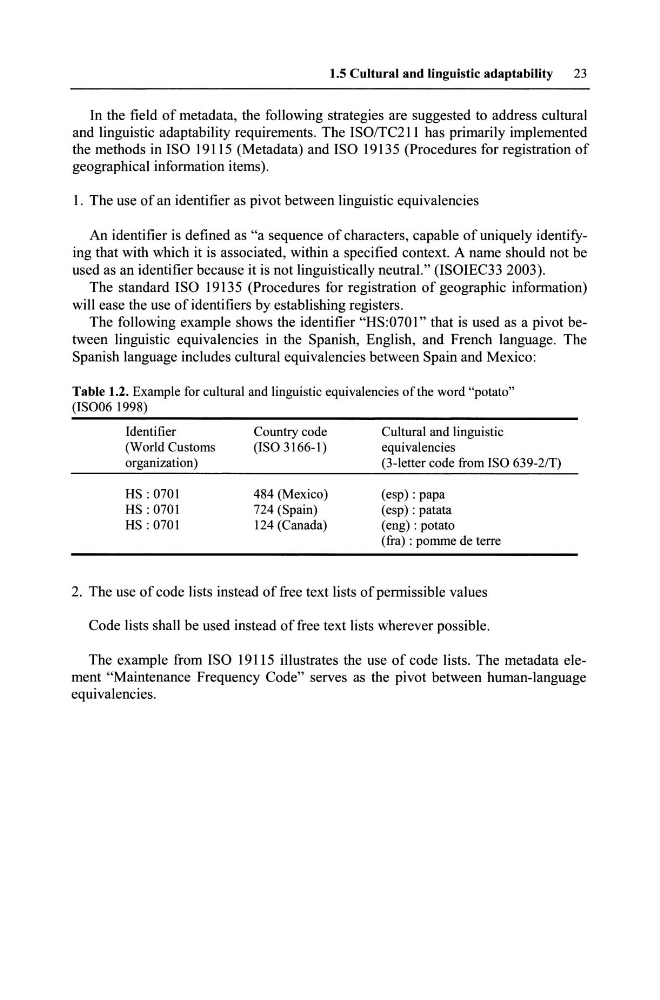
The following example shows the identifier "HS:0701" that is used as a pivot between linguistic equivalencies in the Spanish, English, and French language. The
Spanish language includes cultural equivalencies between Spain and Mexico:
Table 1.2. Example for cultural and linguistic equivalencies ofthe word "potato"
(IS006 1998)
Identifier
(World Customs
organization)
HS: 0701
HS: 0701
HS: 0701
Country code
(ISO 3166-1)
484 (Mexico)
724 (Spain)
124 (Canada)
Cultural and linguistic
equivalencies
(3-1etter code from ISO 639-2fT)
(esp) : papa
(esp) : patata
(eng) : potato
(fra) : pomme de teITe
2. The use of code lists instead of free text lists of permissible values
Code lists shall be used instead of free text lists wherever possible.
The example from ISO 19115 illustrates the use of code lists. The metadata element "Maintenance Frequency Code" serves as the pivot between human-Ianguage
equivalencies.
23
In the field of metadata, the following strategies are suggested to address cultural
and linguistic adaptability requirements. The ISO/TC211 has primarily implemented
the methods in ISO 19115 (Metadata) and ISO 19135 (Procedures for registration of
geographical information items).
1. The use of an identifier as pivot between linguistic equivalencies
An identifier is defined as "a sequence of characters, capable of uniquely identifying that with which it is associated, within a specified context. A name should not be
used as an identifier because it is not linguistically neutral." (ISOIEC33 2003).
The standard ISO 19135 (Procedures for registration of geographie information)
will ease the use of identifiers by establishing registers.
The following example shows the identifier "HS:0701" that is used as a pivot between linguistic equivalencies in the Spanish, English, and French language. The
Spanish language includes cultural equivalencies between Spain and Mexico:
Table 1.2. Example for cultural and linguistic equivalencies ofthe word "potato"
(IS006 1998)
Identifier
(World Customs
organization)
HS: 0701
HS: 0701
HS: 0701
Country code
(ISO 3166-1)
484 (Mexico)
724 (Spain)
124 (Canada)
Cultural and linguistic
equivalencies
(3-1etter code from ISO 639-2fT)
(esp) : papa
(esp) : patata
(eng) : potato
(fra) : pomme de teITe
2. The use of code lists instead of free text lists of permissible values
Code lists shall be used instead of free text lists wherever possible.
The example from ISO 19115 illustrates the use of code lists. The metadata element "Maintenance Frequency Code" serves as the pivot between human-Ianguage
equivalencies.