

176
4 Geometry standards
times take the point of view where it is assumed that eaeh pixel value is the weighted
average measurement of the seene, taken over a grid eell eentred on a grid point.
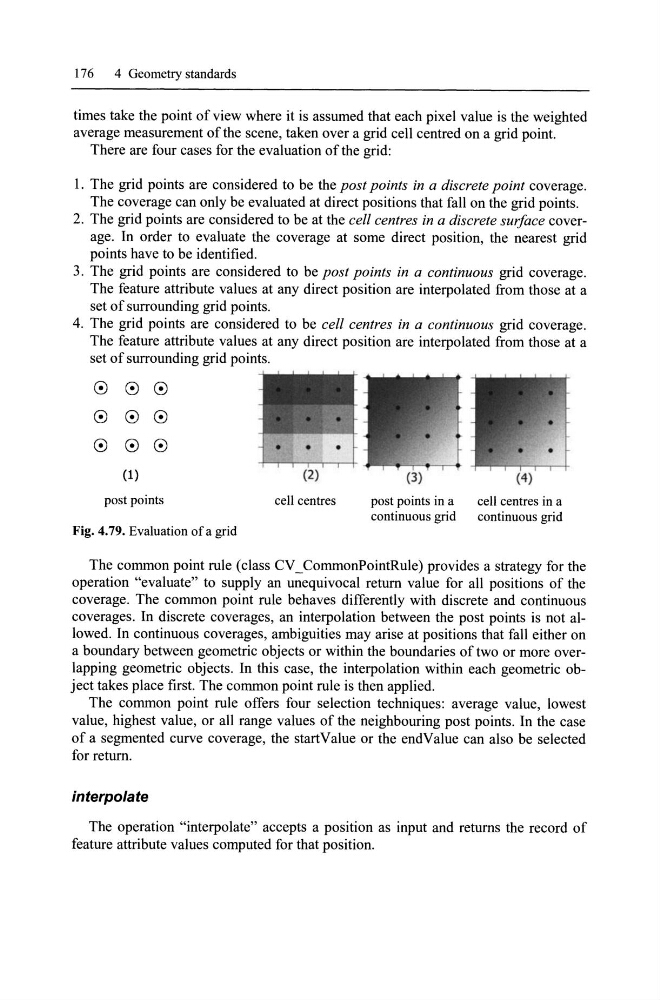
There are four eases for the evaluation ofthe grid:
1. The grid points are eonsidered to be the post points in a discrete point eoverage.
The eoverage ean only be evaluated at direet positions that fall on the grid points.
2. The grid points are eonsidered to be at the cell centres in a discrete surface eoverage. In order to evaluate the eoverage at some direet position, the nearest grid
points have to be identified.
3. The grid points are eonsidered to be post points in a continuous grid eoverage.
The feature attribute values at any direet position are interpolated from those at a
set of surrounding grid points.
4. The grid points are eonsidered to be cell centres in a continuous grid eoverage.
The feature attribute values at any direet position are interpolated from those at a
set of surrounding grid points.
0 0 0
0 0 0
0 0 0
(1)
post points
cell centres
post points in a
cell centres in a
continuous grid
continuous grid
Fig. 4.79. Evaluation of a grid
The eommon point role (c1ass CV _ CommonPointRule) provides a strategy for the
operation "evaluate" to supply an unequivoeal return value for all positions of the
eoverage. The eommon point role behaves differently with diserete and eontinuous
eoverages. In diserete eoverages, an interpolation between the post points is not allowed. In eontinuous eoverages, ambiguities may arise at positions that fall either on
a boundary between geometrie objeets or within the boundaries oftwo or more overlapping geometrie objeets. In this ease, the interpolation within eaeh geometrie objeet takes plaee first. The eommon point role is then applied.
The eommon point role offers four seleetion teehniques: average value, lowest
value, highest value, or all range values of the neighbouring post points. In the ease
of a segmented eurve eoverage, the startValue or the endValue ean also be seleeted
for return.
in terpola te
The operation "interpolate" aeeepts a position as input and returns the reeord of
feature attribute values computed for that position.
4 Geometry standards
times take the point of view where it is assumed that eaeh pixel value is the weighted
average measurement of the seene, taken over a grid eell eentred on a grid point.
There are four eases for the evaluation ofthe grid:
1. The grid points are eonsidered to be the post points in a discrete point eoverage.
The eoverage ean only be evaluated at direet positions that fall on the grid points.
2. The grid points are eonsidered to be at the cell centres in a discrete surface eoverage. In order to evaluate the eoverage at some direet position, the nearest grid
points have to be identified.
3. The grid points are eonsidered to be post points in a continuous grid eoverage.
The feature attribute values at any direet position are interpolated from those at a
set of surrounding grid points.
4. The grid points are eonsidered to be cell centres in a continuous grid eoverage.
The feature attribute values at any direet position are interpolated from those at a
set of surrounding grid points.
0 0 0
0 0 0
0 0 0
(1)
post points
cell centres
post points in a
cell centres in a
continuous grid
continuous grid
Fig. 4.79. Evaluation of a grid
The eommon point role (c1ass CV _ CommonPointRule) provides a strategy for the
operation "evaluate" to supply an unequivoeal return value for all positions of the
eoverage. The eommon point role behaves differently with diserete and eontinuous
eoverages. In diserete eoverages, an interpolation between the post points is not allowed. In eontinuous eoverages, ambiguities may arise at positions that fall either on
a boundary between geometrie objeets or within the boundaries oftwo or more overlapping geometrie objeets. In this ease, the interpolation within eaeh geometrie objeet takes plaee first. The eommon point role is then applied.
The eommon point role offers four seleetion teehniques: average value, lowest
value, highest value, or all range values of the neighbouring post points. In the ease
of a segmented eurve eoverage, the startValue or the endValue ean also be seleeted
for return.
in terpola te
The operation "interpolate" aeeepts a position as input and returns the reeord of
feature attribute values computed for that position.