

4.5 Schema for coverage geometry and functions (ISO 19123)
175
The table 4.2 relates the important operations of coverages to the classes in ISO
19123. Some operations of the subclasses of CV _TINCoverage and CV _SegmentedCurveCoverage are not shown.
The operations "curve" and "segment" are only used with
CV _SegmentedCurveCoverages. All other coverage types use the operation "locate".
evaluation, evaluatelnverse, and locate
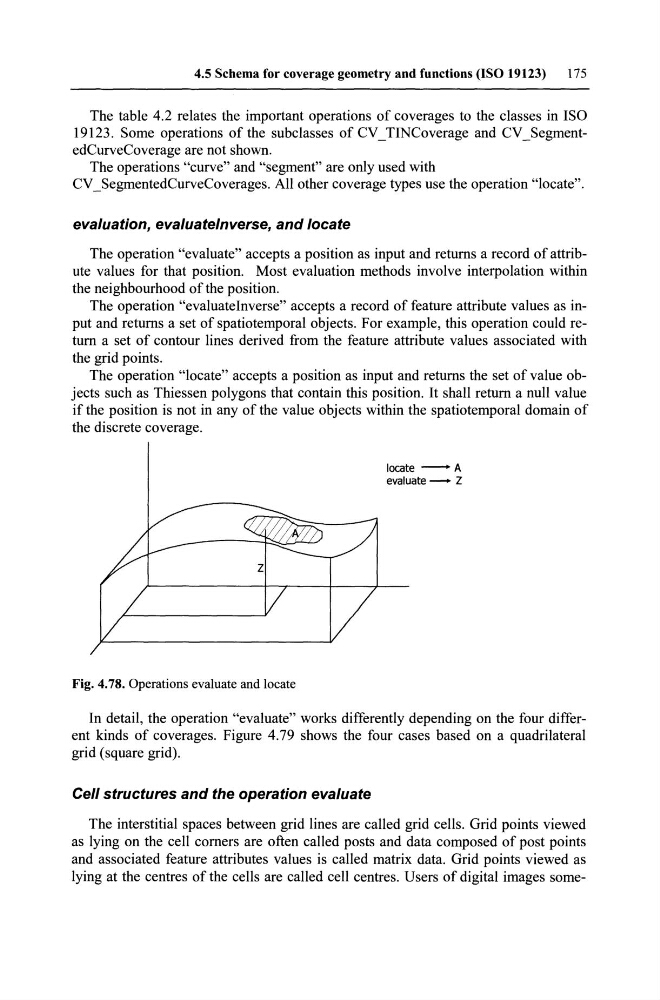
The operation "evaluate" accepts a position as input and returns arecord of attribute values for that position. Most evaluation methods involve interpolation within
the neighbourhood ofthe position.
The operation "evaluateInverse" accepts arecord of feature attribute values as input and returns a set of spatiotemporal objects. For example, this operation could return a set of contour lines derived from the feature attribute values associated with
the grid points.
The operation "locate" accepts a position as input and returns the set of value objects such as Thiessen polygons that contain this position. It shall return a null value
ifthe position is not in any ofthe value objects within the spatiotemporal domain of
the discrete coverage.
Fig. 4.78. Operations evaluate and locate
locate - A
evaluate- Z
In detail, the operation "evaluate" works differently depending on the four different kinds of coverages. Figure 4.79 shows the four cases based on a quadrilateral
grid (square grid).
Cell structures and the operation evaluate
The interstitial spaces between grid lines are called grid cells. Grid points viewed
as lying on the cell corners are often called posts and data composed of post points
and associated feature attributes values is called matrix data. Grid points viewed as
lying at the centres of the cells are called cell centres. Users of digital images some-
175
The table 4.2 relates the important operations of coverages to the classes in ISO
19123. Some operations of the subclasses of CV _TINCoverage and CV _SegmentedCurveCoverage are not shown.
The operations "curve" and "segment" are only used with
CV _SegmentedCurveCoverages. All other coverage types use the operation "locate".
evaluation, evaluatelnverse, and locate
The operation "evaluate" accepts a position as input and returns arecord of attribute values for that position. Most evaluation methods involve interpolation within
the neighbourhood ofthe position.
The operation "evaluateInverse" accepts arecord of feature attribute values as input and returns a set of spatiotemporal objects. For example, this operation could return a set of contour lines derived from the feature attribute values associated with
the grid points.
The operation "locate" accepts a position as input and returns the set of value objects such as Thiessen polygons that contain this position. It shall return a null value
ifthe position is not in any ofthe value objects within the spatiotemporal domain of
the discrete coverage.
Fig. 4.78. Operations evaluate and locate
locate - A
evaluate- Z
In detail, the operation "evaluate" works differently depending on the four different kinds of coverages. Figure 4.79 shows the four cases based on a quadrilateral
grid (square grid).
Cell structures and the operation evaluate
The interstitial spaces between grid lines are called grid cells. Grid points viewed
as lying on the cell corners are often called posts and data composed of post points
and associated feature attributes values is called matrix data. Grid points viewed as
lying at the centres of the cells are called cell centres. Users of digital images some-