

164
4 Geometry standards
nates is stored together with every feature. This means that at one position, more
than one point can exist. This approach is well known from CAD-type systems.
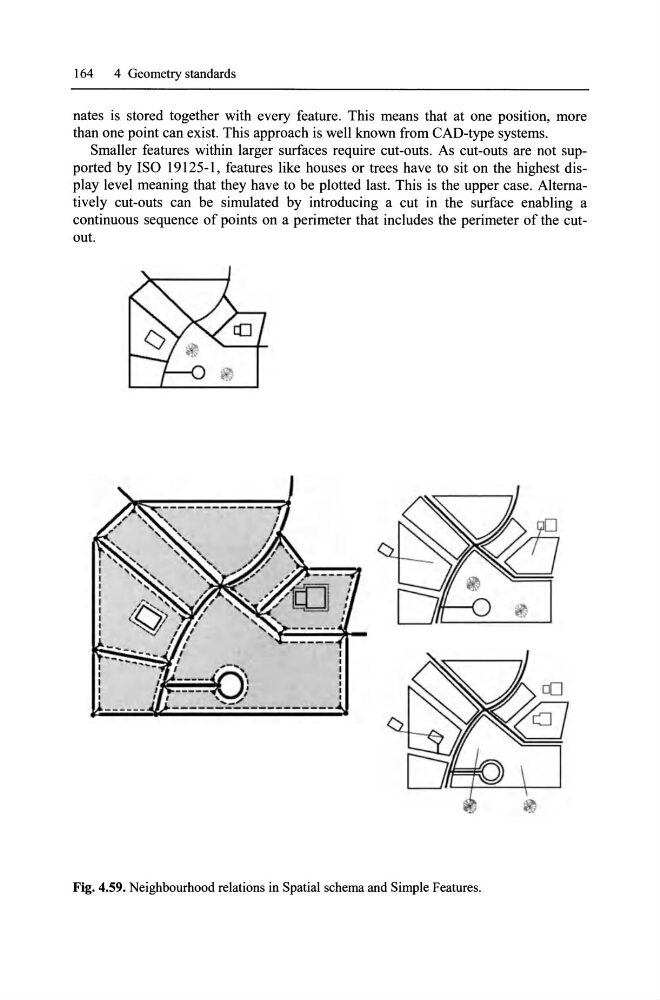
Smaller features within larger surfaces require cut-outs. As cut-outs are not supported by ISO 19125-1, features like houses or trees have to sit on the highest display level meaning that they have to be plotted last. This is the upper case. Altematively cut-outs can be simulated by introducing a cut in the surface enabling a
continuous sequence of points on a perimeter that includes the perimeter of the cutout.
Fig. 4.59. Neighbourhood relations in Spatial schema and Simple Features.
4 Geometry standards
nates is stored together with every feature. This means that at one position, more
than one point can exist. This approach is well known from CAD-type systems.
Smaller features within larger surfaces require cut-outs. As cut-outs are not supported by ISO 19125-1, features like houses or trees have to sit on the highest display level meaning that they have to be plotted last. This is the upper case. Altematively cut-outs can be simulated by introducing a cut in the surface enabling a
continuous sequence of points on a perimeter that includes the perimeter of the cutout.
Fig. 4.59. Neighbourhood relations in Spatial schema and Simple Features.