

122 3 Non-geometry standards
there are up to 4 turns which exit that link and enter into one of the links leaving that
node including the one that reverses the incoming link.
The description of a network includes constraints such as vehicle constraints,
temporal constraints, and lane constraints.
A navigation service delivers the optimal route between two positions within a
network and guides the vehicle along that route.
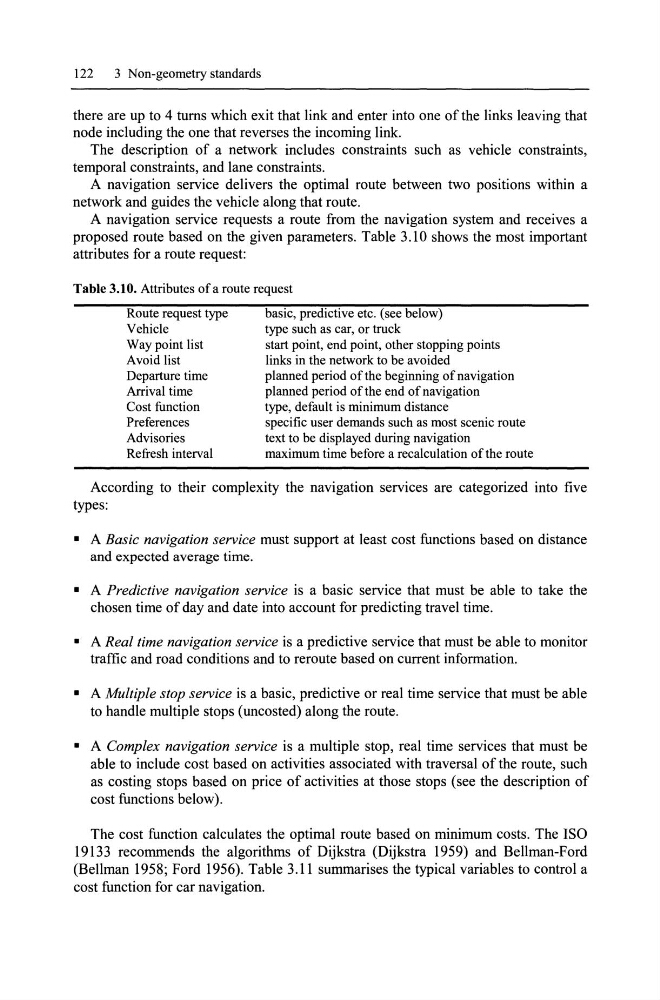
A navigation service requests a route from the navigation system and receives a
proposed route based on the given parameters. Table 3.10 shows the most important
attributes for a route request:
Table 3.10. Attributes of a route request
Route request type
Vehic1e
Way point list
Avoid list
Departure time
Arrival time
Cost function
Preferences
Advisories
Refresh interval
basic, predictive etc. (see below)
type such as car, or truck
start point, end point, other stopping points
links in the network to be avoided
planned period ofthe beginning ofnavigation
planned period ofthe end ofnavigation
type, default is minimum distance
specific user demands such as most scenic route
text to be displayed during navigation
maximum time before a recalculation ofthe route
According to their complexity the navigation services are categorized into five
types:
• A Basic navigation service must support at least cost functions based on distance
and expected average time.
• A Predictive navigation service is a basic service that must be able to take the
chosen time of day and date into account for predicting travel time.
• A Real time navigation service is a predictive service that must be able to monitor
trafik and road conditions and to reroute based on current information.
• A Multiple stop service is a basic, predictive or real time service that must be able
to handle multiple stops (uncosted) along the route.
• A Complex navigation service is a multiple stop, real time services that must be
able to include cost based on activities associated with traversal of the route, such
as costing stops based on price of activities at those stops (see the description of
cost functions below).
The cost function calculates the optimal route based on minimum costs. The ISO
19133 recommends the algorithms of Dijkstra (Dijkstra 1959) and Bellman-Ford
(Bellman 1958; Ford 1956). Table 3.11 summarises the typical variables to control a
cost function for car navigation.
there are up to 4 turns which exit that link and enter into one of the links leaving that
node including the one that reverses the incoming link.
The description of a network includes constraints such as vehicle constraints,
temporal constraints, and lane constraints.
A navigation service delivers the optimal route between two positions within a
network and guides the vehicle along that route.
A navigation service requests a route from the navigation system and receives a
proposed route based on the given parameters. Table 3.10 shows the most important
attributes for a route request:
Table 3.10. Attributes of a route request
Route request type
Vehic1e
Way point list
Avoid list
Departure time
Arrival time
Cost function
Preferences
Advisories
Refresh interval
basic, predictive etc. (see below)
type such as car, or truck
start point, end point, other stopping points
links in the network to be avoided
planned period ofthe beginning ofnavigation
planned period ofthe end ofnavigation
type, default is minimum distance
specific user demands such as most scenic route
text to be displayed during navigation
maximum time before a recalculation ofthe route
According to their complexity the navigation services are categorized into five
types:
• A Basic navigation service must support at least cost functions based on distance
and expected average time.
• A Predictive navigation service is a basic service that must be able to take the
chosen time of day and date into account for predicting travel time.
• A Real time navigation service is a predictive service that must be able to monitor
trafik and road conditions and to reroute based on current information.
• A Multiple stop service is a basic, predictive or real time service that must be able
to handle multiple stops (uncosted) along the route.
• A Complex navigation service is a multiple stop, real time services that must be
able to include cost based on activities associated with traversal of the route, such
as costing stops based on price of activities at those stops (see the description of
cost functions below).
The cost function calculates the optimal route based on minimum costs. The ISO
19133 recommends the algorithms of Dijkstra (Dijkstra 1959) and Bellman-Ford
(Bellman 1958; Ford 1956). Table 3.11 summarises the typical variables to control a
cost function for car navigation.