

3.6 Qualifications and certification of personnel
(ISO/TR 19122)
123
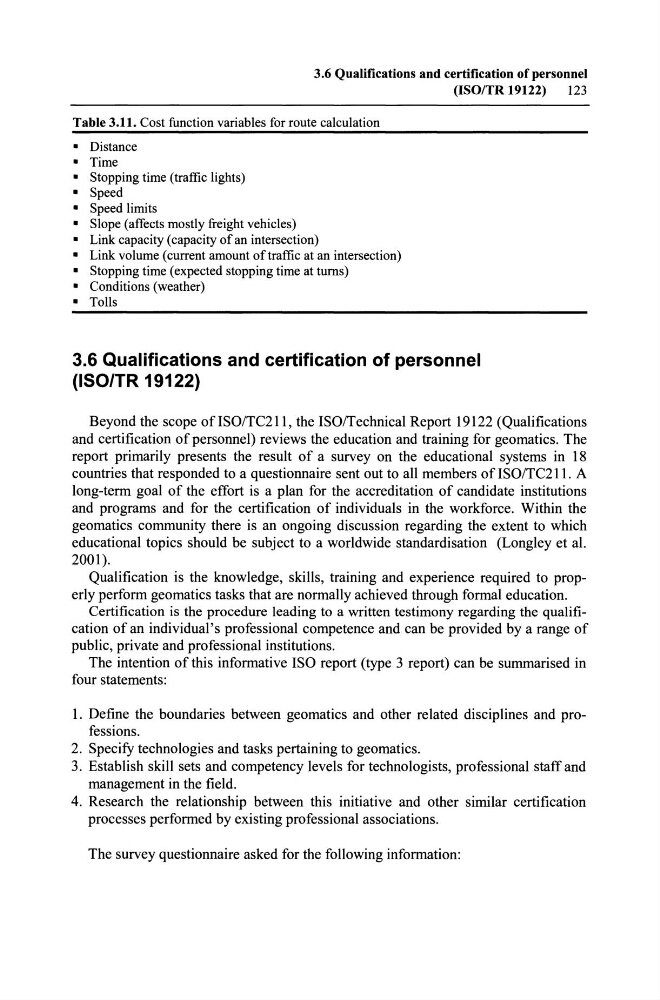
Table 3.11. Cost function variables for route calculation
• Distance
• Time
• Stopping time (trafik lights)
• Speed
• Speed limits
• Slope (affects mostly freight vehicles)
• Link capacity (capacity of an intersection)
• Link volume (current amount oftraffic at an intersection)
• Stopping time (expected stopping time at turns)
• Conditions (weather)
• Tolls
3.6 Qualifications and certification of personnel
(ISO/TR 19122)
Beyond the scope oflSO/TC211, the ISOlTechnical Report 19122 (Qualifications
and certification of personnel) reviews the education and training for geomatics. The
report primarily presents the result of a survey on the educational systems in 18
countries that responded to a questionnaire sent out to all members of ISOITC211. A
long-term goal of the effort is a plan for the accreditation of candidate institutions
and programs and for the certification of individuals in the workforce. Within the
geomatics community there is an ongoing discussion regarding the extent to which
educational topics should be subject to a worldwide standardisation (Longley et al.
2001).
Qualification is the knowledge, skills, training and experience required to properly perform geomatics tasks that are normally achieved through formal education.
Certification is the procedure leading to a wrirten testimony regarding the qualification of an individual's professional competence and can be provided by a range of
public, private and professional institutions.
The intention of this informative ISO report (type 3 report) can be surnmarised in
four statements:
I. Define the boundaries between geomatics and other related disciplines and professions.
2. Specify technologies and tasks pertaining to geomatics.
3. Establish skill sets and competency levels for technologists, professional staff and
management in the field.
4. Research the relationship between this initiative and other similar certification
processes performed by existing professional associations.
The survey questionnaire asked for the following information:
(ISO/TR 19122)
123
Table 3.11. Cost function variables for route calculation
• Distance
• Time
• Stopping time (trafik lights)
• Speed
• Speed limits
• Slope (affects mostly freight vehicles)
• Link capacity (capacity of an intersection)
• Link volume (current amount oftraffic at an intersection)
• Stopping time (expected stopping time at turns)
• Conditions (weather)
• Tolls
3.6 Qualifications and certification of personnel
(ISO/TR 19122)
Beyond the scope oflSO/TC211, the ISOlTechnical Report 19122 (Qualifications
and certification of personnel) reviews the education and training for geomatics. The
report primarily presents the result of a survey on the educational systems in 18
countries that responded to a questionnaire sent out to all members of ISOITC211. A
long-term goal of the effort is a plan for the accreditation of candidate institutions
and programs and for the certification of individuals in the workforce. Within the
geomatics community there is an ongoing discussion regarding the extent to which
educational topics should be subject to a worldwide standardisation (Longley et al.
2001).
Qualification is the knowledge, skills, training and experience required to properly perform geomatics tasks that are normally achieved through formal education.
Certification is the procedure leading to a wrirten testimony regarding the qualification of an individual's professional competence and can be provided by a range of
public, private and professional institutions.
The intention of this informative ISO report (type 3 report) can be surnmarised in
four statements:
I. Define the boundaries between geomatics and other related disciplines and professions.
2. Specify technologies and tasks pertaining to geomatics.
3. Establish skill sets and competency levels for technologists, professional staff and
management in the field.
4. Research the relationship between this initiative and other similar certification
processes performed by existing professional associations.
The survey questionnaire asked for the following information: