

312
J. Robertson et al.
SANDEEL RESULTS:
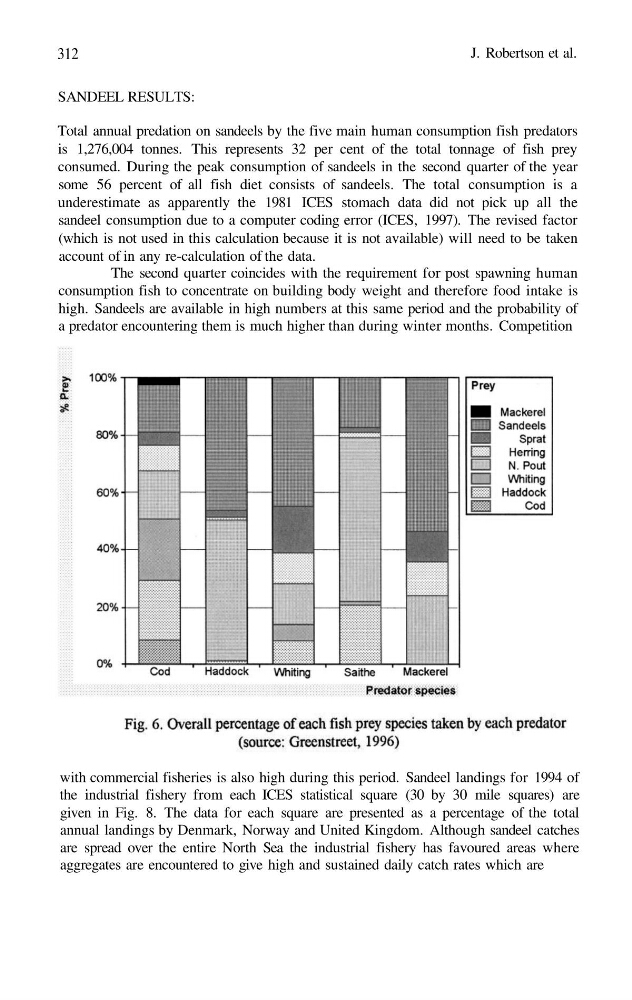
Total annual predation on sandeels by the five main human consumption fish predators
is 1,276,004 tonnes. This represents 32 per cent of the total tonnage of fish prey
consumed. During the peak consumption of sandeels in the second quarter of the year
some 56 percent of all fish diet consists of sandeels. The total consumption is a
underestimate as apparently the 1981 ICES stomach data did not pick up all the
sandeel consumption due to a computer coding error (ICES, 1997). The revised factor
(which is not used in this calculation because it is not available) will need to be taken
account of in any re-calculation of the data.
The second quarter coincides with the requirement for post spawning human
consumption fish to concentrate on building body weight and therefore food intake is
high. Sandeels are available in high numbers at this same period and the probability of
a predator encountering them is much higher than during winter months. Competition
with commercial fisheries is also high during this period. Sandeel landings for 1994 of
the industrial fishery from each ICES statistical square (30 by 30 mile squares) are
given in Fig. 8. The data for each square are presented as a percentage of the total
annual landings by Denmark, Norway and United Kingdom. Although sandeel catches
are spread over the entire North Sea the industrial fishery has favoured areas where
aggregates are encountered to give high and sustained daily catch rates which are
J. Robertson et al.
SANDEEL RESULTS:
Total annual predation on sandeels by the five main human consumption fish predators
is 1,276,004 tonnes. This represents 32 per cent of the total tonnage of fish prey
consumed. During the peak consumption of sandeels in the second quarter of the year
some 56 percent of all fish diet consists of sandeels. The total consumption is a
underestimate as apparently the 1981 ICES stomach data did not pick up all the
sandeel consumption due to a computer coding error (ICES, 1997). The revised factor
(which is not used in this calculation because it is not available) will need to be taken
account of in any re-calculation of the data.
The second quarter coincides with the requirement for post spawning human
consumption fish to concentrate on building body weight and therefore food intake is
high. Sandeels are available in high numbers at this same period and the probability of
a predator encountering them is much higher than during winter months. Competition
with commercial fisheries is also high during this period. Sandeel landings for 1994 of
the industrial fishery from each ICES statistical square (30 by 30 mile squares) are
given in Fig. 8. The data for each square are presented as a percentage of the total
annual landings by Denmark, Norway and United Kingdom. Although sandeel catches
are spread over the entire North Sea the industrial fishery has favoured areas where
aggregates are encountered to give high and sustained daily catch rates which are