

40 Marine Macro- and Microalgae: An Overview
G.2 Summary of the comments received
The reactions by stakeholders included an interest in vessel usage, job creation, and expected increases
in incomes gained through these project activities. They did not express any significant feelings against
the project.
Prospects: New paradigm of mitigation and adaptation—seaweed solution
Verification of this seaweed mechanism as an effective CO 2 sink, thereby leading to seaweed CDM
methodologies, has been the ultimate objective of this project (Chung et al. 2013). As the global climate
changes, the structure and function of the marine ecosystem will be significantly altered. In response, we
should develop appropriate measures that exploit the role of marine vegetation as a tool for mitigation
and adaptation (Turan and Neori 2010).
Our seaweed CDM project, here in its first trial, is a major challenge. Sustainable production, in
the form of a seaweed-integrated multi-trophic aquaculture system (Chopin et al. 2001), is the essential
prerequisite to achievement. For this the relevant regions must be appropriately controlled under
management schemes for Ecosystem-Based Aquaculture and Integrated Coastal Zones (Chung et al.
2002).
When new seaweed communities are cultivated and restored in coastal waters and also expanded
offshore with artificial substrates, a tremendous amount of greenhouse gases can be sequestered.
Harvesting this biomass for subsequent conversion to biofuel (Chynoweth 2002) or paper (Seo et al. 2010)
is a promising measure to counteract global warming. When these circumstances are considered, actual
approval of a seaweed CDM project by the UNFCCC will lead to enhanced, sustainable management of
marine environment and marine resources, thereby greatly benefitting coastal communities.
Acknowledgements
This work has been supported by a “GHG emissions reduction using seaweeds” Project funded by the
Korean Ministry of Oceans and Fisheries, a grant from the National Research Foundation of Korea (NRF2016R1A2B1013637) to IKC, and the APPA Working Group, “Asian Network for using algae as a CO 2
sink.”
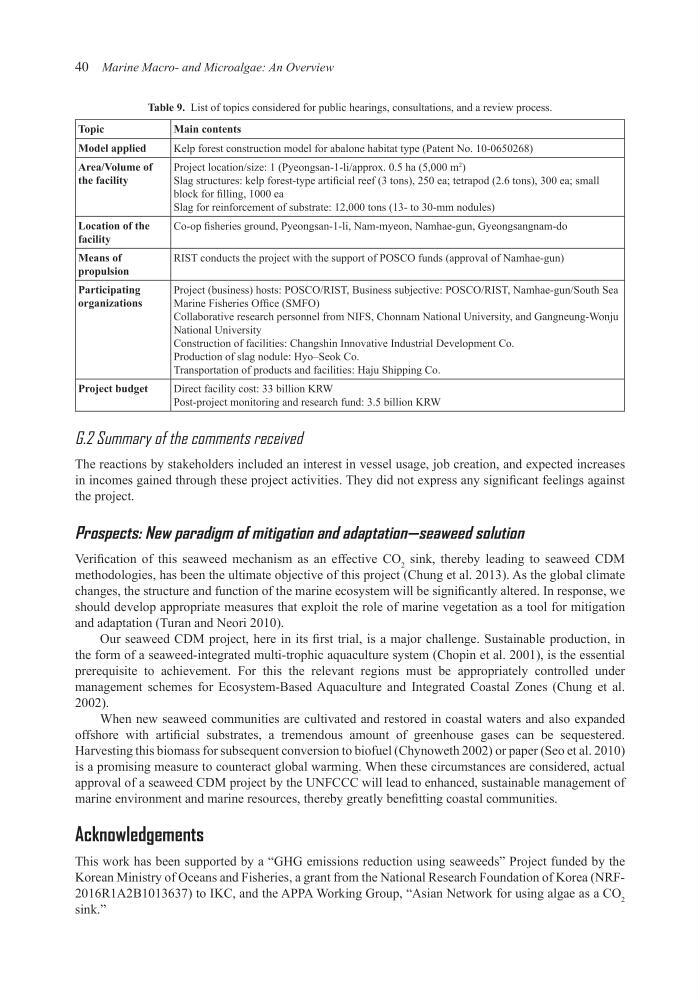
Table 9. List of topics considered for public hearings, consultations, and a review process.
Topic
Main contents
Model applied
Kelp forest construction model for abalone habitat type (Patent No. 10-0650268)
Area/Volume of
the facility
Project location/size: 1 (Pyeongsan-1-li/approx. 0.5 ha (5,000 m
2
)
Slag structures: kelp forest-type artificial reef (3 tons), 250 ea; tetrapod (2.6 tons), 300 ea; small
block for filling, 1000 ea
Slag for reinforcement of substrate: 12,000 tons (13- to 30-mm nodules)
Location of the
facility
Co-op fisheries ground, Pyeongsan-1-li, Nam-myeon, Namhae-gun, Gyeongsangnam-do
Means of
propulsion
RIST conducts the project with the support of POSCO funds (approval of Namhae-gun)
Participating
organizations
Project (business) hosts: POSCO/RIST, Business subjective: POSCO/RIST, Namhae-gun/South Sea
Marine Fisheries Office (SMFO)
Collaborative research personnel from NIFS, Chonnam National University, and Gangneung-Wonju
National University
Construction of facilities: Changshin Innovative Industrial Development Co.
Production of slag nodule: Hyo–Seok Co.
Transportation of products and facilities: Haju Shipping Co.
Project budget
Direct facility cost: 33 billion KRW
Post-project monitoring and research fund: 3.5 billion KRW
G.2 Summary of the comments received
The reactions by stakeholders included an interest in vessel usage, job creation, and expected increases
in incomes gained through these project activities. They did not express any significant feelings against
the project.
Prospects: New paradigm of mitigation and adaptation—seaweed solution
Verification of this seaweed mechanism as an effective CO 2 sink, thereby leading to seaweed CDM
methodologies, has been the ultimate objective of this project (Chung et al. 2013). As the global climate
changes, the structure and function of the marine ecosystem will be significantly altered. In response, we
should develop appropriate measures that exploit the role of marine vegetation as a tool for mitigation
and adaptation (Turan and Neori 2010).
Our seaweed CDM project, here in its first trial, is a major challenge. Sustainable production, in
the form of a seaweed-integrated multi-trophic aquaculture system (Chopin et al. 2001), is the essential
prerequisite to achievement. For this the relevant regions must be appropriately controlled under
management schemes for Ecosystem-Based Aquaculture and Integrated Coastal Zones (Chung et al.
2002).
When new seaweed communities are cultivated and restored in coastal waters and also expanded
offshore with artificial substrates, a tremendous amount of greenhouse gases can be sequestered.
Harvesting this biomass for subsequent conversion to biofuel (Chynoweth 2002) or paper (Seo et al. 2010)
is a promising measure to counteract global warming. When these circumstances are considered, actual
approval of a seaweed CDM project by the UNFCCC will lead to enhanced, sustainable management of
marine environment and marine resources, thereby greatly benefitting coastal communities.
Acknowledgements
This work has been supported by a “GHG emissions reduction using seaweeds” Project funded by the
Korean Ministry of Oceans and Fisheries, a grant from the National Research Foundation of Korea (NRF2016R1A2B1013637) to IKC, and the APPA Working Group, “Asian Network for using algae as a CO 2
sink.”
Table 9. List of topics considered for public hearings, consultations, and a review process.
Topic
Main contents
Model applied
Kelp forest construction model for abalone habitat type (Patent No. 10-0650268)
Area/Volume of
the facility
Project location/size: 1 (Pyeongsan-1-li/approx. 0.5 ha (5,000 m
2
)
Slag structures: kelp forest-type artificial reef (3 tons), 250 ea; tetrapod (2.6 tons), 300 ea; small
block for filling, 1000 ea
Slag for reinforcement of substrate: 12,000 tons (13- to 30-mm nodules)
Location of the
facility
Co-op fisheries ground, Pyeongsan-1-li, Nam-myeon, Namhae-gun, Gyeongsangnam-do
Means of
propulsion
RIST conducts the project with the support of POSCO funds (approval of Namhae-gun)
Participating
organizations
Project (business) hosts: POSCO/RIST, Business subjective: POSCO/RIST, Namhae-gun/South Sea
Marine Fisheries Office (SMFO)
Collaborative research personnel from NIFS, Chonnam National University, and Gangneung-Wonju
National University
Construction of facilities: Changshin Innovative Industrial Development Co.
Production of slag nodule: Hyo–Seok Co.
Transportation of products and facilities: Haju Shipping Co.
Project budget
Direct facility cost: 33 billion KRW
Post-project monitoring and research fund: 3.5 billion KRW