

312 Marine Macro- and Microalgae: An Overview
increase by a factor of over 8,000 over what it is today. Therefore, microalgae production today has little
potential to reduce carbon emissions.
Commercial production of microalgae, however, also produces CO 2 . Energy is required for
cultivation, harvesting, processing (including drying), and formulation (whether for feed, food, or fuel). A
recent study (Taylor et al. 2013) suggests that for microalgal-based fuel production to be carbon negative
(consume more CO 2 than it produces) two conditions must be met: (1) the energy inputs into the plant
must be produced via carbon neutral renewable energy generation such as concentrated solar power and
(2) carbon containing coproducts must be produced that would not be later burnt (such as glycerol). One
would also take credit for the CO 2 releases avoided by not burning non-renewable fossil fuel.
A similar situation can be assumed to exist for feed and food applications: one may expect that the
use of renewable, carbon neutral, energy plus the credits of CO 2 avoided by not producing food and feed
via standard processes could result in CO 2 savings. One might imagine that once renewable energy is
available at the same cost as fossil energy the transition will occur. In the meantime, only the CO 2 credits
generated via emissions avoidance can be counted on. In the interim, we expect that CO 2 capture via
microalgal photosynthesis will not significantly slowdown the increase in global atmospheric CO 2 but
it could be useful to decrease emissions from point sources in places where regulations or costs would
encourage capture of produced CO 2 .
Other ecological and human impacts
Besides those impacts explored above, there are others of a more ecological and human nature that
microalgae can have a large positive effect on. First, the decimation of wild fisheries to supply feed
ingredients to the aquaculture industry can be limited and even reversed with the use of feed ingredients
of microalgal origin. Second, microalgae can supply foodstuffs to bolster the nutritional and economic
wellbeing of disadvantaged human populations.
Aquaculture feed replacements
Aquaculture feeds is the fastest growing sector of the animal feeds industry worldwide increasing at 6–8%
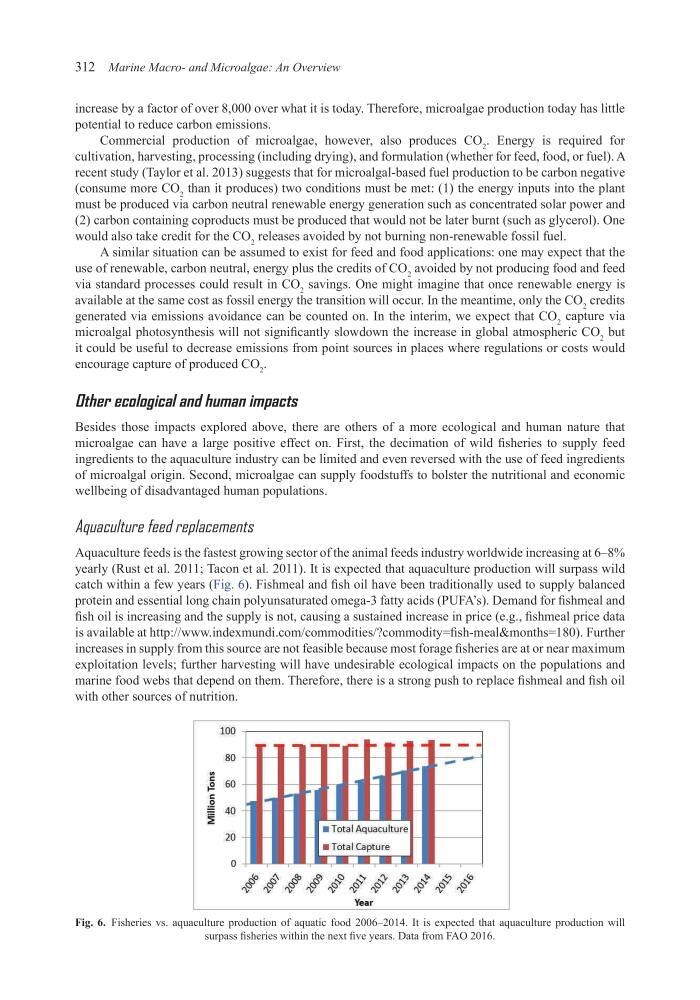
yearly (Rust et al. 2011; Tacon et al. 2011). It is expected that aquaculture production will surpass wild
catch within a few years (Fig. 6). Fishmeal and fish oil have been traditionally used to supply balanced
protein and essential long chain polyunsaturated omega-3 fatty acids (PUFA’s). Demand for fishmeal and
fish oil is increasing and the supply is not, causing a sustained increase in price (e.g., fishmeal price data
is available at http://www.indexmundi.com/commodities/?commodity=fish-meal&months=180). Further
increases in supply from this source are not feasible because most forage fisheries are at or near maximum
exploitation levels; further harvesting will have undesirable ecological impacts on the populations and
marine food webs that depend on them. Therefore, there is a strong push to replace fishmeal and fish oil
with other sources of nutrition.
Fig. 6. Fisheries vs. aquaculture production of aquatic food 2006–2014. It is expected that aquaculture production will
surpass fisheries within the next five years. Data from FAO 2016.
100
80
.,
c: 60
~
c:
~
~
40
20
0
- - - - - . - --""
-
.. ...
1~
1~
..
r- r• Total Aquaculture
r- r• Total Capture
~ ~ ~ ~ ~ ~ ~ ~ ~ ~ ~
~ ~ ~ ~ ~ ~ ~ ~ ~ ~ ~
Year
increase by a factor of over 8,000 over what it is today. Therefore, microalgae production today has little
potential to reduce carbon emissions.
Commercial production of microalgae, however, also produces CO 2 . Energy is required for
cultivation, harvesting, processing (including drying), and formulation (whether for feed, food, or fuel). A
recent study (Taylor et al. 2013) suggests that for microalgal-based fuel production to be carbon negative
(consume more CO 2 than it produces) two conditions must be met: (1) the energy inputs into the plant
must be produced via carbon neutral renewable energy generation such as concentrated solar power and
(2) carbon containing coproducts must be produced that would not be later burnt (such as glycerol). One
would also take credit for the CO 2 releases avoided by not burning non-renewable fossil fuel.
A similar situation can be assumed to exist for feed and food applications: one may expect that the
use of renewable, carbon neutral, energy plus the credits of CO 2 avoided by not producing food and feed
via standard processes could result in CO 2 savings. One might imagine that once renewable energy is
available at the same cost as fossil energy the transition will occur. In the meantime, only the CO 2 credits
generated via emissions avoidance can be counted on. In the interim, we expect that CO 2 capture via
microalgal photosynthesis will not significantly slowdown the increase in global atmospheric CO 2 but
it could be useful to decrease emissions from point sources in places where regulations or costs would
encourage capture of produced CO 2 .
Other ecological and human impacts
Besides those impacts explored above, there are others of a more ecological and human nature that
microalgae can have a large positive effect on. First, the decimation of wild fisheries to supply feed
ingredients to the aquaculture industry can be limited and even reversed with the use of feed ingredients
of microalgal origin. Second, microalgae can supply foodstuffs to bolster the nutritional and economic
wellbeing of disadvantaged human populations.
Aquaculture feed replacements
Aquaculture feeds is the fastest growing sector of the animal feeds industry worldwide increasing at 6–8%
yearly (Rust et al. 2011; Tacon et al. 2011). It is expected that aquaculture production will surpass wild
catch within a few years (Fig. 6). Fishmeal and fish oil have been traditionally used to supply balanced
protein and essential long chain polyunsaturated omega-3 fatty acids (PUFA’s). Demand for fishmeal and
fish oil is increasing and the supply is not, causing a sustained increase in price (e.g., fishmeal price data
is available at http://www.indexmundi.com/commodities/?commodity=fish-meal&months=180). Further
increases in supply from this source are not feasible because most forage fisheries are at or near maximum
exploitation levels; further harvesting will have undesirable ecological impacts on the populations and
marine food webs that depend on them. Therefore, there is a strong push to replace fishmeal and fish oil
with other sources of nutrition.
Fig. 6. Fisheries vs. aquaculture production of aquatic food 2006–2014. It is expected that aquaculture production will
surpass fisheries within the next five years. Data from FAO 2016.
100
80
.,
c: 60
~
c:
~
~
40
20
0
- - - - - . - --""
-
.. ...
1~
1~
..
r- r• Total Aquaculture
r- r• Total Capture
~ ~ ~ ~ ~ ~ ~ ~ ~ ~ ~
~ ~ ~ ~ ~ ~ ~ ~ ~ ~ ~
Year