

Present and Future Economic and Environmental Impacts of Microalgal Technology 311
CO 2
Microalgae consume CO 2 via photosynthesis and carbon represents about 50% of the biomass by weight.
Thus, many researchers and policy makers have suggested that microalgae could be used to capture CO 2
and alleviate emissions.
A multiyear project funded by the US Department of Energy (Nakamura et al. 2005) demonstrated
production of microalgal biomass using simulated flue gases (representing those emitted from power
plants combusting bituminous and sub-bituminous coal, natural gas, and diesel fuel oil) and real flue
gases produced by a coal combustor and a propane combustor (a household water heater). Specifically
it was shown that the algae did not show any negative effects caused by exposure to the different gas
mixtures (and up to 100% CO 2 ) as long as the pH of the cultures was properly managed (Olaizola 2003b).
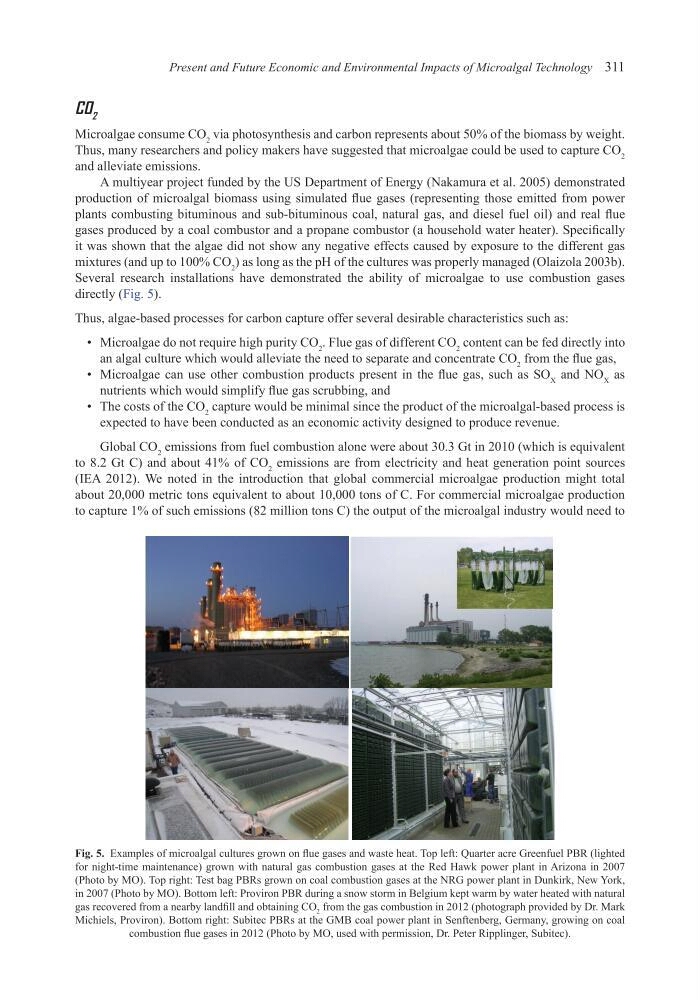
Several research installations have demonstrated the ability of microalgae to use combustion gases
directly (Fig. 5).
Thus, algae-based processes for carbon capture offer several desirable characteristics such as:
• Microalgae do not require high purity CO 2 . Flue gas of different CO 2 content can be fed directly into
an algal culture which would alleviate the need to separate and concentrate CO 2 from the flue gas,
• Microalgae can use other combustion products present in the flue gas, such as SO X and NO X as
nutrients which would simplify flue gas scrubbing, and
• The costs of the CO 2 capture would be minimal since the product of the microalgal-based process is
expected to have been conducted as an economic activity designed to produce revenue.
Global CO 2 emissions from fuel combustion alone were about 30.3 Gt in 2010 (which is equivalent
to 8.2 Gt C) and about 41% of CO 2 emissions are from electricity and heat generation point sources
(IEA 2012). We noted in the introduction that global commercial microalgae production might total
about 20,000 metric tons equivalent to about 10,000 tons of C. For commercial microalgae production
to capture 1% of such emissions (82 million tons C) the output of the microalgal industry would need to
Fig. 5. Examples of microalgal cultures grown on flue gases and waste heat. Top left: Quarter acre Greenfuel PBR (lighted
for night-time maintenance) grown with natural gas combustion gases at the Red Hawk power plant in Arizona in 2007
(Photo by MO). Top right: Test bag PBRs grown on coal combustion gases at the NRG power plant in Dunkirk, New York,
in 2007 (Photo by MO). Bottom left: Proviron PBR during a snow storm in Belgium kept warm by water heated with natural
gas recovered from a nearby landfill and obtaining CO from the gas combustion in 2012 (photograph provided by Dr. Mark
Michiels, Proviron). Bottom right: Subitec PBRs at the GMB coal power plant in Senftenberg, Germany, growing on coal
combustion flue gases in 2012 (Photo by MO, used with permission, Dr. Peter Ripplinger, Subitec).
2
CO 2
Microalgae consume CO 2 via photosynthesis and carbon represents about 50% of the biomass by weight.
Thus, many researchers and policy makers have suggested that microalgae could be used to capture CO 2
and alleviate emissions.
A multiyear project funded by the US Department of Energy (Nakamura et al. 2005) demonstrated
production of microalgal biomass using simulated flue gases (representing those emitted from power
plants combusting bituminous and sub-bituminous coal, natural gas, and diesel fuel oil) and real flue
gases produced by a coal combustor and a propane combustor (a household water heater). Specifically
it was shown that the algae did not show any negative effects caused by exposure to the different gas
mixtures (and up to 100% CO 2 ) as long as the pH of the cultures was properly managed (Olaizola 2003b).
Several research installations have demonstrated the ability of microalgae to use combustion gases
directly (Fig. 5).
Thus, algae-based processes for carbon capture offer several desirable characteristics such as:
• Microalgae do not require high purity CO 2 . Flue gas of different CO 2 content can be fed directly into
an algal culture which would alleviate the need to separate and concentrate CO 2 from the flue gas,
• Microalgae can use other combustion products present in the flue gas, such as SO X and NO X as
nutrients which would simplify flue gas scrubbing, and
• The costs of the CO 2 capture would be minimal since the product of the microalgal-based process is
expected to have been conducted as an economic activity designed to produce revenue.
Global CO 2 emissions from fuel combustion alone were about 30.3 Gt in 2010 (which is equivalent
to 8.2 Gt C) and about 41% of CO 2 emissions are from electricity and heat generation point sources
(IEA 2012). We noted in the introduction that global commercial microalgae production might total
about 20,000 metric tons equivalent to about 10,000 tons of C. For commercial microalgae production
to capture 1% of such emissions (82 million tons C) the output of the microalgal industry would need to
Fig. 5. Examples of microalgal cultures grown on flue gases and waste heat. Top left: Quarter acre Greenfuel PBR (lighted
for night-time maintenance) grown with natural gas combustion gases at the Red Hawk power plant in Arizona in 2007
(Photo by MO). Top right: Test bag PBRs grown on coal combustion gases at the NRG power plant in Dunkirk, New York,
in 2007 (Photo by MO). Bottom left: Proviron PBR during a snow storm in Belgium kept warm by water heated with natural
gas recovered from a nearby landfill and obtaining CO from the gas combustion in 2012 (photograph provided by Dr. Mark
Michiels, Proviron). Bottom right: Subitec PBRs at the GMB coal power plant in Senftenberg, Germany, growing on coal
combustion flue gases in 2012 (Photo by MO, used with permission, Dr. Peter Ripplinger, Subitec).
2