

Present and Future Economic and Environmental Impacts of Microalgal Technology 313
Aquafeed manufacturers have been successful in sourcing partial replacements for fishmeal using
protein from vegetable origin (Tacon and Metian 2008; Rust et al. 2011), although digestibility of some
vegetable materials is limited by low levels and imbalances in essential amino acids, anti-nutrient factors,
and high level of indigestible starch (Naylor et al. 2009). The latter not only reduces the nutritional
quality of the feed, but also increases waste and excretion that contributes to water quality problems (Cho
and Bureau 2001). Vegetable sources also do not supply essential long chain omega-3 fatty acids. Given
that body composition and nutritional requirements are linked (Pike et al. 1990), preferred alternative
ingredients would ideally have similar composition as fishmeal, assuming similar digestibility levels. As
we have noted above, agricultural products used in feed applications also have a large freshwater footprint.
Microalgae are receiving growing attention as aquafeed ingredients. Habib et al. (2008) summarize some
of the uses that Spirulina has been put to including as a protein, color, and nutritional enhancer for fish,
shrimp, poultry, cattle, and domestic animals. However, as with vegetable sources, cyanobacteria do
not supply the essential long chain omega-3 fatty acids necessary for optimal fish health (Sargent et al.
1999; Pettersen et al. 2010). Therefore, a fishmeal and fish oil replacement with high levels of long-chain
omega-3 fatty acids is necessary to expand the industry and alleviate pressure on the wild fisheries.
Marine eukaryotic algae are a natural source of balanced protein (Becker 2007) and oil for fish; they
represent the primary source of essential long chain omega-3 fatty acids for wild marine fish. Work carried
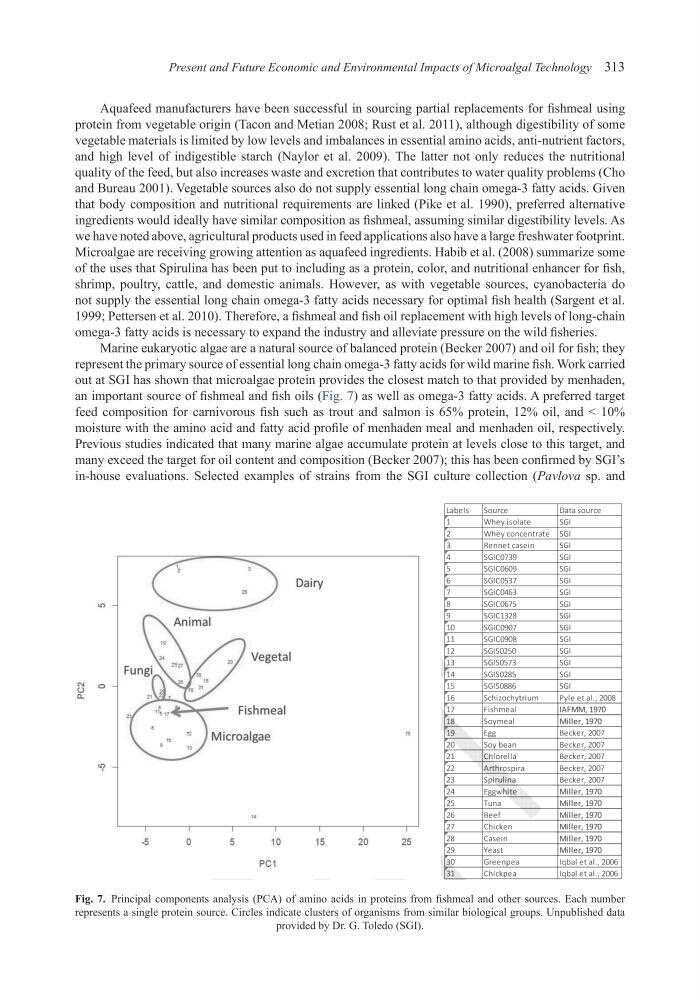
out at SGI has shown that microalgae protein provides the closest match to that provided by menhaden,
an important source of fishmeal and fish oils (Fig. 7) as well as omega-3 fatty acids. A preferred target
feed composition for carnivorous fish such as trout and salmon is 65% protein, 12% oil, and < 10%
moisture with the amino acid and fatty acid profile of menhaden meal and menhaden oil, respectively.
Previous studies indicated that many marine algae accumulate protein at levels close to this target, and
many exceed the target for oil content and composition (Becker 2007); this has been confirmed by SGI’s
in-house evaluations. Selected examples of strains from the SGI culture collection (Pavlova sp. and
Fig. 7. Principal components analysis (PCA) of amino acids in proteins from fishmeal and other sources. Each number
represents a single protein source. Circles indicate clusters of organisms from similar biological groups. Unpublished data
provided by Dr. G. Toledo (SGI).
Labels
Source
Data source
1
Whey isolate
SGI
2
Whey concentrate SGI
3
Rennet casein
SGI
4
SGIC0739
SGI
5
SGIC0609
SGI
Dairy
6
SGIC0537
SGI
7
SGIC0463
SGI
l{)
8
SGIC0675
SGI
9
SGIC1328
SGI
10
SGIC0907
SGI
11
SGIC0908
SGI
Vegetal
12
SGIS0250
SGI
13
SGIS0573
SGI
14
SGIS0285
SGI
~
0
15
SGIS0886
SGI
c...
16
Schizochytrium
Pyle et al., 2008
17
Fish meal
IAFMM, 1970
18
Soymeal
Miller, 1970
19
Egg
Becker, 2007
20
Soy bean
Becker, 2007
21
Chiarella
Becker, 2007
22
Arthrospira
Becker, 2007
23
Spirulina
Becker, 2007
24
Eggwhite
Miller, 1970
25
Tuna
'
Miller, 1970
26
Beef
_/
Miller, 1970
27
Chicken
Miller, 1970
-5
0
5
10
15
20
25
28
Casein
Miller, 1970
29
Yeast
Miller, 1970
PC1
30
Green pea
Iqbal et al., 2006
31
Chickpea
Iqbal et al., 2006
Aquafeed manufacturers have been successful in sourcing partial replacements for fishmeal using
protein from vegetable origin (Tacon and Metian 2008; Rust et al. 2011), although digestibility of some
vegetable materials is limited by low levels and imbalances in essential amino acids, anti-nutrient factors,
and high level of indigestible starch (Naylor et al. 2009). The latter not only reduces the nutritional
quality of the feed, but also increases waste and excretion that contributes to water quality problems (Cho
and Bureau 2001). Vegetable sources also do not supply essential long chain omega-3 fatty acids. Given
that body composition and nutritional requirements are linked (Pike et al. 1990), preferred alternative
ingredients would ideally have similar composition as fishmeal, assuming similar digestibility levels. As
we have noted above, agricultural products used in feed applications also have a large freshwater footprint.
Microalgae are receiving growing attention as aquafeed ingredients. Habib et al. (2008) summarize some
of the uses that Spirulina has been put to including as a protein, color, and nutritional enhancer for fish,
shrimp, poultry, cattle, and domestic animals. However, as with vegetable sources, cyanobacteria do
not supply the essential long chain omega-3 fatty acids necessary for optimal fish health (Sargent et al.
1999; Pettersen et al. 2010). Therefore, a fishmeal and fish oil replacement with high levels of long-chain
omega-3 fatty acids is necessary to expand the industry and alleviate pressure on the wild fisheries.
Marine eukaryotic algae are a natural source of balanced protein (Becker 2007) and oil for fish; they
represent the primary source of essential long chain omega-3 fatty acids for wild marine fish. Work carried
out at SGI has shown that microalgae protein provides the closest match to that provided by menhaden,
an important source of fishmeal and fish oils (Fig. 7) as well as omega-3 fatty acids. A preferred target
feed composition for carnivorous fish such as trout and salmon is 65% protein, 12% oil, and < 10%
moisture with the amino acid and fatty acid profile of menhaden meal and menhaden oil, respectively.
Previous studies indicated that many marine algae accumulate protein at levels close to this target, and
many exceed the target for oil content and composition (Becker 2007); this has been confirmed by SGI’s
in-house evaluations. Selected examples of strains from the SGI culture collection (Pavlova sp. and
Fig. 7. Principal components analysis (PCA) of amino acids in proteins from fishmeal and other sources. Each number
represents a single protein source. Circles indicate clusters of organisms from similar biological groups. Unpublished data
provided by Dr. G. Toledo (SGI).
Labels
Source
Data source
1
Whey isolate
SGI
2
Whey concentrate SGI
3
Rennet casein
SGI
4
SGIC0739
SGI
5
SGIC0609
SGI
Dairy
6
SGIC0537
SGI
7
SGIC0463
SGI
l{)
8
SGIC0675
SGI
9
SGIC1328
SGI
10
SGIC0907
SGI
11
SGIC0908
SGI
Vegetal
12
SGIS0250
SGI
13
SGIS0573
SGI
14
SGIS0285
SGI
~
0
15
SGIS0886
SGI
c...
16
Schizochytrium
Pyle et al., 2008
17
Fish meal
IAFMM, 1970
18
Soymeal
Miller, 1970
19
Egg
Becker, 2007
20
Soy bean
Becker, 2007
21
Chiarella
Becker, 2007
22
Arthrospira
Becker, 2007
23
Spirulina
Becker, 2007
24
Eggwhite
Miller, 1970
25
Tuna
'
Miller, 1970
26
Beef
_/
Miller, 1970
27
Chicken
Miller, 1970
-5
0
5
10
15
20
25
28
Casein
Miller, 1970
29
Yeast
Miller, 1970
PC1
30
Green pea
Iqbal et al., 2006
31
Chickpea
Iqbal et al., 2006