

Importance of Seaweed in the Climate Change—Seaweed Solution 23
definitions stipulated that (1) it should be a man-made marine plant community managed by CDM project
participants; (2) it had a definite scale of area or volume, as designated in the Project Design Document
(PDD) and approved by the CDM Executive Board (EB); and (3) it would operate during the proposed
crediting period.
Strategic goals
The project focused on mapping short- to long-term strategies to encourage the UNFCCC’s approval of
seaweed CDM methodology, while also assessing the economic impacts of reducing GHG emissions
(http://agwseaweed.org). It included several important activities: (1) collecting data to verify that
the seaweed mechanism is effective as a CO 2 sink, (2) identifying the mechanism by which CO 2 is
removed through the metabolism of seaweeds and other marine organisms, (3) developing management
technologies to enhance marine-environment conservation while conducting research on sustainable CO 2
removal, (4) drawing up a plan to participate in CO 2 -removal technology sales and emissions-trading in
response to enactment of the Kyoto Protocol, and (5) uniting with other international parties to create a
favorable environment for the approval of methodologies employed in seaweed CDM project activities.
Project tasks
Our project entailed the following tasks:
• Develop CDM methodology
• Assess its environmental and economic impacts
• Set up a national/international network to deal with relevant policies
• Design management technologies for the establishment and conservation of CCRB in coastal waters
• Estimate CO 2 removals by sinks and evaluate their efficiency
• Lay the groundwork for the practical use of marine biotechnologies that employ CO 2 -fixing
mechanisms
• Take a lead role in conducting research on seaweed physiology and ecology
• Establish a foundation for seaweed studies and the development of professional human resources,
taking into account the fact that Korea has one of the top three seaweed-production technologies in
the world
• Contribute to the recovery and increase in marine-life resources via seaweed afforestation in Korean
coastal waters
• Add new value to seaweed studies that help to increase Korea’s total seaweed stocks
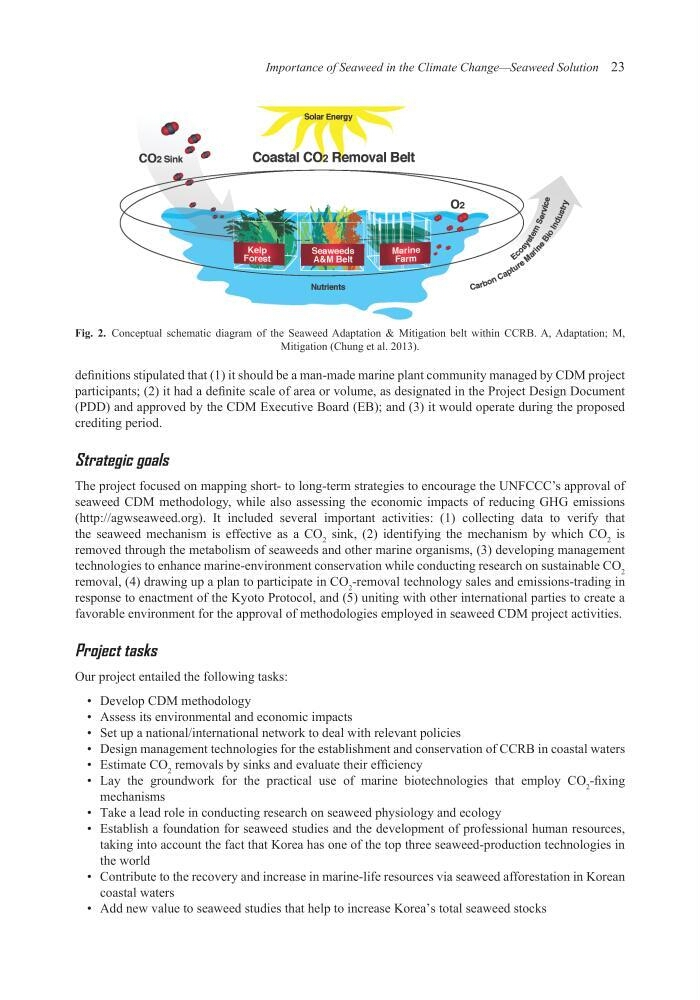
Fig. 2. Conceptual schematic diagram of the Seaweed Adaptation & Mitigation belt within CCRB. A, Adaptation; M,
Mitigation (Chung et al. 2013).
•• •
C02Sink
•
Coastal C02 Removal Belt
definitions stipulated that (1) it should be a man-made marine plant community managed by CDM project
participants; (2) it had a definite scale of area or volume, as designated in the Project Design Document
(PDD) and approved by the CDM Executive Board (EB); and (3) it would operate during the proposed
crediting period.
Strategic goals
The project focused on mapping short- to long-term strategies to encourage the UNFCCC’s approval of
seaweed CDM methodology, while also assessing the economic impacts of reducing GHG emissions
(http://agwseaweed.org). It included several important activities: (1) collecting data to verify that
the seaweed mechanism is effective as a CO 2 sink, (2) identifying the mechanism by which CO 2 is
removed through the metabolism of seaweeds and other marine organisms, (3) developing management
technologies to enhance marine-environment conservation while conducting research on sustainable CO 2
removal, (4) drawing up a plan to participate in CO 2 -removal technology sales and emissions-trading in
response to enactment of the Kyoto Protocol, and (5) uniting with other international parties to create a
favorable environment for the approval of methodologies employed in seaweed CDM project activities.
Project tasks
Our project entailed the following tasks:
• Develop CDM methodology
• Assess its environmental and economic impacts
• Set up a national/international network to deal with relevant policies
• Design management technologies for the establishment and conservation of CCRB in coastal waters
• Estimate CO 2 removals by sinks and evaluate their efficiency
• Lay the groundwork for the practical use of marine biotechnologies that employ CO 2 -fixing
mechanisms
• Take a lead role in conducting research on seaweed physiology and ecology
• Establish a foundation for seaweed studies and the development of professional human resources,
taking into account the fact that Korea has one of the top three seaweed-production technologies in
the world
• Contribute to the recovery and increase in marine-life resources via seaweed afforestation in Korean
coastal waters
• Add new value to seaweed studies that help to increase Korea’s total seaweed stocks
Fig. 2. Conceptual schematic diagram of the Seaweed Adaptation & Mitigation belt within CCRB. A, Adaptation; M,
Mitigation (Chung et al. 2013).
•• •
C02Sink
•
Coastal C02 Removal Belt