

24 Marine Macro- and Microalgae: An Overview
• Favor local and national growth through the sale of seaweed CO 2 -removal technologies, and
participate in emissions trading
• Develop baseline/monitoring methodologies and new techniques for the management of seaweed
CDM projects in coastal zones
Results of the Korean project
Selection of suitable seaweed species for CCRB
We investigated the photosynthetic capacities of wild seaweed species and some cultivar strains to select
those that would be most suitable for CCRB in Korea. To measure their capacity for CO 2 removal, we
applied three different methods to analyze rates of oxygen evolution, the reduction of inorganic carbon
in seawater, and the accumulation of gaseous CO 2 in the air. As potential candidates, we recommended
six seaweeds for the removal of atmospheric CO 2 —Ulva pertusa (‘Galparae’ in Korean), Saccharina
(=Laminaria) japonica (‘Dashima’), Undaria pinnatifida (‘Meeyeok’), Ecklonia cava (‘Gamtae’),
E. stolonifera (‘Gompee’), and Grateloupia lanceolata (‘Gaedobak’).
Methods for monitoring baseline populations for seaweed communities
We monitored seaweed communities along the Korean coast, including Jeju Island, to estimate a baseline
for natural beds. Ten core sites were evaluated for three years (2006–2009) and another 20 satellite sites
were surveyed for one year only. A total of 64 sites were seasonally surveyed in July, October, January,
and April from the subtidal to the splash zone. Conventional methods were applied. To estimate the
seaweed biomass or standing crop, we adopted a nondestructive technique. Based on the percent coverage
and weight of dominant species within a community, we were able to obtain species-specific regression
equations between coverage and biomass for each dominant species (Ko et al. 2008). In the case of kelp
with long and tall fronds, data for density and individual sizes were required. At each sampling site,
five replicates of 50 ´ 50 cm quadrats were assessed in the intertidal, upper, middle, and lower zones,
at subtidal depths of 1, 5, and 10 m. Each community was categorized overall into five size classes,
based on average standing stocks: Class 1, > 2400 g m
–2
; Class 2, 1800 ~ 2400 g m
–2
; Class 3, 1200 ~
1800 g m
–2
; Class 4, 600 ~ 1200 g m
–2
; and Class 5, < 600 g m
–2
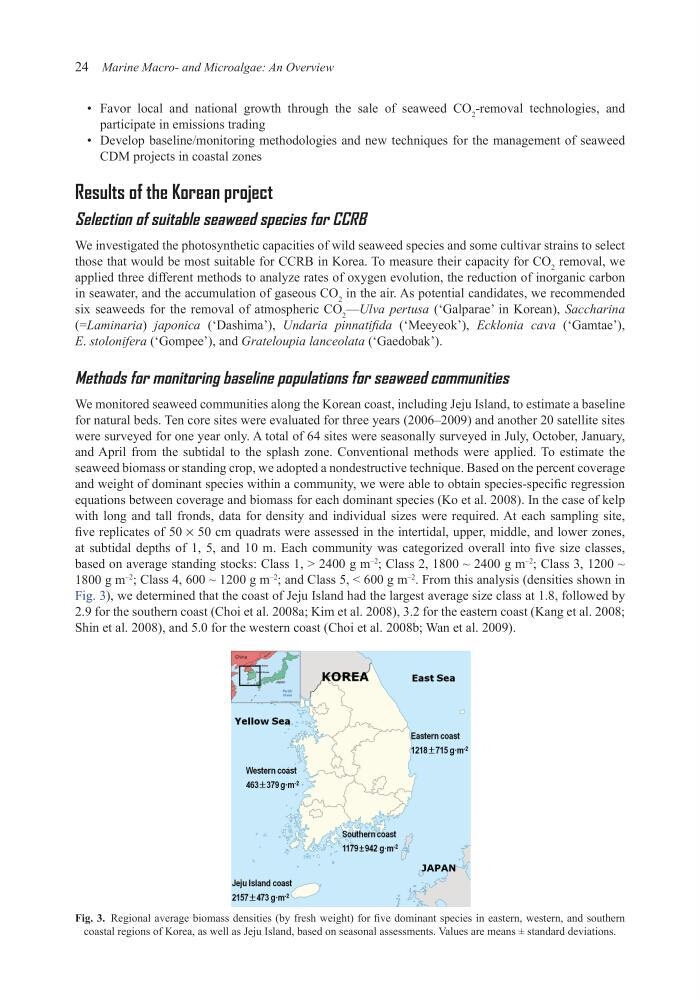
. From this analysis (densities shown in
Fig. 3), we determined that the coast of Jeju Island had the largest average size class at 1.8, followed by
2.9 for the southern coast (Choi et al. 2008a; Kim et al. 2008), 3.2 for the eastern coast (Kang et al. 2008;
Shin et al. 2008), and 5.0 for the western coast (Choi et al. 2008b; Wan et al. 2009).
Fig. 3. Regional average biomass densities (by fresh weight) for five dominant species in eastern, western, and southern
coastal regions of Korea, as well as Jeju Island, based on seasonal assessments. Values are means ± standard deviations.
Jeju Island coast ~·
2157±473 g·m· 2 ~
0
• Favor local and national growth through the sale of seaweed CO 2 -removal technologies, and
participate in emissions trading
• Develop baseline/monitoring methodologies and new techniques for the management of seaweed
CDM projects in coastal zones
Results of the Korean project
Selection of suitable seaweed species for CCRB
We investigated the photosynthetic capacities of wild seaweed species and some cultivar strains to select
those that would be most suitable for CCRB in Korea. To measure their capacity for CO 2 removal, we
applied three different methods to analyze rates of oxygen evolution, the reduction of inorganic carbon
in seawater, and the accumulation of gaseous CO 2 in the air. As potential candidates, we recommended
six seaweeds for the removal of atmospheric CO 2 —Ulva pertusa (‘Galparae’ in Korean), Saccharina
(=Laminaria) japonica (‘Dashima’), Undaria pinnatifida (‘Meeyeok’), Ecklonia cava (‘Gamtae’),
E. stolonifera (‘Gompee’), and Grateloupia lanceolata (‘Gaedobak’).
Methods for monitoring baseline populations for seaweed communities
We monitored seaweed communities along the Korean coast, including Jeju Island, to estimate a baseline
for natural beds. Ten core sites were evaluated for three years (2006–2009) and another 20 satellite sites
were surveyed for one year only. A total of 64 sites were seasonally surveyed in July, October, January,
and April from the subtidal to the splash zone. Conventional methods were applied. To estimate the
seaweed biomass or standing crop, we adopted a nondestructive technique. Based on the percent coverage
and weight of dominant species within a community, we were able to obtain species-specific regression
equations between coverage and biomass for each dominant species (Ko et al. 2008). In the case of kelp
with long and tall fronds, data for density and individual sizes were required. At each sampling site,
five replicates of 50 ´ 50 cm quadrats were assessed in the intertidal, upper, middle, and lower zones,
at subtidal depths of 1, 5, and 10 m. Each community was categorized overall into five size classes,
based on average standing stocks: Class 1, > 2400 g m
–2
; Class 2, 1800 ~ 2400 g m
–2
; Class 3, 1200 ~
1800 g m
–2
; Class 4, 600 ~ 1200 g m
–2
; and Class 5, < 600 g m
–2
. From this analysis (densities shown in
Fig. 3), we determined that the coast of Jeju Island had the largest average size class at 1.8, followed by
2.9 for the southern coast (Choi et al. 2008a; Kim et al. 2008), 3.2 for the eastern coast (Kang et al. 2008;
Shin et al. 2008), and 5.0 for the western coast (Choi et al. 2008b; Wan et al. 2009).
Fig. 3. Regional average biomass densities (by fresh weight) for five dominant species in eastern, western, and southern
coastal regions of Korea, as well as Jeju Island, based on seasonal assessments. Values are means ± standard deviations.
Jeju Island coast ~·
2157±473 g·m· 2 ~
0